























On 1 July, during the US national team’s last-32 match against Bosnia and Herzegovina at the FIFA World Cup, US striker Folarin Balogun was given a red card and earned an automatic one-match ban.


The controversy surrounding FIFA’s decision to suspend the ban’s implementation and allow Balogun to play in the next match against Belgium has rapidly become a significant football governance issue, calling into question the integrity of the world’s most popular sport.
This article considers the rule of law in sport, procedural fairness, transparency and FIFA’s accountability, as well as possible changes that could improve the current unsatisfactory position.
The article 9 problem: referees are supposed to have the last word
It is not uncommon in club league matches around the football world for red card decisions to be appealed. However, this had never been done at a World Cup. FIFA appears to have at least bent its own rules to achieve this unprecedented outcome and to appease president Trump.
In this instance, although FIFA has not published formal reasons for the decision, its disciplinary committee has issued a press statement (itself an odd move) explaining that it has not overturned the red card or the one-match ban, but rather used its discretion under article 27 of the FIFA Disciplinary Code to suspend the operation of that punishment.
Article 27 does give the committee discretion to suspend the implementation of a disciplinary measure, but it has never been used in this way before. Article 9 of the code would normally be expected to govern this kind of situation.
Article 9 enshrines one of football’s most fundamental constitutional principles: decisions taken by referees on the field of play are generally final and not subject to subsequent review by disciplinary bodies. The provision exists because football requires certainty. Particularly in a fast-moving tournament such as the World Cup, matches cannot be endlessly relitigated after the final whistle and judicial bodies cannot routinely act as appellate referees.
Importantly, however, article 9 does not create an absolute prohibition on intervention.
Article 9.2 provides a narrow exception, allowing a disciplinary body to intervene where a referee has made an obvious error. This kind of intervention is intended to be exceptional and reserved for cases where there is a clear and identifiable error capable of objective verification. The classic example is one of mistaken identity, where a player is cautioned or dismissed for an offence committed by another player.
In the Balogun case, FIFA’s use of article 27 creates a significant rule-of-law concern. If article 27 can be used almost arbitrarily whenever FIFA (or a host nation’s president) believes a red card suspension would be unfair, then the very limited ‘obvious error’ exception in article 9.2 can simply be leapfrogged and a suspension of the consequences of a red card granted via article 27.
The Balogun case therefore raises not merely questions about one controversial dismissal, but broader concerns about the arbitrary manner in which article 27 has been used in this case and how FIFA can maintain the certainty in decision-making which the limited exception to refereeing finality in article 9.2 was designed to create.
Missing reasons and FIFA’s accountability gap
Another very troubling aspect of this affair is not only the outcome itself but the lack of transparency in the decision-making and FIFA’s attempts to avoid scrutiny of the decision.
As mentioned, FIFA has not published any detailed reasoning for the decision. The Belgian FA has subsequently complained about this and sought clarification regarding the process and legal basis for the decision, but received no substantive explanation.
Reasoned decisions are not a bureaucratic inconvenience; they are a fundamental component of sports justice.
The uncertainty created about why the discretion was exercised and the factors considered severely undermines the integrity of the process, regardless of whether the ultimate decision was correct.
However, the story does not stop there. What happened next is perhaps just as remarkable.
Having seen no reason for the decision, Belgium sought to raise a formal challenge, given that Balogun was being permitted to play against them rather than be suspended. However, FIFA refused to hear Belgium’s challenge because it was not a party to the process, which it deemed was between the US Soccer Federation and FIFA, and therefore lacked standing to appeal.
This finding is extraordinary. The country scheduled to play next against Balogun was deemed insufficiently affected or proximate to challenge the decision allowing him to participate.
If Belgium cannot challenge the decision, who can? It appears that FIFA has said no one can.
This adds to growing concerns that FIFA is a law unto itself with virtually no accountability – it is presently beyond the reach of the normal mechanics which lead to justice.
Why are we surprised?
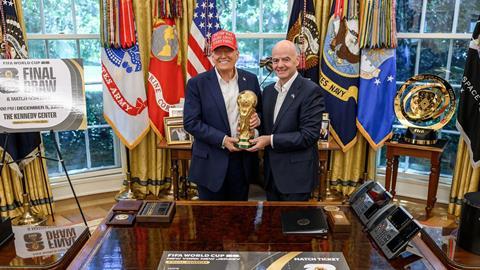
The irony of what FIFA has done is difficult to ignore. FIFA has spent decades championing the principle that political actors must not interfere in football governance. In the Balogun affair, however, the perception – fairly or unfairly – is that the president of football’s most powerful governing body was seen to be entertaining representations from the world’s most powerful political office-holder regarding an ongoing disciplinary matter.
Both presidents have gained a reputation for arbitrary interventions which disrupt the conventional order of things. President Trump’s flip-flopping over arbitrary trade tariffs has led to one of the most volatile market periods in decades.
FIFA is no stranger to the sort of arbitrary rule-bending seen in the Balogun scandal. Last year, Inter Miami (part-owned by arguably football’s greatest current player, Lionel Messi) were inserted into the FIFA Club World Cup as the US champions at the conclusion of the regular MLS season, but ahead of the ‘play-offs’ which would actually determine the US champion team. There is also the perception that FIFA fixed Cristiano Ronaldo’s participation in the World Cup by reducing a three-match ban to a one-game ban and a two-game suspended sentence, allowing another of the game’s global (and commercially valuable) superstars to dominate our TV screens. The only conclusion available to the ordinary fan is that if FIFA considers you important enough, you can be reprieved.
Whether that perception is accurate is almost beside the point. In regulatory systems, appearances matter. Justice must not only be done; it must be seen to be done.
The chronology is troubling: a controversial red card is issued; political lobbying from the head of state of the tournament host nation is reported; FIFA deploys an almost never-used discretionary power to neutralise the sporting consequences of the dismissal; and then the opposing federation is denied standing to challenge the decision.
Viewed collectively, these events inevitably invite questions that FIFA has yet to adequately answer. Football stakeholders should not simply be left without redress in this situation and fans should not be left to wonder about the integrity of their sport.
What can be done?
It is clear that FIFA has no intention of closing the accountability gap it has created. It is heartening to see other football bodies such as UEFA speaking out on this matter. Football fans surely hope that they will continue to press for increased transparency and additional rights of challenge for stakeholders.
A major problem is the closed judicial shop, which FIFA has created by requiring all football participants to sign up to FIFA’s own dispute resolution and disciplinary codes. This makes it very difficult to ‘police’ FIFA’s decision-making. If the UK were hosting the World Cup and the same Balogun incident occurred, could Belgium have looked to the English courts by way of appeal? The answer is no.
In the recent case of RFC Seraing v FIFA, the Court of Justice of the European Union held that football arbitration decisions can now be reviewed by the national courts of EU member states to ensure compliance with EU public policy.
While that decision offers a chink of light cast over the murkiness of FIFA’s rule-bending, it does not directly help in the Balogun case.
Individual governments may not wish to act unilaterally and implement rules that could be perceived as hostile towards FIFA, placing them at a competitive disadvantage when bidding to host future FIFA events.
However, with the next Euros to be hosted by England, Scotland, Wales, and the Republic of Ireland in 2028 (albeit that is a UEFA tournament), the governments of those countries should now consider whether to at the very least introduce limited legislation which would allow the national courts to grant relief – for example, where an international sporting tournament is to take place in its jurisdiction and the organiser’s own processes do not follow the principles of natural justice or otherwise offend the public interest.
If other European nations followed suit, particularly with Spain as one of the hosts of the next FIFA World Cup, that could well prompt FIFA to take steps itself to close the accountability gap and ensure participants that find themselves in Belgium’s position are not left without the ability to challenge dubious decisions taken behind closed doors.
Simon Bushell is senior partner and Kevin Kilgour a partner at Seladore Legal, London








No comments yet