
















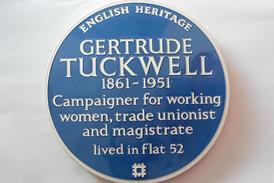






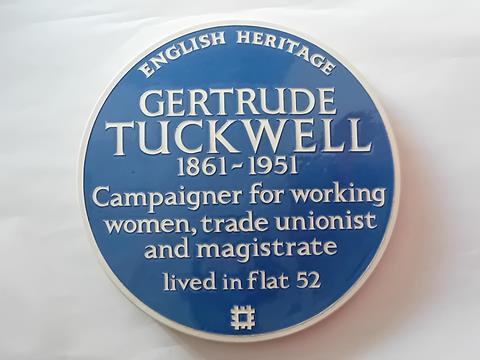
The first woman to be sworn in as a London magistrate and a leading figure in the women’s trade union movement has been honoured with a blue plaque by English Heritage.
Gertrude Tuckwell devoted her life to improving working conditions for women. She investigated the dangers faced by women workers including lead poisoning among pottery workers and ‘phossy jaw’ among match workers.
Before becoming a magistrate, Tuckwell helped establish the National Anti-Sweating League in 1909, which introduced minimum wages in some of the lowest-paid industries.
Following the enactment of the Sex Disqualification (Removal) Act 1919, Tuckwell was the first woman to be sworn in as a London magistrate. Six other women were also announced as justices of the peace across the country by the lord chancellor. Tuckwell became involved in the newly formed Magistrates’ Association in around 1921. She also chaired the National Association of Probation Officers.
Tuckwell’s plaque will mark Westminster Mansions on Little Smith Street in London where she lived when she helped establish both the National Anti-Sweating League and the National Federation of Women Workers.
Another pioneering London woman, Dr Annie McCall, will also have her blue plaque unveiled in Stockwell on the site of a maternity hospital she established. McCall, who qualified as a doctor in 1885, established an antenatal clinic and in 1889 founded the Clapham Maternity Hospital. Its School of Midwifery was the first in Britain to be run for women, by women. In the 1890s, maternal mortality at the hospital was less than half the rate for the country as a whole.
English Heritage historian Howard Spencer said: ‘Separately, Annie McCall and Gertrude Tuckwell each saw where women were being failed by existing systems and set about changing them: McCall through improving maternity care and midwifery, and Tuckwell through her broad campaigning for better conditions for working women.
Their plaques offer a chance to celebrate two women who, in very different fields, helped to reshape the opportunities and lives of women in London and across the country.’
Speaking on Tuckwell’s impact, English Heritage historian Dr Rebecca Preston said: ‘Tuckwell understood that improving women’s lives meant tackling the conditions in which they worked. Her campaigning exposed dangerous and exploitative working conditions and helped turn the demand for better treatment of women workers into changes in the law. And her being London’s first woman magistrate is a notable achievement in itself.
‘Close to the parliamentary corridors of power, Westminster Mansions is a particularly appropriate address for Tuckwell’s plaque.'





No comments yet