























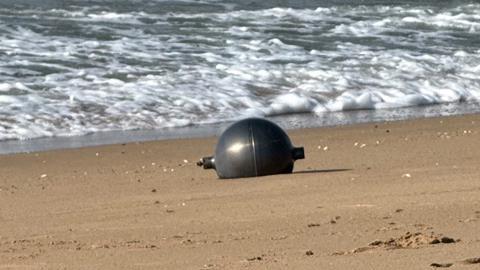
The discovery of six large metallic spheres washed ashore on Queensland’s Forrest Beach has once again brought the realities of the modern space age down to Earth. Australian authorities believe the objects are pressure vessels from a launch vehicle that recently re-entered the atmosphere, although investigations continue to determine precisely which rocket they came from. Local emergency services established exclusion zones amid concerns that the objects could contain hazardous substances, illustrating that the consequences of space activity do not end once a spacecraft leaves orbit.

The Queensland discovery is not an isolated event. Australia has previously recovered debris from Indian launch vehicles, while similar objects have appeared in Namibia and elsewhere. As the number of satellites, commercial launches and rocket bodies continues to increase, such incidents are becoming less exceptional and more predictable.
Yet while engineers focus on tracking debris and scientists examine its environmental effects, an equally important question remains largely overlooked: who is legally responsible when space debris returns to Earth?
International space law remains built upon treaties negotiated during the first decades of the space age. The 1967 Outer Space Treaty established the foundational legal principles governing activities beyond Earth’s atmosphere, while the 1968 Rescue Agreement and subsequent treaties addressed issues such as recovering astronauts and returning objects launched into outer space. These agreements were remarkable achievements for their time, but they predate today’s commercial space economy and the unprecedented volume of objects now orbiting the planet. Consequently, they provide only limited guidance for managing the environmental and legal challenges created by modern space debris.
Identifying responsibility presents the first obstacle. The Queensland spheres have been described as pressure vessels commonly used in launch vehicles. Similar components are employed by numerous space agencies and commercial operators, making immediate identification difficult. Ideally, every significant spacecraft component would remain identifiable throughout its operational life and after re-entry. In practice, however, objects frequently fragment during atmospheric descent, while millions of smaller debris fragments continue orbiting the Earth beyond any realistic prospect of comprehensive tracking.
Despite these practical difficulties, international law contains an important principle. Article VI of the Outer Space Treaty provides that states bear international responsibility for national space activities, regardless of whether those activities are conducted by government agencies or private companies. The rapid expansion of commercial operators therefore does not eliminate state responsibility. Instead, states remain responsible for supervising and authorising activities undertaken by entities operating under their jurisdiction. This distinction is becoming increasingly important as private companies launch thousands of satellites every year, while international law continues to regulate mainly through states.
Even once responsibility can be established, another problem emerges: what happens to the debris itself?
The Rescue Agreement provides procedures for returning recovered space objects to the launching authority. Where a state discovers a spacecraft or its component parts within its territory, it must notify both the launching authority and the UN secretary-general. The launching authority may request the object’s return and is expected to bear the associated recovery costs. Where recovered debris presents a danger to public safety, it may also be required to eliminate the hazard. These provisions offer a mechanism for ownership and recovery, but they say remarkably little about environmental protection. This omission matters because returning debris is not harmless. Some spacecraft components may retain propellant or other hazardous materials requiring specialist handling. Even where debris presents no immediate danger on land, re-entering objects contribute to atmospheric pollution, while discarded rocket stages and satellite components may eventually enter the oceans. Existing space treaties were never designed to regulate pollution in this way. Their main concern was facilitating peaceful exploration, allocating jurisdiction and preventing international disputes during the cold war. Environmental governance was largely absent from international space law at the time these agreements were negotiated.
Other areas of international law may therefore help fill the regulatory gaps. The customary international law principle prohibiting transboundary environmental harm requires states to exercise due diligence where activities within their jurisdiction pose significant risks to other states or the global environment. Duties to cooperate, exchange information and undertake environmental impact assessments have become well established in international environmental law and could become increasingly relevant to space activities.
Likewise, where debris enters the oceans, the UN Convention on the Law of the Sea may also have a role. The convention requires states to protect and preserve the marine environment and prevent pollution from any source. Although these provisions predate the modern problem of re-entering spacecraft, their broad drafting leaves little doubt that they also apply to pollution caused by returning space objects.
Neither framework, however, provides a complete solution.
What is increasingly needed is a dedicated international framework addressing the entire lifecycle of space debris, much like the decommissioning regimes that have become an established feature of energy law. Operators in sectors such as offshore oil and gas, and increasingly, renewable energy, are required to plan and finance the safe removal of infrastructure at the end of its operational life, ensuring that environmental responsibilities extend beyond construction and operation.
A comparable approach could be adopted for space activities by establishing clearer obligations for debris mitigation before launch, requiring end-of-life disposal plans, improving international identification and tracking requirements, developing uniform procedures for recovery and disposal, and strengthening environmental responsibilities for both states and commercial operators. Such a framework should also further address cases where responsibility cannot readily be attributed. Given the growing volume of unidentifiable debris, an international mechanism based on shared responsibility and operating under the oversight of an international organisation could coordinate recovery efforts, finance clean-up operations and ensure that the absence of an identifiable launching authority does not leave hazardous debris abandoned.
The Queensland spheres are therefore more than an unusual curiosity. They demonstrate how rapidly expanding space activity is exposing legal questions that existing treaties were never designed to answer. As humanity’s presence in space becomes increasingly commercial and crowded, the challenge is no longer simply reaching orbit, but ensuring that what goes up is managed responsibly when it inevitably comes back down. Without modernising international law, discoveries like those on Australia’s beaches are likely to become an increasingly familiar reminder that the environmental consequences of the space age are no longer confined to outer space.
Dr Laurence Atkin-Teillet is a lecturer at Nottingham Law School








No comments yet