
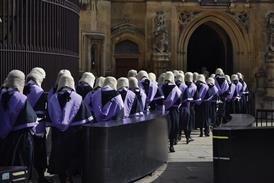





















For everyone interested in the justice system, the most significant announcement in the legislative programme on Wednesday was not a new one. Although bills normally lapse when parliament is prorogued, MPs and peers can agree to carry over a public bill from one session to the next. So the Courts and Tribunals Bill – mysteriously renamed the Courts Modernisation Bill in the King’s speech – is now heading towards its report stage in the Commons.

In committee, the government managed to defeat all attempts to limit the bill’s restrictions on jury trial. But what will happen once it returns to the Commons chamber is anyone’s guess. With a working majority of 165, the government would normally have no difficulty in ensuring its legislation reaches the House of Lords unscathed. But these are not normal times for the Labour party.
The Telegraph reported last week that as many as 60 Labour MPs might vote against the bill or abstain. Karl Turner MP, who had the Labour whip withdrawn because of his opposition to the jury reforms, accepted that a rebellion on this scale might not be enough to block the bill. But he thought the House of Lords would kick it into the long grass.
All that, of course, was before ministers started resigning from the government and Labour MPs started looking for ways of distancing themselves from their party leader. Anyone who aspires to replace Keir Starmer is bound to promise a review, at the very least, of the planned jury reforms. An incoming prime minister is likely to appoint a new justice secretary who is bound to take a fresh look at the legislation. In the meantime, Starmer may well decide that a parliamentary vote on a contentious matter is not something he wants to rush into. So the key parts of the courts bill must now be at risk.
Another justice bill being carried over is the Public Office (Accountability) Bill, which would impose a legal duty of candour and assistance on public officials at inquiries and investigations into the state. Ministers have called this the Hillsborough Law, naming it after the football disaster that was followed by a series of cover-ups. But new legislation to remove peerages is unlikely to be called the Mandelson bill. The criminal justice system is also likely to be affected by Home Office plans to create a national police service to tackle serious and complex crime. A Police Reform Bill will abolish police and crime commissioners while ensuring responsive and accountable local policing.
In a statement on the government’s asylum and returns policy last December, Shabana Mahmood argued that Article 8 of the European Convention on Human Rights, which protects family life, was being used by people who would not otherwise have the right to live in the UK. The home secretary plans to tighten the application of Article 8 and ensure that the public interest carries proper weight. The words ‘public interest’ do not, in fact, appear in Article 8, although interference with the right to respect for family life is allowed to meet specified objectives.
Controversially, the proposed Immigration and Asylum Bill will create a new appeals body in place of the First-tier Tribunal. It will be staffed by trained adjudicators who need not be lawyers. While its decisions will be fully independent, says the government, it will be integrated into the immigration system to ensure migrants are removed quickly after unsuccessful appeals.
It’s a year now since ministers received a report from Jonathan Hall KC, the independent reviewer of terrorism legislation, on state threats that fall short of armed conflict. The proposed Tackling State Threats Bill would allow the UK to ban Iran’s Islamic Revolutionary Guard Corps.
Hall also reported on the limited charges available to those with no underlying ideology who commit crimes of extreme violence. That followed the Southport murders in 2024, whose perpetrator could not be charged with terrorism because there was no evidence that he intended to advance a political, religious, racial or ideological cause. A National Security Bill will criminalise creating and sharing harmful, violent material and make it an offence to plan a mass casualty attack.
Leasehold reform and commonhold are back on the agenda. There is no sign of a bill that would give cohabiting couples the rights enjoyed by spouses or civil partners. But the government has again promised a draft bill to ban abusive conversion practices – referring, in this context, to sexual orientation and transgender identity.
Draft bills are unlikely to become law in the current parliamentary session. How much of this programme would survive a change of Labour leader remains to be seen. ‘Other measures will be laid before you,’ said the King – as the sovereign always does. He said nothing about other prime ministers.
joshua@rozenberg.net









1 Reader's comment