






















Although legal issues made little impact on the phoney war stage of the Labour leadership battle, one development last week was both surprising and disturbing.

A circuit judge at Southampton Crown Court had issued youth rehabilitation orders with 180 days of intensive surveillance and supervision to two boys, now aged 15. In November 2024 and January 2025, they had raped two lone girls in Fordingbridge, Hampshire, and filmed the attacks. Unfortunately, Judge Nicholas Rowland failed to prepare written sentencing remarks and publish them at the time – though he appeared to have taken account of the relevant Sentencing Council guideline, which says that a custodial sentence should be passed only if the offence is so serious that no other sanction would be appropriate.
Cue public outrage. Praising the boys’ victims for showing ‘extraordinary bravery and strength in heinous circumstances’, the prime minister said this was ‘an appalling case’ and ‘right that law officers are urgently reviewing the sentences’. Keir Starmer’s implication was clear: the boys should have been locked up.
‘I would have hoped that a former director of public prosecutions would have a better understanding of the constitutional proprieties and leave the law officers to do their own job without being politically contaminated,’ the former Conservative solicitor general Lord Garnier KC observed in a letter to The Times.
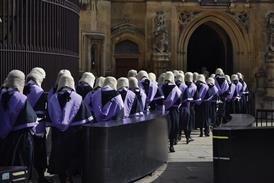
And the attorney general himself was unusually keen to comment. ‘There is an epidemic of violence against women and girls in this country,’ Lord Hermer (pictured) said, ‘and this government will not hesitate in taking action to ensure all women and girls feel safe and have confidence in the justice system.’ Hermer’s subsequent decision to refer the case to the Court of Appeal was ‘clearly the right outcome’, Starmer said later.
It is best not to analyse the attorney general’s remarks too closely. Would the offenders – neither of whom appears to be very bright – have been deterred by the prospect of spending time in secure accommodation? Would their transfer to a children’s home or training centre – if that’s what the appeal judges now order – give potential victims confidence in the justice system?
What we can be sure of is that unjustified attacks on individual judges damage the rule of law. The Court of Appeal should explain to the public that judges are required to follow statutory guidelines and that women and girls are more likely to feel safe if young criminals can be diverted from a life of crime.
Judges must never enter the political arena, of course, but there is much they can do to fight their corner. I was in Belfast last week to join a panel discussion with the lady chief justice of Northern Ireland about the rule of law. Dame Siobhan Keegan chose her words carefully – it was a public event – but there was no doubt about her willingness to defend the rule of law and the work of her judiciary against those who might seek to undermine it. Keegan may soon have a much larger audience: she is expected to succeed Lord Stephens of Creevyloughgare when he retires from the UK Supreme Court next spring.
A concern in Belfast – not expressed by Keegan, of course – is that the Northern Ireland government may withdraw legal aid from claimants at permission stage in judicial review claims. According to the Department of Justice, ‘the proposed change is not to restrict access to justice but to ensure that legal aid is available where it can have the greatest impact’– which means for cases that proceed to full hearing. But not even the strongest claim will get that far if the applicant cannot afford to apply for permission.
The situation is not much better in England and Wales, where a new paper published by the Public Law Project points out that individuals earning little more than £32,000 a year – and so excluded from legal aid – cannot take the risk of holding public bodies to account. Paying the defendant’s costs on a failed or discontinued claim for judicial review is simply not something they can afford.
There was less controversy over a second sentence passed at Southampton Crown Court this week – although it strikes me as more questionable. Vickrum Digwa was given a minimum term of 21 years after murdering Henry Nowak, 18, with the dagger Digwa wore on his belt. But the starting point is 25 years if a murderer takes a knife to the scene of a murder ‘intending to… have it available to use as a weapon’.
Did he? No, said Judge Mousley KC – apparently persuaded that the Sikh was carrying the knife as a matter of religious obligation.
Is that right? If the rule of law means we should all be treated equally, what privileges should we allow minorities? And how should they be treated by the police? Getting this right is far from easy.









2 Readers' comments