























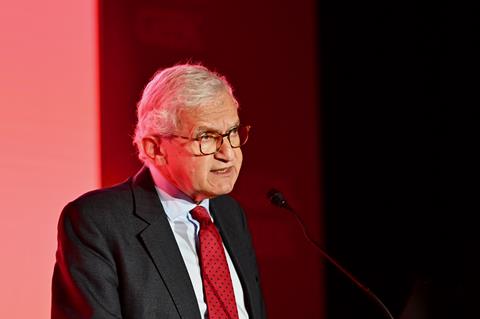
England and Wales' status as the jurisdiction of choice for commerce is not guaranteed to survive in the digital world, the master of the rolls said last night. In what is expected to be the first in a round of valedictory speeches, Sir Geoffrey Vos stressed the importance of ensuring that English law keeps up with developments such as cryptography and artificial intelligence.
Ensuring that English law remains attractive to the international commercial community is 'more important than ever was in the age of the [large-language model],' Vos told an event celebrating the work of the UK Jurisdiction Taskforce and International Jurisdiction Taskforce, two initiatives of the government-funded LawtechUK programme.
'There are a number of critical pressures that are not often highlighted,' he said. 'Perhaps they're not dared to be highlighted. Because in the brave new world of ever more capable AI, the law chosen by the dominant LLMs is likely, isn't it, to have an advantage. Most LLMs are not domiciled here, they are domiciled either in the US or China and those laws will therefore provide a starting point at least for the provision of AI.'
Read more
English law - and other legal systems - is at a 'critical juncture right now', the master of the rolls said. 'The post-LLM world is rapidly devleoping. The legal infrastructure of the pre LLM world, in which English law largely dominated, by choice of the parties, will not necessarily survive. All industries are adopting and will become more dependent upon LLMs on artficial intelligence on technological models that may or may not have English law as their foundation and therefore we need to be careul when we assume that what has been in the past will follow through to the future.'
Making sure that existing legal frameworks are fit for the digital age is the job of the two taskforces, he said. 'We are not the only pebble on the beach but we can lead by example.'
Vos, who retires next week after nearly six years as master of the rolls, said he would continue to chair the taskforces. Future work will include a new statement on the legal status of so-called agentic AI, to give certainty of English law in that area a 'significant boost', he said.
Meanwhile the international taskforce is considering plans for 'catalysing' the transition to digital documentation of international trade. 'It's a sad fact that, in 2026 when everuthing is digital, only 11% of the 45 million bills of lading circulated every year are electronic', he said. However digitisation faced strong vested interests. 'The sluggishness provided by the transmission of paper documentation is an advantage to some,' he said. 'Paper literally buys time for payments and settlements and slows transactions down.'





1 Reader's comment