























The capital is a testbed for driverless technology. But the London Assembly remains sceptical, which is jeopardising new opportunities for an automotive industry ‘in an existential crisis’
Nearly every one of the 1.2 million people killed in road accidents around the world last year died because of a driver’s human error. What possible objection could be made to removing human error from driving seats?
Quite a few, it seems. Last month the transport committee of London’s governing body, the London Assembly, published a sceptical report on robot vehicles. ‘It’s unclear how well driverless technology will work on London’s roads,’ said committee chair Caroline Russell. The committee called for local powers to set tougher safety standards and to cap the number of autonomous vehicles on London’s streets.
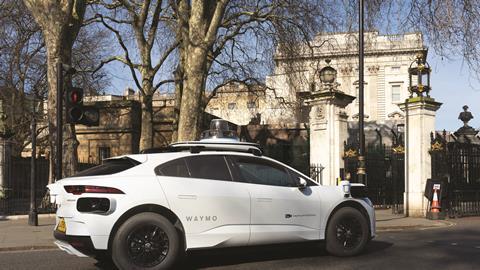
This matters because London is the testbed for a government attempt to put the UK at the forefront of driverless technology. In a small-scale ‘automated passenger service’ pilot supported by central government, at least four businesses are planning to deploy self-driving taxis. Vehicles with the tell-tale rooftop sensor arrays are already a familiar sight in central London – invariably with a hi-vis jacketed ‘safety driver’ looking bored behind the wheel.
The thinking is that if robot taxis can cope with London’s ancient lanes, complex junctions and ecosystems of jaywalkers, cyclists and random streetworks, they can cope anywhere. This would create opportunities for a UK automotive industry currently in an existential crisis, said Ben Gardner, partner at London firm Shoosmiths – which last week picked up a gong at the Self Driving Industry Awards.
In theory, US-style fully automated taxis are due to start picking up fares next year. But Gardner noted that key secondary legislation under the Automated Vehicles Act 2024 remains to be completed. ‘It won’t be until the end of 2027 that we have full legal clarity,’ he said.
'If the data show no interventions or near misses, that may be time to remove the safety driver'
Ben Gardner, Shoosmiths
Among the matters needing clarification is the act’s provision that self-driving vehicles must be at least as safe as a ‘careful and competent’ human driver. Both ‘careful and competent’ and ‘safe’ require definitions, Gardner said. He envisages an extra step in the vehicle type approval process in which self-driving software will have to pass the equivalent of the human driving test. However, ‘at the moment it is not abundantly clear what the process is going to look like’.
Meanwhile the London Assembly committee’s report – pointedly titled ‘Who’s driving’ – reckons that local government should have a say. Unlike conventional taxi services, which since 1843 have been regulated locally (mainly by the Metropolitan Police), the power to issue permits for autonomous passenger services is held at national level. Would-be operators must apply to the Driver and Vehicle Standards Agency for an ‘APS’ permit: London’s transport authority TfL does not have a formal role. The report recommends that the regulations under the Automated Vehicles Act devolve to TfL the power to issue or withdraw APS permits and put conditions on operators.
One such regulation may be a tougher definition of safety. The report suggests that automated vehicles should not be tested against ‘careful and competent’ human car drivers but against the definitions of safety applied to public transport such as trains. ‘The London Assembly has got a very particular view,’ Gardner said, pointing out that this very issue was debated in the parliamentary passage of the act.
Where he agrees with the committee’s report is on the need for clarity on sharing the data generated by autonomous vehicles. This is particularly crucial for insurance purposes, Gardner said. ‘Insurance companies need data to set premiums, but at the moment there is a chicken and egg: cars can’t generate data without insurance; insurance premiums can’t be set without data.’ The Autonomous Vehicle Act regulations will have to set out clearly what and how data on accidents and near misses will be shared.
Likewise, the transport committee’s report proposes that TfL should require that information about crashes and near misses be delivered within 24 hours.
So when will fully automated cars finally arrive on Britain’s roads? ‘We still don’t know,’ Gardner said. Much depends on the outcome of the London trials with safety drivers. ‘If the data show no interventions or near misses, that may be time to remove the safety driver,’ he said. However, he points out that fully automated driving is merely the end point in a series of technological innovations improving safety, fuel efficiency and the car rider’s experience.
As the government’s former chief road safety adviser Dr Nick Reed reminded the Self Driving Awards ceremony last week: ‘Autonomous vehicles on the road now are the worst they’re going to be. They’re going to get better and better and better.’













No comments yet