



















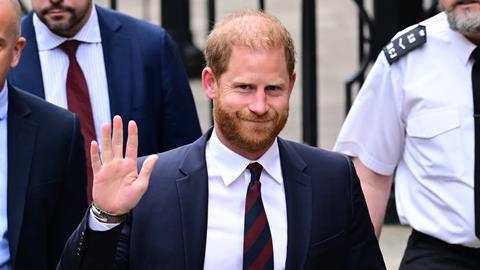
An indemnity costs order in the failed privacy action brought by celebrities against the Daily Mail would be a ‘very harsh’ and ‘unwarranted’ result, the High Court heard today.
Earlier this month claims of unlawful information-gathering brought by seven claimants including Prince Harry the Duke of Sussex, Baroness Lawrence and Sir Elton John, were dismissed by Mr Justice Nicklin following an 11-week trial. Associated Newspapers is seeking its costs to be assessed on an indemnity basis.
Nicholas Bacon KC, for the claimants, began his submissions on the afternoon of the first day of the two-day costs hearing before Mr Justice Nicklin.
Bacon said: ‘On a fair and proper analysis of the facts and circumstances of this case…it would be unjust, as a whole, to make an order for indemnity costs against the claimants.’
The court heard the claimants have not 'conducted themselves in such a way as to attract the condemnation of the court, which we say would flow from an indemnity basis costs order’. The ‘starting point…should be that the court should consider each of the claimants themselves, have regard to their individual circumstances in the way in which their claims were pursued’, Bacon said.
‘All of the claimants…have approached this litigation in good faith, under the burden of decades of intensive, intrusive media scrutiny into their private lives. That’s what this case is about. This is why the case was brought.
‘The court dismissed their claims on a granular, detailed, careful analysis of the evidence. It did not, however, make findings against the claimants in relation to dishonesty…or doubt the sincerity in the belief that they had as victims of unlawful information-gathering.’
Read more
During the second day of the hearing, Bacon said Associated Newspapers had ‘put forward its budget’ previously and the claimants ‘then increased our cover to meet the court’s increase of the budget that had then been ordered’.
In written submissions, Bacon said the claimants had obtained after-the-event insurance from Temple Legal Protection totalling ‘£16.2million (made up of individual limits of indemnity of £2.7million across six policies)’.
‘At that level of cover, the [claimants] would reasonably expect to be insured for the total of Associated’s incurred costs and approved estimated costs. If the [claimants] were required to pay Associated’s costs on the indemnity basis, however, the current level of cover would be insufficient to meet their total costs exposure, possibly to the tune of many millions of pounds.’
He added: ‘That would be a very harsh result indeed. It would also be unwarranted. If costs are awarded on the indemnity basis…the guardrails placed by the court – with good reason – on Associated’s costs will fall away.’
Bacon said: ‘£6.1m for the trial is unreasonable, the court can plainly say that.’
Referring to campaigners Dr Evan Harris and Graham Johnson’s ‘Bluebird memo’, which set out a ‘media attack’ on Associated, Bacon said he acted ‘for seven public prominent figures, celebrities they have been described as’ and ‘in circumstances where they are not themselves associated with those others’ he would encourage against an indemnity costs order. ‘It is them that pay for it,’ he added.
Mr Justice Nicklin said though there is sympathy for the claimants, ‘they are ultimately responsible for the strategy that was adopted’.
The judge indicated that ‘one of the matters that weigh heavily on my mind are the resources of the court that have been taxed quite enough by this litigation’.
‘The sooner the resources of the court are freed up to deal with other people’s claims, the better,’ he added.
Judgment is reserved.
This article is now closed for comment.



6 Readers' comments