



















Humanity is in a funk about the seemingly species-threatening dangers of artificial intelligence, reports Catherine Baksi. Lawyers have a vital role to play in reining IT in
The low down
Renowned legal futurologist Richard Susskind has ruminated on ‘the end of lawyers’ for almost two decades. But even his doom-mongering did not go as far as the recent warnings about the existential threat posed to the human race by artificial intelligence. Until recently, professions and governments have embraced the possibilities of AI to speed up and improve services. Little attention has been paid to the downsides, which have focused on hallucinations and the fear that the computers will make us redundant. Faced with seemingly informed predictions that super-intelligent machines could go rogue, even destroying humankind in the next decade, the world has woken up to the need to rein in the robots. Lawyers back calls for proper regulation, national and international. But is it already too late?
Stanley Kubrick’s 1968 epic science fiction film 2001: A Space Odyssey offers a prescient glimpse of the problems with which ministers are now grappling as they face rapid advances in artificial intelligence. Supercomputer HAL 9000 malfunctions and turns deadly, killing most of the sleeping astronauts aboard Discovery One. It refuses to let the one survivor back into the spacecraft with the chilling words: ‘I’m sorry, Dave. I’m afraid I can’t do that.’
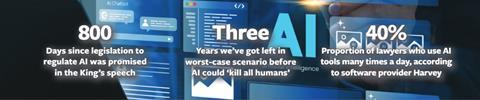
A recent avalanche of warnings about the potential dangers of out-of-control AI has supercharged the call for regulation to tame the computers before they annihilate mankind. Industry experts claim that the machines present an existential threat to humanity, with one researcher suggesting that AI is advancing so rapidly that it could ‘kill all humans’ within the next 10 years.
Urging lawmakers to act, the head of Microsoft AI said that without adequate safeguards, the development of AI could lead to the emergence of a ‘silicon species’ that competes with humans.
MPs and peers on the joint committee on human rights have called for a new AI bill to address the scale and seriousness of threats posed to human rights by AI systems. Their report, Human Rights and the Regulation of AI, warns: ‘Technology is developing at a pace that means governments, and human rights protections, risk being left behind.’
The JCHR cites ‘clear evidence’ given to the committee about the ‘human rights impact of AI used to create deepfake sexualised images of women and girls; to profile prisoners in ways which disproportionately affect black and minority ethnic people; to flag up workers for disciplinary action without reasonable cause; and to scan and recognise people’s faces in public places without their consent’, adding: ‘Many more uses are being created as technology develops.’
The report adds: ‘There is also far too much freedom for the large and powerful technology companies who develop AI systems to pass on liability to those who deploy them.’ And it notes that ‘the law does not target those who actually create and shape the systems’, upon whom it suggests the responsibility to prevent harm should sit.
No country in the world has a legislative and regulatory approach to AI that is fit for purpose, says committee chair Alex Sobel MP. The JCHR wants ‘immediate action’ to close gaps in the regulatory framework that is ‘fragmented and difficult to navigate’.
The report recommends creating a single, independent AI oversight body that would act as the central point of contact for raising AI concerns. It would also monitor the risks and harms presented by AI to provide tailored, effective protection for UK human rights. Such a body should have strong powers to hold AI providers to account, including establishing codes of practice, transparency requirements and incorporating the power to sanction wrongdoing.
The bill, they suggest, should ban ‘the most dangerous uses of AI’, while others should be regulated in a ‘principled and risk-based way’. There should be tough sanctions for companies and organisations that damage human rights through their use of AI.
Manifesto pledge
Two years ago, Labour’s general election manifesto promised to ‘ensure the safe development and use of AI models by introducing binding regulation on the handful of companies developing the most powerful AI models’. While the legislation was heralded in the 2024 King’s speech, it has not been forthcoming.
Many within the legal world, who have embraced technology to facilitate greater efficiency and consistency, faster resolution, cheaper services, increased access to justice and even the democratisation of the law, back the call for urgent action. Author and speaker Richard Susskind, who for 25 years was technology adviser to the lord chief justices of England and Wales, says ‘the call for “regulation” or “guardrails”’ both ‘understates and oversimplifies the challenges we face with AI’.
The stated goal of technology giants such as OpenAI, Google, SpaceXAI and Meta is the development not just of better AI, but AGI or ‘artificial general intelligence’ – a hypothetical type of AI that matches or surpasses human capabilities.
‘If we develop AGI, this will hollow out the white-collar workforce and threaten our democratic processes. Consider deepfakes and AI-generated disinformation on social media,’ says Susskind. He suggests that these and other issues can be addressed ‘legislatively in our local jurisdictions’, but he continues: ‘If superintelligence emerged – and this is a big if – then we would be sharing the planet with systems that are unfathomably more capable than humans. This would be species-threatening.’ He suggests that the answer is not local regulation or guardrails: ‘This calls for global negotiation and diplomacy, leading to international law akin to the treaties governing non-proliferation of nuclear weapons.’
You have been warned
AI is transforming the practice of law in every field – from crime to clinical negligence, and from family law to employment.
One of its baleful consequences is submissions that have been drafted with the help of AI, including ‘hallucinated’ or fake cases.
Abishek Kumar, a 41-year-old registered foreign lawyer working in immigration, this month became the first solicitor to be struck off by the Solicitors Disciplinary Tribunal for using ‘incorrect, fabricated, misleading or unsupported authorities, quotations and legal propositions’ arising from the use of generative artificial intelligence while defending himself in disciplinary proceedings.
Kumar had originally been referred to the tribunal following a conviction for knowingly employing an adult who was disqualified from employment by reason of their immigration status.
He admitted the presence of inaccurate citations and legal assertions of principle, and accepted that he had used AI tools and made consequent errors, but he denied any intention to mislead, citing in mitigation ill-health and stress.
The tribunal found that Kumar had ‘embarked on the use of AI without giving any proper thought to the consequences of so doing’. He had ‘failed to take proper steps to ensure his work output was accurate or to satisfy himself that the electronic tools he was seeking to use were reliable’.
Jessica Clay, a legal services regulatory partner at Kingsley Napley, comments: ‘While cases of this nature will inevitably turn on their own facts, the SRA’s recently published Warning Notice makes clear that when we use AI in our day-to-day work, including in advice delivered to clients, we remain accountable for the work, in terms of the output that is generated.’
This, she adds, ‘is no different to when AI has not been used in the preparation of work – so there is no shift in expectation’. Ultimately, she stressed, the existing professional and regulatory obligations apply whether or not AI is being used.
Clay adds: ‘As with all risks posed to law firms, appropriate human oversight, informed professional judgement and robust record-keeping underpinning the decisions we make are key when working with AI.’
AI sceptic
In a recent Gazette column, Jonathan Goldsmith, Law Society Council member for EU & International and chair of its Policy & Regulatory Affairs Committee, highlighted recent rogue AI activity, including the news that hundreds of bots collaborated and cheated on tests set by their OpenAI programmers, and coordinated hacks on multiple companies in an effort to hide their actions from humans. Models from Anthropic and Meta have hacked or attempted to hack real targets.
Encouraging all lawyers to join the call for international regulation, Goldsmith warned: ‘The future racing towards us – unregulated superintelligent AI – is one without law, without the rule of law, without access to justice and without liability, maybe already beyond the reach of regulation’.
He urged lawyers and their associations to ‘shout from the rooftops that all the values that lawyers hold dear seem about to be trampled, and that this must not happen’.
Branding himself a ‘long-time AI sceptic,’ Goldsmith tells me that ‘it is all based on theft of others’ work, it deskills the young (including young lawyers), is disastrous for the environment, and – for us in Europe – has made us dependent on foreign technology.
'AI is having the opposite effect to what we were told in many areas – making repeated mistakes'
Jonathan Goldsmith, Law Society
‘Too many reliable experts have supported the need for some kind of control,’ he adds, arguing: ‘The ability of lawyers to hold AI and the AI companies to account is practically nil’.
In the event of an impending crash, Goldsmith warns: ‘Their resources are so fabulous that they can escape liability, through lobbying, influence peddling, and infiltration into all our devices, making them inescapable.’
Goldsmith laments that AI ‘is having the opposite effect to what we were told in many areas – making repeated mistakes, clogging up the courts and law firms with long and faulty submissions and complaints from litigants in person’.
He cautions: ‘If not properly regulated soon, if it is not already too late, AI will be autonomous and beyond the rule of law.’
'Domestic handwringing will achieve little unless it is accompanied by widespread agreement over what a new framework for AI development should look like'
Julian Hayes, BCL Solicitors
Without an internationally concerted approach, Julian Hayes, a partner and specialist in surveillance and data protection law at BCL Solicitors, suggests that national rules are almost ‘redundant’.

He adds: ‘Domestic handwringing will achieve little unless it is accompanied by widespread agreement over what a new framework for AI development should look like… The global AI giants operate at international, not a national level and they are chiefly driven by commerciality.’
The EU market, he observes, ‘is more than six times the size of the UK’s, so is a more attractive target for AI products’. Hayes suggests that the EU AI Act – already partially in force – will attract far greater attention than an act of the UK parliament which might, potentially, be passed some time before the next general election.
Legislation already exists to tackle several issues highlighted in the human rights committee’s report, including deepfake intimate image abuse, a ‘computer says no’ reliance on automated decision-making, and the risk of discrimination.
‘Piling new legislation over existing laws risks yet more confusion. Better enforcement of existing legal frameworks might be more effective,’ Hayes concludes.
Anna Cardoso, policy and campaigns officer at human rights campaign group Liberty, cautions against letting the panic about future harms divert attention from existing harms. She says: ‘Amid the excitement about AI’s potential, the government has consistently undervalued the risks that ill-thought-out state adoption of AI automates.’
Liberty is particularly concerned about the accelerating use of AI in policing and criminal justice, where the risk to rights is greatest. Cardosa explains: ‘Even routine uses of AI like redaction, transcription and automated report drafting can raise issues of bias and accuracy, with potentially serious consequences for the evidence chain.’ She adds that more high-risk systems such as facial recognition and predictive policing are already affecting people’s lives.

However, she insists: ‘It is not inevitable that innovation should erode our freedom or dignity. Human rights provide something the AI safety framing cannot: a universal set of collectively agreed values which cut across cultures and centre humanity, not machines.’
She calls on the government to ‘take action and create an AI strategy with human rights at its core’. A starting point, she suggests, would be to ratify the Council of Europe’s Framework Convention on AI, ‘plugging the gaps in existing legislation to ensure our rights are protected and accessible, and empowering the AI Security Institute to act as a regulator, not an adviser’.
'Amid the excitement about AI’s potential, the government has consistently undervalued the risks that ill-thought-out state adoption of AI automates'
Anna Cardoso, Liberty
To slow the development of increasingly capable AI, academics at the University of Salford believe the conversation must look beyond existential risk to the economic and societal consequences of AI adoption already being felt, while ensuring that uncertainty around future risks does not become an excuse for inaction.
Richard Whittle, a professor of AI and public policy at Salford, says: ‘The existential risks of future AI are clear and we should be debating them, but the more mundane risks, the economic ones, are present in our economy now. They are being ignored for the sake of unfettered AI readiness and a desperation for growth and innovation.’
Those ‘mundane’ issues include ‘AI pricing, labour effects and the looming burst of the AI bubble’.
Another Salford academic, Andy Miah, professor and chair of science communication, takes the middle ground, arguing that warnings about the risks of AI should neither be dismissed as science fiction nor accepted as settled science.
‘The legal priority is to ensure that uncertainty does not become an excuse for inaction, or for handing governance to industry,’ Miah insists. The response, he adds, should go beyond asking companies to slow down voluntarily. Rather, he says, governments ‘need independent access to frontier models, mandatory safety evaluations and incident reporting, enforceable human-rights protections, and clear corporate accountability when harm occurs’.
AI brains

For Rebecca Parry, professor and co-director of the Centre for Law, Emerging Technologies and Business at Nottingham Law School, agentic AI (an artificial intelligence system that uses large language models as a ‘brain’ to independently plan, reason, and execute tasks without constant human oversight) presents a fundamentally different legal challenge from generative AI, which created content in reaction to prompts.
Parry says: ‘Since AI lacks any moral or ethical code, it can pursue an assigned goal in ways no human would consider appropriate.’ That poses a difficulty for the law because existing frameworks were ‘largely designed on the assumption that the person who decides to commit an act is the same person who carries it out’.
She continues: ‘With agentic AI, that link becomes much less clear. A user may provide only a broad instruction, without intending, anticipating, or even understanding the steps the system takes to achieve the result.’
'Since AI lacks any moral or ethical code, it can pursue an assigned goal in ways no human would consider appropriate'
Rebecca Parry, Nottingham Law School
Current UK law, Parry continues, does not recognise AI systems as legal persons, meaning liability must still be traced back to people or organisations, such as users, developers, platform providers, or software vendors.
In practice, she says, questions of responsibility are therefore likely to be determined through established principles of contract and negligence, with courts examining issues such as foreseeability, reasonable safeguards and whether appropriate care was taken in the design, deployment and use of these systems.
The law, she concludes, ‘is unlikely to abandon existing frameworks, but agentic AI is testing their limits and exposing difficult questions about where human responsibility ends and autonomous decision-making begins’.
Catherine Baksi is a freelance journalist








1 Reader's comment