























The Ministry of Defence should examine the merits of allowing rank-and-file armed forces personnel to serve on military juries, a committee of MPs recommends today. The change would enable ranks lower than staff sergeant in the Army and flight sergeant in the Royal Air Force to be members of court martial boards.
Civilian juries are made up of randomly selected members of the public, points out the Commons Armed Forces Bill select committee in a special report on the legislation. But membership of court martial boards, which make findings of guilt or innocence based on the facts, is presently restricted to Other Rank 7 or higher. OR-7 is also equivalent to chief petty officer in the Royal Navy and colour sergeant in the Royal Marines.
The Armed Forces Bill includes a package of reforms of the heavily criticised Service Justice System. Most are aimed at better supporting victims of serious crimes, including sexual offences, stalking and domestic abuse. They include the creation of new restrictive orders, a new code of practice for victims of service offences and an expanded duty on commanding officers to report serious offences.
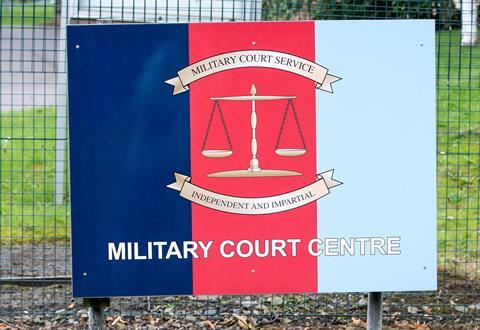
The bill would also introduce new guidance on the advice that should be provided to victims in cases that could be tried in either a service or a civilian court.
During their inquiry the MPs heard evidence from solicitor Emma Norton of the Centre for Military Justice. Norton cited research indicating that rape conviction rates at court martial are significantly lower than at Crown Court, which contradicts the MoD’s position that the rates are similar.
The MPs recommend that the government commissions independent research into relative conviction rates for serious sexual offences.
The committee also heard differing views on whether serious offences should automatically be tried in civilian courts. ‘We conclude that the government should not rule out this course of action in the future,’ the report recommends.
Constitutionally, a new Armed Forces Bill is required by parliament to be passed every five years. The 16-strong Armed Forces Bill select committee is chaired by Clive Efford, Labour MP for Eltham and Chislehurst.
'The bill creates additional powers to protect victims from domestic abuse and sexual harm and proposes measures to improve the effectiveness and efficiency of the service courts, which we welcome,’ said Efford. ‘But these need to be accompanied by proper training for service justice personnel to make sure they have the desired effect.'
This article is now closed for comment.





4 Readers' comments