






















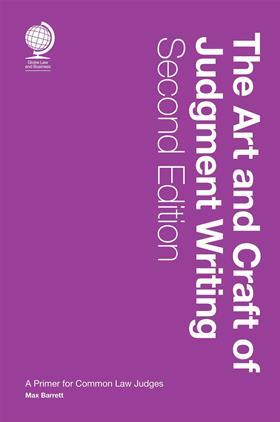
The Art and Craft of Judgment Writing: A Primer for Common Law Judges (second edition)
Max Barrett
£165, Globe Law and Business
★★★★✩
A judgment is an explanation of why a court or tribunal has made its decision, addressed to both or all the parties, but also arguably to the unsuccessful litigant as a ‘letter to the loser’. A good judgment should set out the law, facts, how the law applies and the decision. Judgments can be written and consist of many pages or be given verbally, ex tempore.
The judgment is addressed to the parties and lawyers, and also to other courts, academics and potentially the public directly or through the press. Should it be written in accessible language or formal legalese? Is the main aim of a good judgment to be appeal-proof? All courts and tribunals are under time pressure and litigants are entitled to timely decisions. These factors do not ensure well-argued, logical and clear decisions.
I work primarily in tribunals, where much effort is made to produce clear decisions that follow a logical analysis. Gone are the days of a hastily written few lines; now each has to be clear, answering a series of legal questions. There are many precedents setting out what is required in a decision and why. Above all, the disappointed party should understand why they lost.
It is a considerable achievement and mark of this book’s success that the second edition has come out within a few years of the first. This volume is greatly expanded to include sections about AI, the use of visual aids such as diagrams and illustrations, storytelling, editing and the use of gender-inclusive language.
There is a wide, inclusive feel to this book, covering judges and judgments from many common-law jurisdictions such as the US, India, Australia and Canada. It analyses different approaches to composition. Judgment writing is personal and an opportunity for a judge’s personality to shine. The author looks at the work of famous British judges from history and more recently. Stand-out examples are Lord Denning and Lord Bingham, who made the point that dissenting judges write for future judges. Interesting comment.
Denning was one of the last century’s great judges, pushing the boundaries. He probably stayed in post for too long. His use of the English language was impressive and memorable. In his book The Discipline of Law, Denning summarised his views on style for all lawyers, including cultivating a command of language, choosing words well and, above all, being clear.
A good example of his style is: ‘In summertime, village cricket is the delight of everyone. Nearly every village has its own cricket field where the young men play and the old men watch. In the village of Lintz in County Durham, they have their own ground, where they have played these last 70 years. They tend it well. The wicket area is well rolled and mown. The outfield is kept short. It has a good club house for the players and seats for the onlookers. The village team play there on Saturdays and Sundays.’ (Miller v Jackson [1977] QB 966)
It is not a coincidence that many landmark cases are great examples of writing (Donoghue v Stevenson and Rylands v Fletcher). Another example was Somerset v Stewart from the 1770s, when an escaped slave was recaptured and put on a ship on the Thames awaiting transportation to the Caribbean. Some abolitionists started an action in habeas corpus. The judge, Lord Mansfield, listened to the opposing arguments and held that the common law forbade slavery as ‘so odious’ that only legislation would allow it. There was none, so Somerset ‘must be discharged’. Interestingly, Mansfield had tried to get the parties to settle and even tried to persuade someone to buy the slave. The judge had connections with the West Indies and was foster father to a girl who had been fathered by one of Mansfield’s nephews and may have had a slave mother.
The court held that ‘a master could not seize a slave in England and detain him preparatory to sending him out of the realm to be sold’. It also ruled that habeas corpus was a constitutional right available to slaves to prevent removal from the realm because they were not goods but servants.
There is a substantial section on writers who are exemplary stylists. These are not from the legal world but essayists and novelists. They include Mark Twain, Thomas Hardy, Somerset Maugham and George Orwell, but not Dickens.
One might ask, who cares? Judgment reasons are just a summary which one party will like while the party that comes second will not be so keen. The point is that style is about clarity and readability. Most of the judgments we hear or read will not make the law reports, academic journals or newspapers. They are not going to be read for fun by anyone. However, they still require good style. Style constitutes not only elegant writing, but also the avoidance of cliche and the use of simple language.
In future, perhaps most judgments will at least be drafted by AI. Increasingly, judges will explain decisions in social and public media to avoid backlash and misreporting.
There is much work to be done to make decisions accessible when one party has a communication issue or is vulnerable. We increasingly see television news clips of senior judges announcing their decisions in important cases or judges in serious criminal cases explaining the reasoning.
You only see the judge, usually dressed in robes and not the defendant, lawyers or the public gallery.
There is another aspect of style which should be considered: the polite way of being cross. Sometimes judges say they are ‘disappointed’ with an expert’s evidence, that the evidence was ‘lacking’ or that a case could have been clearer. Often, understatement is more powerful than its opposite.
I am not sure what we should advise a client to do if they get a judgment which is in their favour, but the style is poor. Probably nothing. This is a clear, scholarly and important work. All lawyers will benefit from this book.
David Pickup is a partner at Pickup & Scott Solicitors, Aylesbury








No comments yet