






















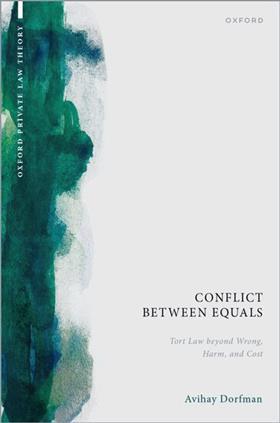
Conflict between Equals: Tort Law beyond Wrong, Harm and Cost
Avihay Dorfman
£130, Oxford University Press
★★★★✩
I have read this book as a practitioner, rather than as the academic or legal philosopher for whom it may be principally intended. As a solicitor, I approach a claim in tort with certain basic questions hard-wired into my brain: was there a duty, was it breached and what damage followed? Once those questions have been answered, I confess that my mind rarely ventures much further. Avihay Dorfman’s Conflict between Equals asks us to do exactly that, and venture much further. It does not simply explain the principles of or development of tort law. It asks why we have those principles in the first place and seeks to unsettle and reconstruct much of what practitioners may take for granted.
Dorfman’s starting point is that familiar ideas such as wrong, harm and cost cannot, by themselves, tell us what tort law should protect or prohibit. Each depends on an earlier judgment about what people are entitled to do to one another. His ambition is therefore to identify a normative baseline: a principled way of moving from the interests that matter, through the conflicts between them, to the rights and duties which tort law should recognise.
He begins with fundamental interests, including bodily integrity and self-expression, which are central to living as free and equal individuals. Those interests inevitably come into conflict. The question is not simply whether someone has suffered harm, but how the law should respond when one person’s interests collide with another’s.
He divides these conflicts into three broad categories: inherently valuable, tolerably valuable and valueless. The distinction matters because Dorfman proposes that tort law should not respond to every conflict in the same way. It should create the conditions for inherently valuable conflicts, contain the negative effects of tolerably valuable conflicts, and prevent or remedy valueless conflicts.
Alongside this sits Dorfman’s theory of equality. He rejects the idea that equality always means treating two people in precisely the same way. Their interests and circumstances may differ, and the law must decide which of those differences matter. As Dorfman puts it, tort law must take 'the (right kinds of) difference seriously' if people are genuinely to relate as equals. On this account, legal duties do not merely restrict freedom; they can sometimes be necessary for people to live as free and equal individuals.
This shifts the focus away from tort law as merely a backward-looking exercise in deciding what went wrong and awarding a remedy. Dorfman argues that it also has a role before anything has gone wrong: establishing the terms on which private individuals interact and protecting the conditions of a liberal society.
The book is highly ambitious and challenging. Dorfman is not content simply to justify tort law as it stands. His framework is intended to help identify what may be missing and how the law should develop. The book therefore moves between familiar doctrine and larger questions about freedom, equality and justice. As he explains in his conclusion, in his view tort law cannot be reduced to the ex-post task of courts responding to discrete instances of wrongdoing and their aftermath. It also has an ex-ante mission: to construct terms of interaction which engage appropriately with the parties’ conflicting interests and treat them as substantive equals. This constructive ambition extends beyond individual relationships and transactions. It helps shape the normative framework we inhabit in daily life, including the social goods that constitute a liberal society.
This reformative ambition is illustrated by Dorfman’s proposals for torts of discrimination and private censorship. These examples are interesting and show how his theory might address gaps in existing law.
I cannot pretend that this was an easy read. At times it felt like performing mental acrobatics, and there were passages I had to revisit before I could see where the argument was going. The distinctions are subtle, the vocabulary demanding and the book requires considerable concentration. The busy practitioner may need to take time over these passages, but the effort is rewarded by compelling ideas and a shift in perspective which is hard-won but transformative.
The book made me look at familiar principles very differently and that can only be a good thing. Questions which practitioners tend to treat as the beginning of the analysis - duty, breach, damage and loss - become the end product of a more fundamental inquiry into the conflicts between people’s interests and the terms on which they can meet as equals.
Conflict between Equals turns tort law inside out. I am not sure I absorbed every turn of the argument, but it left me questioning assumptions which had previously seemed too familiar to question at all. It made me see the law I practise every day through a new lens and appreciate the universal importance of the questions with which we, as practitioners, grapple daily. For a book of this kind, that is no mean feat.
Sally Azarmi is a solicitor and director at Azarmi & Company
Conflict between Equals: Tort Law beyond Wrong, Harm and Cost
★★★★★
Avihay Dorfman presents the reader with two theories on tort law. First is the ‘conflict theory’. This suggests that the moral function of tort law is to address human conflict – free speech versus good name; liberty of action versus bodily integrity – by engaging with the values underlying conflict. Tort law addresses such conflicts of interest by determining legal rights and duties that are proportionate to the value of the conflict.
Second is the ‘equality theory’, which proffers that tort law structures conflicts according to an egalitarian ideal, namely treating the parties to conflict as equals. The author then asks: why tort law at all, and should we worry if tort law did not exist?
Under the conflict theory, how do we attribute value to a claim? We are told there are three main categories of conflict: inherently valuable, tolerably valuable and valueless. Freedom of speech and protection of a person’s good name are examples of an inherently valuable conflict. Dorfman attempts to explain how the legal right to free speech should provide protection against state actors and private persons who wield power over us. But what of speech that might be seen by some as offensive? At this point, the infamous Westboro Baptist Church leader Fred Phelps makes a timely appearance. On 10 March 2006, Phelps and other members of his church picketed the funeral of US Marine Matthew Snyder. On public land about 300m from where the funeral was being held, they displayed placards, including ‘Thank God for Dead Soldiers’. In 2011, the US Supreme Court held that speech made in a public place on a matter of public concern cannot be the basis of liability for a tort of emotional distress, even if the speech is viewed as offensive or outrageous.
‘According to the conflict theory, the ability to challenge how things stand resonates with the good of liberal culture. To realize this good, speech must be allowed to have real bite, including by picking on, even skewering deeply held convictions, habits, and norms.’ This suggests to this reader not only that a person has no ‘right not to be offended’ in connection with a matter of public concern, but that it would be detrimental to liberal culture for such a right to prevail. In Snyder, the defendant relied on the First Amendment to the US constitution.
Dorfman then considers how English law has approached similar cases. In Rhodes v OPO, the UK Supreme Court considered the competing interests of a concert pianist who had written a memoir of the physical and sexual abuse he suffered as a young boy and his subsequent battles with drink, drugs and his own mental health. His son, through the boy’s mother, sought an injunction on the ground that publication would cause him severe emotional distress and psychological harm. The court ruled that ‘freedom to report the truth is a basic right to which the law gives a very high level of protection’. Rhodes did not intend to cause psychiatric harm or severe mental or emotional distress to his son.
An example of a tolerably valuable conflict arises in contact sports and the conflict between freedom to compete and bodily integrity. Eliminating vigorous and powerful play, it is argued, undermines both the competitive character and the challenges which are integral to participating in these sports. Because the conflict is valuable, tort law must contain the conflict and, save for deliberately or recklessly injuring other participants, players must be largely free to choose their level of physicality. However, what of former rugby players who are pursuing claims against the sport’s governing bodies, alleging negligence connected to brain damage and neurological conditions? These are not claims against a competitor who used unnecessary force with the intention to cause injury but against a governing body which, it is argued, failed to adequately protect players.
For the valueless conflict, tort law is called upon to prevent the conflict in advance. Dorfman argues that vesting the victim with a right of action is the way to respond to valueless conflicts that take the form of either deliberate or relational wrongdoing. Trespass may be included in this category, though the landowner may argue the point.
The equality theory explains why relating as equals necessitates duties, specifically tort duties, as opposed to voluntarily assumed duties. One way in which courts have seen fit to redress inequality between parties is the informal practice of leniency toward the plaintiff’s burden of proving causation under a certain set of circumstances. In Haft v Lone Palm Hotel, Haft and his child died from drowning in a pool without a lifeguard in the hotel in which they had stayed. The hotel breached an affirmative, statutory duty it owed the Hafts to either provide a lifeguard service or clearly indicate the absence of such service. No one actually witnessed the drowning, and so the causal connection between the breach and the fatal injuries is deeply uncertain. The California Supreme Court, appealing to the ‘unfairness of this burden situation’ and to considerations of ‘policy and justice’, shifted the burden to disprove causation on to the hotel.
The author answers his questions by arguing that we should, indeed, worry if tort law did not exist, and that both the conflict and equality theories are necessary for tort law to operate effectively.
This book explores the law of tort in a conceptual and theoretical way, covering many thought-provoking examples of how the practice of the law of tort can be enhanced for the benefit of society at large.
Kevin McVeigh is a partner at Elliotts Legal, Belfast








No comments yet