




















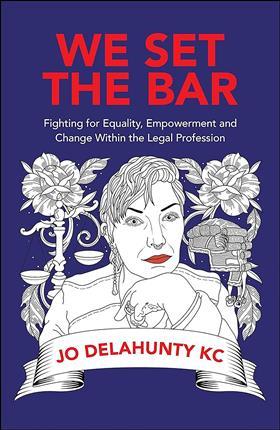
We Set the Bar: Fighting for Equality, Empowerment and Change within the Legal Profession
Jo Delahunty
£19.99, Bristol University Pres
★★★★★
Jo Delahunty’s new book does exactly what the title says: addresses standards of conduct and behaviour at the bar (and the legal profession generally) by reference to the issues named in the subtitle – equality, empowerment and change. The word ‘fighting’ in the subtitle indicates that change is needed and will be resisted. The ‘We’ embraces those who have worked for reform, as well as future campaigners.
‘Who is this book for?’ Delahunty asks. ‘It’s for my colleagues, it’s for my power masters, it’s for the general public, it’s for the young who we need to come into our profession to take it forward and be its champions for the future.’ With its stories of inequality and abuse at the bar, alongside coverage of the facts and figures, the book functions as a reference point as well as a wake-up call – even a call to arms – for lawyers already in practice at every level.
Delahunty – 40 years a barrister, 20 a silk – is the daughter of a working-class single mother from north London. Her mother was an inspiration, having risen from the factory floor to become PA to the most senior solicitor in a City firm, and one of the first women in the country to be approved for a sole mortgage on the basis of her own salary. Young Jo attended the local comprehensive school, where teachers recognised her intelligence but tried to contain her brash confidence. The story of how she got into Oxford, on her own merits but encouraged and facilitated by Ruth Deech (Baroness Deech KC), is testament to Delahunty’s determination, as well as Deech’s generosity and judgement. Delahunty describes her motives for becoming a lawyer, her ignorance of the barriers she would face and her naivety about the likelihood of achieving her aims. But she also makes it clear that she did get there and has remained true to her mission. Delahunty does legal aid child protection work – not the most glamorous of specialisms, nor the most remunerative – but, as she shows, one of the most rewarding and valuable.
From the start, the book puts human faces on the stark statistics of inequality of access to the bar. It celebrates those who, like Delahunty, ‘set the bar’ by reaching out to those who might never consider the profession, let alone be encouraged to enter it. The book acknowledges ‘personal champions’ and role models and also tells the stories (with permission) of other entrants into law from non-standard backgrounds or through non-standard routes. Acknowledging that most people have really no idea of ‘what a barrister’s life is like’, Delahunty fills us in, with a focus on the codes that govern barrister conduct, all the better to shine a light on the infractions of those codes described in later sections.
A central chapter deals with Power and Patronage – that is, the relationship between senior and junior members of chambers, and the role played in this relationship by ‘gender, sexuality, class and colour’. Instances of bullying and harassment suffered by Delahunty and others, including the assumption by senior men that their female juniors will have sex with them (indeed, will only progress in their career if they do), are detailed unflinchingly. What is striking about these accounts is that Delahunty does not hesitate to name the perpetrators and (again, with permission) their victims. For those who thought that, after several inquiries and reports, this feature of a barrister’s life was a thing of the past, Delahunty provides a section called ‘There are still bastards out there’. The next chapter shows that power is also exerted inside the courtroom and she calls out abusive judges – and their inadequate censure.
A chapter devoted to progression at the bar offers a potted history of women’s admission. For all that 50% of barristers are now female, it will surprise no one that they are clustered at the bottom of the pyramid and more likely than men to leave the profession early, for reasons we all know but may find hard to believe still exist. The added value of this book lies in detailed information about existing initiatives to tackle injustice and discrimination, and a template for what can be done, including the role that male lawyers can play. The reluctant admission of women to the Garrick Club (a club to which many male lawyers belong) is used as an example to show that rules may be changed, women may be admitted, but other means will then be found to contain and exclude us, unless we keep fighting.
A chapter on diversity goes much further than the usual brief discussion of ‘LGBT’ and the race to encompass the experiences of neurodiverse lawyers and, again, what can be done to welcome and facilitate everyone’s contribution. Finally, Delahunty returns to the challenges of her own work – not least the underfunding and undervaluing of legal aid, not to speak of anything intended to help women. She asks, ‘Is it worth it?’, and her answer comes as no surprise. This book should inspire readers to make informed decisions about what they want to do.
Hard-hitting as it is, this is also a very engaging book, like the author herself. It sometimes makes for grim reading, but it still manages to entertain. It is part memoir, part academic study, part state-of-the-art report, part advice book and, taken as a whole, a political text.
This should be required reading for all aspiring lawyers, female or male. It is only by educating the next generation that we will be able to shift legal men’s easy assumption of privilege and entitlement. Change will not happen without professional will.
Rosemary Auchmuty is professor of law emerita at the University of Reading






No comments yet