






















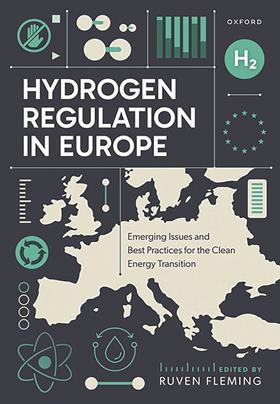
Hydrogen Regulation in Europe: Emerging Issues and Best Practices for the Clean Energy Transition
Editor: Ruven Fleming
£125, Oxford University Press
★★★★✩
This volume addresses a topic that is increasingly central in the contemporary debate on energy transition, namely the legal frameworks governing hydrogen development across Europe. The book is ambitious in scope and, at the same time, quite concrete in its methodological approach.
After an introductory chapter by editor Ruven Fleming, which offers a useful conceptual framing and identifies the key regulatory tensions, the volume is divided into two main parts. The first is dedicated to upstream issues, in particular permitting regimes for electrolysers, while the second focuses on downstream questions, including infrastructure repurposing and pipeline regulation. This division is convincing, even if, in practice, the distinction between upstream and downstream is not always so sharp in legal terms.
One of the principal merits of the book is its comparative dimension. The national chapters (covering jurisdictions such as the Netherlands, Denmark, Germany, Poland, Spain, Italy, Greece and the UK) provide detailed and often very practical insights into administrative procedures and regulatory constraints. In this respect, the book will be particularly useful not only to academics but also to practitioners.
At the same time, the comparative approach is not always fully exploited at an analytical level. The reader sometimes has the impression of a collection of national reports, rather than a fully integrated comparative study. A more explicit cross-cutting analysis, possibly in the concluding chapter, would have strengthened the overall coherence.
The second part of the volume, dealing with downstream issues, is especially relevant currently. The chapters on repurposing offshore oil and gas infrastructure and on hydrogen pipelines highlight the legal complexity of adapting existing regulatory frameworks to new technological realities. Here, the interaction between EU law and domestic administrative law emerges as a key theme, although it could have been further developed.
From a broader perspective, the book confirms that hydrogen regulation in Europe is still in a phase of construction, characterised by fragmentation and experimentation. This is perhaps inevitable, but it also raises questions about legal certainty and investment security, which are only partially addressed.
Overall, this is a valuable and timely contribution to the literature on energy law. It does not provide all the answers (for instance, an analysis of the transportation phase might have been useful), but it offers a solid basis for further research and discussion.
Dr Carlo Corcione is a lawyer and manager specialising in trade, shipping and logistics









No comments yet