





















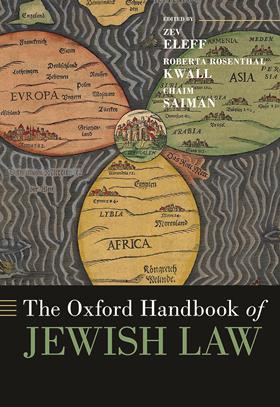
The Oxford Handbook of Jewish Law
Editors: Zev Eleff, Roberta Rosenthal Kwall, Chaim Saiman
£142.50, Oxford University Press
★★★★✩
This book examines Jewish law (Halakhah) from both historical and current perspectives, and also contemplates the future as law continues to evolve. As the introduction makes clear, the hope is that this volume, which clearly contains much original research material, as well as codifying succinctly what has gone before, will lead to further research and publications.
The volume is divided into three parts: ‘Reading Foundational Jewish Texts and Law’; ‘Distinguishing Characteristics of Jewish Law’; and ‘Jewish Law and Practice in Modernity’. These headings may seem dry, but that is very far from the case in respect of the underlying content. An immense range of subjects is covered, from the origins of Jewish law (and its somewhat protean but actually deeply logical evolution) through to consideration of very modern subjects, such as ‘Jewish Legal Responses to Covid-19’, ‘Jewish Commercial Law and Modern Political Economy’ and ‘The Role of Scientific Findings in Contemporary Jewish Law’.
There are striking comparisons between the development of common law jurisprudence (particularly the US legal system, given the provenance of the editors) and Halakhah. Recognition of both the ‘written law’ and ‘oral law’ traditions of the two systems is well-documented and fascinating. The evolution of the common law and the commentaries of the early rabbis seem to have many similarities. However, there are interesting differences in the ways that the two systems have approached legal issues. Halakhah in some respects places much more emphasis on ‘duties’, whereas common law systems often seem more focused on ‘rights’. Also, the point is made that whereas rabbinical works often seem to rejoice in the richness of different legal interpretations, Anglo-American jurisprudence appears much more focused in resolving legal doubt.
The book is vast (at over 800 pages) but scalable because the chapters are self-contained. Also, most of the chapters have ‘introductions’ and ‘conclusions’, so that one can read them as summaries without having to read the rest.
For those who wish to embed themselves in the fundamentals of Jewish law, the book explains (in Roman letter form) various constitutive elements, such as ‘Torah’, ‘Mishnah’, ‘Talmud’ and ‘Midrash’. It also looks at how Jewish law has divided into different approaches adopted by movements such as the Orthodox, Conservative and Reform communities in the US and the UK. The central significance of Israel in the development of Halakhah is also addressed.
For those who wish to dive more deeply into comparisons and contrasts between Halakhah and its relationship to Judaism as a religion, on the one hand, and Anglo-US and other secular legal systems on the other, there is a fascinating set of chapters grouped under the sub-heading ‘Halakhah and State’.
There are also good footnotes and a helpful index. This book is a towering work of scholarship, though the next edition would benefit from the inclusion of short biographies of all the contributors.
David Glass is a consultant solicitor at Excello Law







No comments yet