
























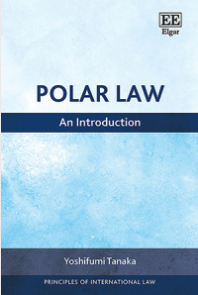
Polar Law: An Introduction
Yoshifumi Tanaka
£130, Edward Elgar Publishing
★★★★★
The polar regions have become one of the defining frontiers of 21st century international law. Climate change, geopolitical competition, biodiversity conservation, marine governance, indigenous interests, scientific cooperation, and the sustainable use of natural resources increasingly converge in the Arctic and Antarctic, making these regions laboratories for testing the resilience and adaptability of the international legal order. Against this backdrop, Yoshifumi Tanaka’s Polar Law arrives as a timely and substantial contribution to legal scholarship, offering an ambitious examination of the legal architecture governing Earth’s polar regions through the framework of public international law.
Rather than treating Arctic and Antarctic law as isolated or highly specialised subjects, Tanaka advances the persuasive proposition that polar law should be understood as an emerging and coherent branch of international law. His central thesis - that the polar regions constitute a microcosm of the broader legal and political challenges confronting the international community - is both compelling and intellectually productive. Throughout the volume, he demonstrates that developments in the polar regions illuminate wider questions regarding sovereignty, jurisdiction, environmental governance, international cooperation, dispute settlement, and the evolution of international legal norms.
One of the book’s greatest strengths lies in its systematic and doctrinal approach. Tanaka carefully guides readers through the legal frameworks applicable to both polar regions while acknowledging the profound differences between them. The Antarctic, governed principally by the Antarctic Treaty System, represents one of the world's most successful experiments in peaceful international governance and scientific cooperation. The Arctic, by contrast, presents a far more complex mosaic of coastal state sovereignty, maritime entitlements under the United Nations Convention on the Law of the Sea (UNCLOS), indigenous rights, resource development, and regional governance mechanisms. Tanaka successfully compares these distinct legal landscapes without oversimplifying their unique historical and institutional characteristics.
The discussion of international spatial order is particularly noteworthy. Questions concerning territorial claims, maritime delimitation, jurisdiction, and the legal status of polar spaces are among the most politically sensitive issues in contemporary international law. Tanaka examines these matters with analytical precision, explaining not only the applicable legal rules but also the policy considerations that continue to shape state practice. His treatment illustrates how traditional doctrines of public international law must continually adapt to emerging environmental realities and technological developments that increasingly enable access to previously inaccessible regions.
Equally impressive is the book’s sustained focus on environmental protection and sustainability. The polar regions are among the ecosystems most vulnerable to anthropogenic climate change, and their ecological significance extends far beyond their geographical boundaries. Tanaka appropriately places conservation at the centre of polar law rather than treating it as merely one component among many. His examination of biodiversity protection, ecosystem preservation, fisheries management, and sustainable resource utilisation reflects the growing influence of environmental principles within international law, including precaution, ecosystem-based management, and sustainable development.

Tanaka’s discussion of natural resources is measured and balanced, avoiding simplistic binaries between resource development and environmental preservation. Instead, he highlights the need to reconcile sovereign rights, environmental obligations, and collective international interests, reflecting the broader evolution of contemporary international environmental law.
The book also examines the regulation of shipping in the polar regions, an increasingly significant issue as climate change opens new maritime routes. The author places these developments within the wider framework of the law of the sea, explaining the legal challenges relating to navigation, maritime safety, environmental protection, and coastal state jurisdiction. Equally important is his treatment of scientific research, which he presents as a cornerstone of polar governance and international cooperation, particularly in Antarctica.
Another strength of the volume is its analysis of the peaceful settlement of disputes. By exploring mechanisms for resolving disagreements over maritime boundaries, natural resources, and environmental obligations, Tanaka demonstrates the continuing importance of international adjudication and arbitration in maintaining legal certainty in regions of growing geopolitical significance.
Throughout the book, Tanaka combines doctrinal rigour with accessibility. His careful engagement with treaties, judicial decisions, state practice, and scholarly literature makes the work a valuable resource for both teaching and research, while his clear and systematic style ensures that even complex legal issues remain accessible to readers from related disciplines.
Perhaps most importantly, Polar Law shows that the Arctic and Antarctic are not merely geographically remote regions governed by specialised legal rules. Rather, they serve as testing grounds for many of the defining challenges facing contemporary international law, including climate governance, biodiversity conservation, sustainable resource management, and international cooperation. Although no single volume can encompass every aspect of this rapidly evolving field, Tanaka succeeds in providing a coherent and comprehensive framework that will remain valuable for students, scholars, and policymakers alike.
For lawyers and practitioners, the book offers considerably more than an academic overview. Government lawyers, diplomats, arbitrators, policy advisers, and professionals working in maritime, environmental, or international law will find it an authoritative guide to the legal issues shaping the polar regions. Its systematic analysis, extensive references, and practical engagement with evolving legal regimes make it an indispensable resource for legal research, policy development, treaty interpretation, and advisory work.
Ultimately, Polar Law demonstrates that the governance of the polar regions is central to the future development of public international law. Tanaka has produced a rigorous, timely, and highly readable study that deserves to become a standard reference for anyone seeking to understand the legal dimensions of the Arctic and Antarctic in an era of profound environmental and geopolitical change.
Simone Mamini is a doctoral researcher in law and a visiting lecturer in maritime and international law at City St George’s, University of London









No comments yet