























Clients’ use of artificial intelligence is changing how they interact with law firms – and not always for the better. Joanna Goodman reports from the Gazette’s latest roundtable
At the table
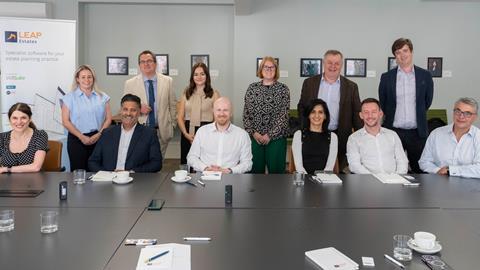
Back row (l-r) Alexandra Gordon Tassells; Eduardo Reyes Law Society Gazette; Jenny Walsh Osbornes Law; Tracy Hatswell Wason Male & Wagland; Stephen Lawson IDR Law; Ben Williamson Russell-Cooke
Seated, front row (l-r) Joanna Goodman Law Society Gazette; Amjed Zaman LCF Law; Ed Liddell Sintons; Saher Iqbal Brindley Twist Tafft & James; Andrew Hitchon LEAP; Bill Montague Dexter Montague
The Gazette roundtable brought together representatives from firms specialising in private client work. We discussed clients’ changing needs and behaviours as people increasingly use generative artificial intelligence in their personal and professional lives, and the growing digital divide in access to legal services. We also considered the implications for the practice of law, risk and regulation, and business practice and potential succession issues for law firms and the profession as AI and digital resources become more widespread.
Changing client behaviours
'It takes longer to explain things to clients who have already done AI research and got it completely wrong. You have to re-educate them and argue the points'
Alexandra Gordon, Tassells
Generative AI is creating extra work for lawyers as clients use large language models such as ChatGPT and Claude to generate the initial enquiry they send to a law firm, while others cannot access digital/online legal resources at all. Bill Montague, a partner at Dexter Montague, a full-service firm in Reading, observes that law firm private clients are a microcosm of British society. They ‘range from middle-class, well-informed people who come to you armed with information, to those who are vulnerable and/or elderly’.
Ed Liddell is an associate at Sintons, a full-service commercial firm in Newcastle upon Tyne, with satellite offices in London, Leeds and York. He regularly receives AI-generated instructions: ‘It is increasingly common that someone will have a pre-prepared list. Even if they don’t tell you it’s from AI, you can tell by the way it’s been set out.’ This is particularly obvious on complex legal structures such as trusts. ‘You have to have an innate understanding of the trust and of what the documentation says, which I just don’t think AI can do, at this point anyway.’
Alexandra Gordon, managing partner of Tassells in Kent, which specialises in private client and property work, has noticed the impact of AI in initial client meetings: ‘It takes longer to explain things to clients who have already done AI research and got it completely wrong. You have to re-educate them and argue the points with them, which can be quite tricky.’

Ben Williamson is a senior associate at Russell-Cooke in London, whose private client team is well known for cross-border work, including contentious probate and succession planning for overseas clients. He observes that initial enquiry emails are more detailed now than three or four years ago. While some are quite impressive, ‘it’s that fine balancing act, isn’t it? Where you’re working out what is accurate and what isn’t, when you’ve got, probably, a four-page introductory email to sift through before we’ve even onboarded them’.
Jenny Walsh, head of the trusts department at Osbornes Law, is fielding AI-drafted client enquiries and complaints: ‘One of the solicitors I supervise had a completely unjustified complaint … and the gentleman had clearly used AI to draft it. He was completely incorrect, and he was quoting legal textbooks… I responded to him with extracts from the actual textbook, not what was cited by ChatGPT.’
Saher Iqbal, head of the private client department at Brindley Twist Tafft & James in the Midlands, recounts that she ‘sent a draft will out to a client and their son or daughter queried every clause. I had to give them what was almost a law tutorial and go through everything with them’.
Tracy Hatswell, a partner at Wason Male & Wagland, a high-street practice in Potters Bar, feels that clients using AI are wasting lawyers’ time. She explains that for a high-street practice, a will is often a loss leader from a time perspective: ‘But that loss-leader work is becoming significantly greater in time and effort because of these AI questions. It almost feels like it’s devaluing our profession a little bit. Whereas we’re supposed to be the experts, picking out what’s relevant for the client…And when that’s constantly challenged, it starts to feel a little bit wearing. I also think that it’s creating a massive void.’

Digital divide
Hatswell believes that AI has accelerated the digital divide in the private client sector. One example is digital onboarding: ‘When I say to some of my wills clients that I’ll send them the Infotrack link, they reply that they don’t have a smartphone or a camera on their computer. You’re then in that process of: how do we keep the gap from getting any wider for clients who can’t access the internet or a smartphone, when you’re onboarding by matching selfies against passport photos. For most youngsters, it’s second nature. But some 70-plus clients looking to update their wills are really struggling. And the gap is getting bigger with each passing year.’
Unknown unknowns
Stephen Lawson, joint chair of the Law Society private client and estates committee, is a partner at Harrogate firm IDR Law, specialising in contentious probate. He applies Donald Rumsfeld’s famous ‘unknown unknowns’ to onboarding litigants who use AI to prepare their case: ‘The problem with some clients is they don’t know what they don’t know. This makes our position, in a way, more important. But equally, it makes onboarding more difficult.’ Walsh agrees, adding that it can make people unreasonable to deal with.

Taking care of business
A side benefit for law firms of people turning to AI for legal guidance is that it drives work to them. Both Walsh and Williamson have received enquiries via ChatGPT and social media. However, Gordon is less keen because the work involves delivering matters that AI has made unnecessarily complex.
Andrew Hitchon, head of private client at LEAP and LEAP Estates, and a former equity partner at a regional law firm, highlights AI’s value when managing the increasing volume of client correspondence. Referring to Montague and Hatswell’s comments about clients without smartphones being excluded from AI onboarding and other resources, he asks about clients at the other end of the AI literacy scale who are so accustomed to using it that they expect instant answers from lawyers too.
'We charge in units: emails in and emails out. We sell our time. If you’re emailing me, that time is chargeable'
Jenny Walsh, Osbornes Law
Hatswell acknowledges that, especially in conveyancing, people use email like text messaging. They send multiple one-line messages and expecting an instant response create issues when it comes to billing: ‘If there are six emails in an hour, you can’t charge for all of them. I go into a meeting. When I come out, I might have 70 emails. Even if I spend a minute on each one, I’ve wasted an hour as probably 90% of that time won’t be billable.’
Osbornes Law manages client expectations at the outset. ‘We set that out in our client care letter, specifically stating how we break it down,’ Walsh explains. ‘We charge in units: emails in and emails out. We sell our time. If you’re emailing me, that time is chargeable. But I don’t know how many people read the client care letter.’ Williamson experiences similar problems with clients sending multiple WhatsApp messages.

While clients using AI creates extra work for lawyers, AI solutions such as LEAP help lawyers to manage it better. Gordon is using LEAP’s AI functionality to manage large volumes of repetitive queries, especially about probate: ‘You ask it a question. It will search the whole matter and give you a link to the relevant documents. For example, it will go through 50 client emails to find the one which has their ID documents. You can also ask technical questions like, “What does section 33 of the Wills Act mean?” and it will give you a client-friendly version. We get so many emails that we don’t have paper files anymore.’
Hitchon explains how LEAP can help firms meet client expectations around rapid responses – for example, if a client is looking for an update: ‘Using the AI functionality to summarise where the matter is up to straight away almost puts them on the back foot a little bit because you can summarise what’s there, very quickly.’ He adds that while AI is changing client behaviours, LEAP offers a shield from the AI noise.
Portal posers
Despite the rapid take-up of generative AI since 2023, progress on digital portals is patchy. Sintons associate Ed Liddell and IDR partner Stephen Lawson are unimpressed by the CE-File portal, which enables electronic filing of court documents and online payment of court fees. Lawson recalls meeting a civil servant from HMCTS who agreed that it was problematic.
Ben Williamson, senior associate at Russell-Cooke, acknowledges that the online probate portal has significantly improved, with faster turnaround and fewer delays. ‘It’s not well designed, though,’ he adds. ‘To edit a legal statement you’ve already prepared, you have to complete it before you can go back and edit.’
Amjed Zaman, personal law partner at LCF Law in Yorkshire, is impressed by the probate portal, which is already enabling straightforward probate grants to be processed rapidly. However, he agrees with Williamson about the lack of an edit feature. Andrew Hitchon, head of private client at LEAP, suggests that adding in AI functionality could address this. Although the portal is already enabling straightforward probate grants to be processed rapidly, ‘tech’s moved so fast… If you’re not going forward and you are standing still, you’re actually left behind.’
Zaman is experiencing issues with complex probate applications that are no longer being expedited, and is unhappy about the lack of an online complaints process. Other panellists have received emails requesting documents which had already been filed. Walsh received a notice that an application had been escalated to the registrar after the grant of probate had been issued.
Saher Iqbal, head of the private client department at Brindley Twist Tafft & James, is frustrated by the inability to follow up paper applications: ‘Telling a client when you’ve done a paper-based application that we’re still waiting, and they [ask] why can’t you chase. Well, you’re not allowed to call for a certain amount of time, and then when you do, they hang up on you. So it’s great that the online stuff is happening, but the paper-based [system] has been left behind. And if you have any queries, you go down to the bottom of the pile.’
AI supporting private client work
AI’s biggest impact is still client behaviour, with more clients presenting AI-generated documents for lawyers to check. There is general agreement that an AI-generated will would be a red flag because of compliance requirements such as identity verification.
This has led to the issue of potentially fraudulent AI documents being sent to solicitors for validation. ‘It is a solicitor’s duty to know who you get your instructions from,’ says Lawson. ‘That’s the whole point of having identity checks.’ He also mentions that there are proposals for tighter verification for electronic wills.
AI use cases range from rewording/managing client correspondence to analysing the large volumes of documents. Lawson offers three examples: ‘A big piece of our work concerns mental capacity. Something like Alzheimer’s might develop over 10 years, so we have to check 10 years of medical records. Obviously, we had to check the output, but an AI system recently went through 2,600 hospital records and 1,400 GP records in four minutes. The second example is actually getting access to medical records and the preparation of court pleadings. The third example was a surrender of a life interest, and LEAP drafted it in a couple of minutes. Previously, we would have gone to a barrister, so we probably saved £3,000.’ He adds that when it comes to reading and analysing thousands of documents, clients are informed that AI assisted the team.
'Getting AI to draft you a trust document from scratch is no different than getting a trainee to do it. It should always be checked'
Andrew Hitchon, LEAP
A key issue for applying AI to legal processes is establishing guardrails. Lawson underlines the importance of teaching junior lawyers not to rely on AI. Montague agrees, referencing a project his firm did with Reading University students on AI in high-street practice. It found that ‘one of the risks of AI in terms of future generations of lawyers is that they will lack basic legal analytical skills because they’ve grown up relying on AI’.
This suggests that AI in law firms is most valuable for experienced lawyers and the level of risk depends on how it is used. ‘It’s about looking at AI from different perspectives,’ says Hitchon. ‘Am I going to use AI as an extraction method – for example, analysing medical records? Or am I going to create a document? For example, using AI to formalise your handwritten file note into a proper attendance note is a great way to start using AI. But getting it to draft you a trust document from scratch is no different than getting a trainee to do it. It should always be checked.’ He highlights the need to identify all sources because documents can end up in litigation, potentially years later.

Lawyers routinely use AI for admin tasks such as minuting attendance notes. ‘Our contentious probate lawyers are all over the country,’ says Lawson. ‘Virtually all our work is done remotely, and as phone calls can last over an hour, we use AI devices that record and summarise conversations.’ He asks whether private practice will change its business model in response to competition from online will providers and electronic wills.
Iqbal responds that high-street practices make a loss on wills, but having them witnessed in the office meets all the ID and know-your-client requirements, ensuring everything is done correctly. ‘I get probate instructions for wills that we’ve not prepared,’ she says. ‘Then find out that they’ve not been witnessed correctly or certain things weren’t explained – that’s when the work becomes contentious. Probate instructions are different because you might get executors who live far and wide.’
Wason Male & Wagland uses AI within LEAP because it is closed source. ‘We are not allowed to use anything else, not even Copilot,’ says Hatswell, who appreciates the time-saving feature that transforms handwritten notes into official attendance notes. She is less keen on electronic wills, although she does not consider them a threat to high-street practices. ‘Being able to sit in front of the client and know that they are not under undue influence, and being able to do proper mental capacity assessments is where I add value. The only thing that scratches at the back of my head when I have these conversations is my runoff insurance, because ultimately, will a private practice firm still be viable in the high street?’ She adds that while high-net-worth individuals with complicated blended families are not going to risk a digital will, and youngsters may make one that costs (next to) nothing with a bot on their phone, a gap in the market remains.
'If you only rely on AI and you can’t form thoughts or legal arguments yourself, then you’re not a lawyer, are you?'
Amjed Zaman, LCF Law
Hatswell hopes that the Law Society will consider whether wills and probate should be a regulated area. There is a need to ‘stop putting pressure on private practice to make sure people get their inheritance tax right when you let the public do their own online probate applications, and they don’t do proper declarations of assets because they don’t understand … trusts. I’d like to see the Law Society step up and recognise that AI is a big risk to our future. It raises challenges around fraud and questions [about] whether there will be accessible law firms on the high street. What is the Law Society doing to regulate the impact of that? The pace of change is fast, but the pace of regulation isn’t.’

Lawson stresses that the Society’s position is that will writing should be regulated. As joint chair of the private client and estates committee, he has organised multiple meetings with government representatives, most recently the electronic wills consultation.
Another sign of the times is that clients generally expect law firms to use AI perhaps more than they actually do. ‘People think we press a button and generate a will,’ says Gordon. ‘We do use Fast Draft, but it just gets the basics and we usually end up redrafting it.’
There is agreement that AI is generally excellent for research and time-consuming legal processes, but it is important to maintain guardrails. For private client work in particular, there are also circumstances when it is important to involve the client directly.
Amjed Zaman, a personal law partner in the Bradford office of LCF Law, highlights the importance of educating the next generation of lawyers to treat AI as a paralegal and always check its output and sources: ‘If you only rely on AI and you can’t form thoughts or legal arguments yourself, then you’re not a lawyer, are you?’
This roundtable was kindly sponsored by LEAP
Photographs by Noah Da Costa
Joanna Goodman is a freelance journalist









No comments yet