


















An embarrassing U-turn? Or a shrewd concession to the power of the press? Either way, Andy Burnham’s decision this week to exclude killers and some other offenders from the government’s early-release scheme for prisoners serving fixed sentences is a hostage to fortune.

And perhaps also a conjuring trick with no visible means of support. A month ago, the prime minister announced that offenders convicted of rape, serious child sexual offences and other grooming offences would be excluded from a group being released on licence after serving as little as a third of their sentences. ‘I wanted to go even further,’ the prime minister said at the time, ‘but it’s not possible without the prison system reaching capacity and collapsing, which would put public safety at much greater risk.’
But now, we are told, it will be possible after all. The list of standard determinate sentences excluded from early release under what the government calls its ‘progression model’ ranges from genocide to possessing an indecent photograph of a child.
How can hundreds of inmates remain in custody – for years, in some cases – without the prison system ‘reaching capacity and collapsing’? Burnham had two answers.
The first was to ‘deport some foreign criminals immediately after sentencing… while keeping those in prison for the most serious crimes locked up for a substantial period before they are removed’. But these powers – which could mean some offenders not serving a prison sentence at all – will not be implemented until early next year.
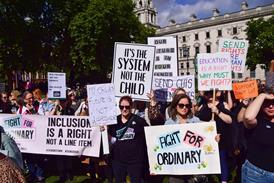
The second was to end indefinite sentences of imprisonment for public protection. IPP sentences have not been available to the courts since 2012, but more than 2,000 prisoners are still serving them. Legislation will be needed to amend or cancel these sentences ‘by the end of this parliament’ – which may not be until 2029.
Burnham might have expected some credit for promising to wipe out ‘the greatest single stain on our criminal justice system’, as it was described in 2020 by Lord Brown of Eaton-under-Heywood, the former Supreme Court justice. But although the prime minister acknowledged the need to protect public safety, he came under fire for a policy that might allow high-risk IPP offenders back on the streets.
That was the line taken by the Telegraph, which had led the calls to exclude killers from early release. The Guardian, by contrast, reported concerns that keeping offenders in prison for longer than planned would leave the prison estate ‘one major incident away from a disaster’.
By the time Alex Norris came to make his statement to parliament on Tuesday evening, he had little new to say. The justice secretary had to sit on the front bench for nearly three-and-a-half hours while Burnham answered 125 questions from MPs about whatever was on their mind; little surprise that Norris then rattled through his statement as if he had a train to catch. His Conservative shadow Nick Timothy replied by reading out a shopping list of questions that Norris was never going to answer.
Timothy began well, claiming that the government was announcing its fifth early-release policy in six weeks. Norris apologised to victims for the uncertainty but said he had been acting in a noble cause. What he could not explain was why a policy it had taken the Labour government two years to devise and implement was being redrawn just as it was about to tackle the prison overcrowding crisis.
‘At every stage,’ the opposition spokesman said, ‘we were told ministers had no choice but to include dangerous criminals because the alternative would be the collapse of the entire system. Now the plan is to stop one group of dangerous criminals leaving prison early by letting a different group of dangerous criminals out instead.’
In reality, very few dangerous IPP prisoners are likely to be let out by the end of next June, by when the prison service will have to find an additional 1,400 prison places. Primary legislation will have to be passed and the government will be taking advice from the former Labour home secretary Lord Blunkett, who came to regret the IPP sentences he introduced in 2005, and the former Conservative justice secretary Sir Robert Buckland, who made no attempt to release prisoners regarded as dangerous while he was in office.
Although it will not be a short-term fix, ministers are right to tackle the IPP problem. ‘There is definitely a challenge,’ said Norris, ‘around support for those who have been in prison for a decade longer than they were sentenced to.’ What he meant was that these prisoners have been driven mad by the uncertainty about when they will be released and whether they will be recalled.
That is why some of them are dangerous. They will need careful support in the community. But the risk of reoffending is one we take every time a prisoner is released.









No comments yet