






















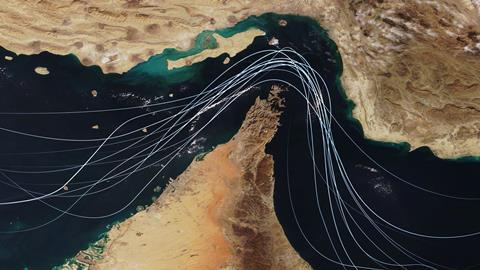
The situation regarding the Strait of Hormuz continues to evolve. Most recently, the Iranian foreign minister proposed a one-week ceasefire whereby if certain conditions were met the strait would be re-opened on the seventh day and talks would restart. But this was rejected by President Trump several days later. The following addresses the key legal implications arising from the crisis, on the facts as they are currently understood, including the legal framework governing the strait, the implications for shipping contracts and other international straits, as well as the latest developments from the US and Iran.


Legal framework
No single state has sovereignty over the whole of the strait: Iran and Oman have sovereignty (and control) over their respective territorial seas. But the strait itself, whilst including Iranian and Omani territorial waters, is an international strait for global navigation and governed by the law of the sea – that is, the UN Convention on the Law of the Sea of 1982 (UNCLOS) which came into force on 14 November 1994. As such, the issue is how sovereignty and transit rights work together rather than who controls the strait.
With respect to UNCLOS, this provides for two regimes: innocent passage and transit passage. Under the narrower regime of innocent passage, a state has greater scope to regulate conduct in its territorial seas because all ships (Article 17) which pass through the strait (Article 18) must be innocent, meaning they do not prejudice the peace, good order or security of the state (Article 19.1); however, states are expressly prohibited from imposing tolls (Article 26.1) and suspending passage (Article 45.2). Under the broader regime of transit passage, states are sovereign over their respective territorial seas (Article 2) and they have the right to regulate passage in respect of navigation and regulation of maritime traffic (Article 42.1), pollution, fishing vessels and customs management; but they are expressly prohibited from suspending or closing the strait (Article 44).
With respect to Iran, it contends the innocent passage regime applies only. This is because Iran has signed but not ratified UNCLOS and on signature made a declaration objecting to the transit passage regime. For these reasons, UNCLOS would only bind Iran if it reflected customary international law but whilst it is generally accepted that the innocent passage regime reflects customary international law, whether the transit passage regime does remains contested. In any event, regardless of the applicable regime, no state is permitted to suspend or close the strait nor impose tolls. This extends to non-littoral states including the US which have the same rights as those who transit through the strait (Article 38) but do not have any sovereign rights over it.
Notwithstanding the above, the fact that the US and Iran have taken opposing positions regarding the strait is unsurprising. Control over and weaponisation of the strait has been an issue traversed previously including during the 'Tanker War' between Iran and Iraq in the 1980s. In this regard, on 29 July 2026 the US Department of State issued the press statement 'Countering Iran’s Exploitation of the Strait of Hormuz' noting, inter alia, that it would 'continue to hold Iran accountable for weaponizing vital international waterways and evading sanctions through shadow fleet operations and deceptive financial schemes…'.
Similarly, in response to the re-opening of the strait under the MOU earlier this year, Iran and Oman issued conflicting statements as to the position regarding control and fees. Indeed, Iran alleged control over the strait and on 13 July 2026 even introduced the bill 'Strategic Action for the Security and Sustainable Progress of the Strait of Hormuz and the Persian Gulf' before the Iranian Parliament. By contrast, the US rejected this and have alleged they have 'total control'. Further, Iran stated its intention to introduce a compulsory transit fee, meanwhile Oman reportedly developed a proposal whereby commercial vessels would pay a voluntary fee to cover navigation services, search and rescue operations and environmental protection. Since then, however, on 26 August 2026 CNN reported that both states have published a joint foreign ministry statement outlining a 'phased framework' to jointly establish a temporary shipping corridor, close the UN authorised southern shipping corridor, and demine the strait. The same day, Sepah News, an Iranian state-run agency, reported that the Islamic Revolutionary Guard Corps had announced the conclusion of a 'revenue-sharing agreement' with Oman. Details of this agreement are yet to be published thus whether this complies with UNCLOS remains to be seen.
Implications for shipping contracts
As a consequential effect of trade resuming through the Strait of Hormuz in part, whether a party is still obligated to perform under a shipping contract depends on the applicable law. Assuming English law applies, then it will depend on whether a party has sought to rely on a contractual force majeure right or the common law doctrine of frustration.
With respect to force majeure, whether a party may, or may not, be able to rely on such a clause is dependent on how this is drafted under the contract in question and what this specifically provides for: (i) whether a party is entitled to cancel the contract (or the contract is automatically cancelled), (ii) whether a party is excused from performance wholly or partially, and/or (iii) whether a party is entitled to suspend performance or extend time. For instance, in ADM Industries Centers Ltd v. Inerco Trade SA [2026] EWHC 1873 (Comm), the court considered the meaning of 'unforeseeable' in the contractual definition of 'Event of Force Majeure' before it. In this case, where there was a qualifying event of force majeure, the contract provided that performance would be suspended during the event; if the event continued after a certain period of time then the contract could be cancelled at the option of the buyer; but if the option was not exercised after a certain period of time the contract would be automatically cancelled.
To the extent force majeure rights have already been exercised, and either (i) or (ii) apply, then a party will be excused from performance under the contract even though the force majeure situation has ended. But to the extent (iii) applies, because the Strait of Hormuz has been closed again a party will not be required to perform because the force majeure situation has re-emerged.
With respect to frustration, a contract will be 'frustrated' if a supervening event not caused by the parties renders the contract impossible to perform such that it transfers the contractual obligations to be performed into something 'radically different'.
To the extent a court finds that there is frustration then this will automatically end the contract and release the parties from further performance. As such, parties whose contracts have already ended in this way will remain so despite performance of their obligations under contract being once again possible. To the extent a court finds there has been no frustration, however, then the contract will not have automatically ended.
The doctrine of frustration was considered recently in GTLK Malta Four Ltd v. Pola Maritime Ltd and Ors [2026] EWHC 2514 (Comm). There the defendant argued that the claimant was in repudiatory breach of their obligations under the charterparty and, further or alternatively, that the charterparty had been frustrated. In particular, the court referred to The Sea Angel [2007] 2 All ER (Comm) 634 which found, inter alia, that to determine if performance is radically different an inquiry must be made into whether there has been 'a break in identity between the contract as provided for and contemplated and its performance in the new circumstances.' Applying this, the court found inter alia that whilst sanctions affected the defendant’s performance of the charter, performance was not radically altered.
Implications for other straits
Following the effective closure of the Strait of Hormuz by the Iranian government, and a series of US blockades of the strait to prevent Iranian vessels from crossing, on 20 July 2026 the Houthis stated that they would impose a blockade on the Bab Al Mandab Strait – this caused further strain to global energy markets. Following closure of the Strait of Hormuz, Saudi Arabia, in an attempt to mitigate the damage caused by the closure, increased the East-West Pipeline’s capacity from 5 to 7 million BPD by converting parallel pipelines that were previously used for natural gas liquids to those that can carry crude oil. This allowed Saudi Arabia to increase its exports through its Red Sea ports from 3 to 5 million BPD, given that the other 2 million BPD are directed to its refineries in Yanbu.
Following the Houthis’ announcement on 20 July 2026, crude oil prices have increased significantly. WTI Crude rose from around $82 per barrel on the day of the announcement to around $99 per barrel on 21 October 2026. In the same period, Brent Crude rose from about $89 per barrel to approximately $110 per barrel. This also meant that Saudi Arabia risked losing access to its primary alternative means of shipping crude oil. It is also worth noting that the present situation remains quite fluid. Yemen’s Presidential Leadership Council claimed that it recaptured the Mokha and that it took back control of the Bab Al Mandab Strait.
The regional conflict leading to the closure of the Strait of Hormuz and tensions surrounding the Bab Al Mandab Strait have seemingly resulted in similar risks spreading to other parts of the world. Indeed, on 22 April 2026, Indonesia’s minister of finance, Purbaya Yudhi Sadewa, stated 'We sit along a key global trade and energy route, yet ships passing through the Malacca Strait are not charged' and that he does not 'know if that’s right or wrong.' The minister proceeded to suggest that any tolls imposed would be shared equally between Indonesia, Malaysia and Singapore (which all border the Strait of Malacca). Both Malaysia and Singapore swiftly voiced their opposition to this with Malaysia’s foreign minister stating 'there are no unilateral decisions' meanwhile Singapore’s foreign minister stated 'we will not participate in any attempt to close or to interdict or to impose tolls of traffic'. This led to Indonesia’s foreign minister rebuking the State’s finance minister for his comments. This is not the first time Indonesia, or Indonesian public officials have made such comments regarding the Strait of Malacca and other straits, however. The State’s geography means it has control over other straits, namely Sunda and Makassar. In the early 2000’s, Indonesia proposed a charge for having commercial vessels escorted through the straits it controls when piracy was an issue. Both Malaysia and Singapore rejected that proposal.
It is worth noting that, unlike Iran, Indonesia ratified UNCLOS in 2000. In doing so, it included a declaration/reservation that it did not accept 'any procedures provided for in Part XV, section 2 of UNCLOS with respect to disputes concerning the interpretation or application of Articles 15, 74 and 83 relating to sea boundary delimitations, or those involving historic bays or titles…' This means that it is bound by the broader transit passage regime established under Articles 37-44 of UNCLOS (explained further above). Further, it must be highlighted that closing the Strait of Malacca, or imposing a toll, would have significant ramifications for international trade and energy markets with Indonesian president Prabowo Subianto himself remarking during a televised briefing in Jakarta earlier this year that the number of vessel transits through the Strait of Malacca equates to around 70% of East Asia’s energy needs and trade.
Latest developments from the US and Iran
Following the breakdown of the MOU between the US and Iran, the Iranian government again proceeded to close off the Strait of Hormuz. In this regard, Iranian state media notably reported the comments of parliament speaker, Mohammad Baqer Qalibaf, earlier this month that 'the position of the Islamic Republic of Iran is completely clear and firm, and the Strait of Hormuz will not be opened until our seven conditions, based on the Islamabad Memorandum of Understanding, are met.'
The ongoing efforts on the part of the State of Qatar, the Sultanate of Oman, the Swiss Federation and other states, to help facilitate a lasting peace agreement between the sides have run into another obstacle, however. Iran has, again, insisted that uranium enrichment is a right guaranteed under the Non-Proliferation Treaty meanwhile President Trump has insisted that Iran is to comply with his zero-policy stance as to uranium enrichment.
The MOU stated that the issue of Iran’s enriched uranium stockpile was to be left to future negotiations but seemed to set out the minimum approach to be undertaken by the Iranians, which is to mix highly enriched uranium with lower-enriched material (a process known as 'downblending') under the supervision of the International Atomic Energy Agency.
Despite the above, it would seem that shipping companies have found alternatives to the contested chokepoint. The Financial Times recently reported that according to data from Kpler in the week ending 18 October 2026 shipments from Gulf oil producers excluding Iran averaged 24.6 million barrels a day, higher than the 23.3 million prewar average. This is notwithstanding the recent uptick in attacks on commercial vessels in the month of October – 28 compared to 18 in September. Shipments through the strait itself, however, are still a third lower than prewar levels.
Concluding observations
The actions taken by the USA and Israel against Iran since March 2026 have exposed serious disputes as to rights and obligations in respect of passage through the Strait of Hormuz. Those in turn have created serious disruption in the supply of oil, gas and derivatives.
The legal consequences that flow are likely to be significant.
Grace Webster, senior associate, and Mohammed Al Ahmadani, associate, McNair International








No comments yet