
















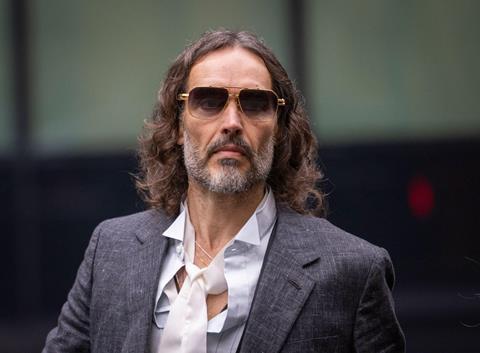
Russell Brand is beginning his prison sentence after a jury found him guilty of one count of rape and three counts of sexual assault. While the jury has reached its verdict and the criminal trial has now concluded, it is unlikely to be the end of the story. New allegations are still coming to light and survivors can potentially bring civil compensation claims.

Although criminal proceedings can punish a perpetrator, they do not provide a survivor of sexual abuse with anything tangible to help repair the damage done to them. A civil claim can help a survivor to rebuild their lives by obtaining financial compensation for physical or psychiatric injuries, as well as special damages such as therapy costs or lost earnings.
If any of the complainants in Brand’s trial were to bring civil claims, they would still need to prove to a civil court that the assaults happened. For those against whom Brand has been found guilty, the convictions can be relied upon under s.11 Civil Evidence Act 1968. This provision allows for the admissibility of criminal convictions as evidence in civil proceedings, following which there is a presumption that the person committed the relevant offence. The burden is then on the convicted party to prove that he did not commit it; this is naturally a high bar to reach, and it is extremely rare for defendants to even attempt it.
Where Brand was found not guilty, it is still possible that the relevant complainants could successfully prove the assaults in a civil court, where there is a lower standard of proof. The fact that Brand was charged with the offences is highly relevant.
Under the Full Code Test, to press charges the CPS must consider there is a realistic prospect of conviction; put another way (for offences in the Crown Court), it is more likely than not that a jury will convict the defendant of the relevant charge. This closely mirrors the balance of probabilities assessment that a civil judge will carry out. Indeed it is arguably a slightly higher threshold as a prosecutor must consider what a jury will decide; as criminal practitioners will be aware, statistically juries are slightly more likely to acquit than a magistrate sitting alone.
The evidence in support of such charges, as well as the fact Brand was found guilty of other similar crimes, would all be relevant to a civil judge’s assessment on the balance of probabilities. Of course each claim would require individual assessment and consideration given to the evidence ventilated by both parties at the criminal trial. But at Bolt Burdon Kemp we have successfully brought civil claims on behalf of survivors of abuse where the perpetrators were charged with crimes but ultimately not convicted.
Of course even where the evidential position is not in question, a key issue when contemplating a civil claim is whether the defendant has sufficient assets to pay compensation and costs.
Some media reports place Russell Brand’s net worth at £15m, but there are questions over his dispersal of assets; it has been reported, for example, that he recently transferred his home into his wife’s name. It is likely that a judge would take a dim view of attempts by any defendant to wilfully hide assets ahead of potential civil claims, and there are legal powers available, including freezing orders or remedies under the Insolvency Act, to recover money owed to claimants. Survivors already face barriers in coming forward, and it would drastically undermine our justice system if an abuser could simply hide their assets to avoid paying compensation. That said, the sheer number of potential claimants could raise questions as to the sufficiency of available assets.
It is also possible that certain media outlets could find themselves in the frame. Brand was convicted of sexually assaulting a woman at the Choice FM studios in 2004 and of another sexual assault whilst working on a Channel 4 project in 2009. The relevant organisations could see claims against them, including in negligence or vicarious liability. For the latter, consideration would need to be given to Brand’s employment status and whether there was a close connection between the assaults and his role, pursuant to the two stage test set out in Mohamud v WM Morrison Supermarkets plc [2016] UKSC 11 and other caselaw.
Of course, none of this would be possible without the tremendous bravery and determination shown by the survivors who came forward. It is only right that they, and others who may still be yet to come forward, obtain some redress for the harm done to them. So although the recent criminal trial has concluded, the process of holding Russell Brand accountable is far from over.
Hayley Chapman-Todd is an associate in the abuse claims team at Bolt Burdon Kemp