
























If we were applying management-speak to the last year of the Solicitors Regulation Authority, we might say it has been on a journey.
In reality, recent months and years have been a bit of a nightmare.
The SRA has been heavily criticised (albeit relatively unpunished) for its mistakes the build-up to the closure of SSB Law. Another sudden collapse, this time the law firm network PM Law, appeared to go below its radar altogether. High-profile cases have been lost at the tribunal, which has started to increase costs orders against the regulator for poorly managed prosecutions. Chief executive Paul Philip left with the organisation seemingly ineffective, discredited and listless.
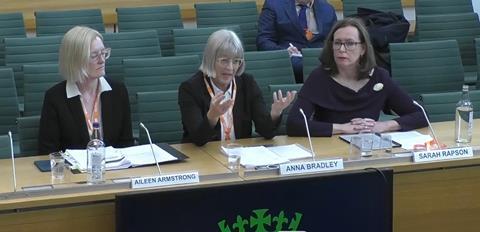
So it was that leaders were summoned to appear before the justice select committee on Tuesday. It was hardly the grilling they might have feared – just five members of the committee bothered to show up. Yet there were plenty of talking points and new lines as both organisations sought to – management speak again – ‘move forward’.
1) The SRA is really sorry now
In stark contrast to the bluster of the Axiom Ince response, when the SRA pointedly refused to apologise for anything, there is no shortage of expressions of regret now. SRA chair Anna Bradley, who batted away calls for her to resign, admitted that events of the past two years or so have identified ‘significant flaws in the way that we regulate’. She said the organisation had ‘failed to join the dots’ to spot the signs that something was amiss at firms which have collapsed. It might not seem like a huge revelation, but the tone – particularly since Sarah Rapson took over as chief executive last November – has noticeably changed from one of stubborn defensiveness to one of contrition.
2) Sorry, but not personally accountable
That said, there is still a whiff of denial at the top table. At one stage, committee chair Andy Slaughter listed the failings of the SRA and said it was ‘not a very good record, frankly’. As a relatively new arrival, he absolved Rapson of blame but asked Bradley directly whether she took responsibility as someone who had been in place since 2019.
Her response was telling: ‘I think we absolutely accept responsibility for the fact that these events have happened in the way that they have and that they have showed us to be wanting. I think the really important thing for us as an organisation is to make sure that we have identified the learnings and that we are acting on them as soon as possible.’
Slaughter had pointedly asked Bradley whether she individually should take responsibility. Her response, referring to the wider team, suggests she does not.
3. Rapson the reformer is pushing at an open door
Rapson said it was important to not be defensive and to own what has gone wrong. ‘We know we are not the regulator we need to be for this really important sector’.
She is diplomatic and has always been careful not to directly criticise her predecessor, but it is fairly clear that she has assessed the organisation as being in dire need of corrective surgery.
‘Our teams of 800 or 900 people are ready for change,’ she told the committee. ‘I have been in organisations where it is ”oh no, not more change” or ”can we change it by having no more change for now”, but that is not my experience of this organisation. We have a leadership team and a board [and] people across the organisation who are really up for changing this regulator. They are also out and about talking to solicitors, hearing what solicitors might be saying about their regulator and sometimes it is quite uncomfortable listening. There is an opportunity to make this the modern, effective regulator we all want it to be.’
4. Ethics are high on the priority list
Executive director Aileen Armstrong revealed that the SRA will soon publish a consultation on continuing competence. One of the proposals will be to mandate participation in an annual discussion around ethics, to build on existing requirements about ongoing training. A return to CPD points is unlikely, but the SRA will want to see meaningful ethics training across the profession.
5. The regulatory framework is not working
Bradley said there was ‘no question’ that the current system is causing everyone difficulties and it was not clear to consumers where they should go to complain and who is responsible for which areas.
‘We think it causes all sorts of issues about accountability and confusion for us as a regulator,’ she said. ‘There is no question that if you sat down with a blank sheet of paper this is not what you would design. The question has to be for policymakers: is it time to have another think? If there is an appetite for that we would be happy to engage.’
Bradley said her own view was that it was time to review the Legal Services Act, reducing the numbers of regulators and clarifying their roles. She has previously proselytised in favour of a single regulator.
6. The SRA will try to offer more help post-Mazur, but can’t hand-hold
Rapson admitted there had been mistaken advice issued in relation to Mazur but said the overriding guidance coming from the organisation on the importance of effective supervision had been constant throughout.
‘I think we can do more to help people understand what it means to be effectively supervised or what does an effective supervisory regime need to be, because it is clearly not clear for people.
‘But what can’t do for people as a regulator is prescribe in every single situation ”this is how it needs to be”.’
She has asked her team to produce case studies that will help firms decide whether their set-up is lawful.
7. There is nothing to fear from AI-led firms
Leaders of the Legal Services Board said earlier in the same session it had been ‘fantastic’ that Garfield Law, a debt recovery specialist providing services through AI, had entered the market.
The topic of AI-led firms came up again during the SRA questions and Armstrong brought up Garfield Law as an illustration of the approach taken by the regulator to innovation and new technology.
She said: ‘In terms of how we approached [Garfield Law], we focused our approach really keeping in the front of our mind the outcomes and safeguards that we need for consumers and we worked closely with the owners of that firm to really understand what protections would be in place and we verified that the technology they would be using wasn’t autonomous and there was a solicitor in the loop.’













5 Readers' comments