























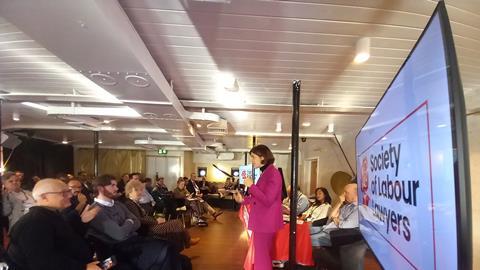
You would have forgiven the lawyer members of the Labour party a touch of resentment as prime minister Andy Burnham set out his plans to overhaul social care.
Few would disagree that the care sector needs reform and investment, but with Burnham prepared to risk his political future by ditching the triple lock pension guarantee to pay for it, lawyers might wonder why the same zeal does not apply to justice issues.
For 14 years, campaigners from the legal wing of the party fought to highlight the shortcomings of an underfunded justice system. But although their team is in power, it felt to some at this week’s party conference in Liverpool as though justice is forever destined to be the bridesmaid.
There is no shortage of desire to improve the system. Justice minister Sarah Sackman even revealed at one fringe event that she had been worried by the possibility of being moved elsewhere in Burnham’s reshuffle. A far cry from the days when the justice gig was seen as either a booby prize or a stepping stone – and Sackman’s two years in the role already represents a relatively marathon stint.
But even Sackman – while stressing the extra money Labour has committed to criminal and housing legal aid – had to admit to delegates there is no more to go around. ‘I would be lying if I said there is a whole lot more money to spend. I have got to be honest. You heard the [chancellor of the exchequer] John Healey speech earlier and we are not awash with money – the fiscal situation is tight.’
Sackman did however voice her backing for the development of a national justice system based on the NHS principle that early treatment of problems saves on high spending further down the line.
She added: ‘Law centres are a fraction of what we spend on legal aid. I am not quite sure why legal support and legal aid is not part of a national legal service. Do we need to think about how we intervene earlier? Can we think about how we get people advice earlier in the hope that some of those problems can be resolved at an early stage?’
Labour has plenty of justice policies that do not require huge sums of money – and indeed the controversial Interest on Lawyers’ Client Accounts Scheme is intended to top up the coffers. The scheme was endorsed by Sackman at one fringe event and appears likely to be introduced – not least because the Ministry of Justice recently advertised for two people to lead it.
However, justice secretary Alex Norris’s 12-minute address failed to set out any new policies, leaving lawyers uncertain whether the government intends to go ahead with the jury trial reforms introduced by his predecessor David Lammy.
Norris paid tribute to Lammy for having ‘set in motion the major reforms we needed’. But in various media engagements, he appeared to be distancing himself from the jury proposals. The Politico website reported that Norris had confirmed in a yet-to-be-aired podcast that he would scrap the plans and bring in a new bill.
Justice minister Jake Richards will have known his thoughts on the future of Britain’s membership of the European Convention on Human Rights would be closely watched (the crowds spilling out the back of the packed room were an obvious marker). So he chose his words carefully, taking care to draw dividing lines with the Conservatives and Reform UK – both committed to leaving – but trying not to alienate Labour voters unhappy with the convention and in particular its implications for immigration.
Richards said Labour was ‘absolutely committed’ to the ECHR but not necessarily to its current incarnation. ‘I am very proud the UK government is playing its part in making sure that [reform of the ECHR] is a constructive process,’ he said. ‘That is the only way you get a policy that works, that is consistent with our obligations and which begins to try and win the public argument.
‘Leaving the ECHR is not going to help us tackle the small boats crisis one jot, and anyone who says otherwise would be lying. It is important we make this argument. The Labour party cannot be in a position where we simply defend what has happened before. We have to embrace realpolitik and what is happening across Europe.’
That was a rare moment of clarity at a conference where delegates heard little about how Labour will improve the justice system. The only certainty was that there is scant money to do it.





No comments yet