























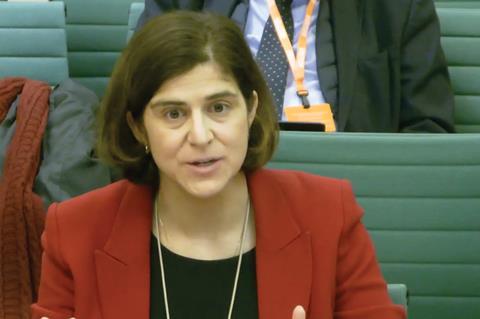
Courts minister Sarah Sackman took a buffeting from the Commons justice committee over seemingly contradictory messages on jury trial curbs. MPs want to see the modelling
Reforms to restrict the right to a jury trial were only announced at the start of December, but the government appears to have tied itself in knots over the practicalities of its plan to bring down the Crown court backlog.
Declaring a ‘crisis’ on 2 December, justice secretary David Lammy said his proposed measures were ‘necessary to tackle the emergency in our courts’. A month later, courts minister Sarah Sackman told the House of Commons that jury trials would still be curbed even if the criminal courts were not in crisis.
When Lammy appeared before the Commons justice select committee just before Christmas, committee member Dr Neil Shastri-Hurst noted that there were currently 17,500 prisoners on remand. He asked the justice secretary if the reforms would apply retrospectively. ‘No,’ Lammy replied.
No? Sackman told the committee this week that the changes would be applied to eligible cases where the trial has not commenced in the Crown court but are already in the system. When Lammy’s comments were put to the minister, Sackman said his response was in the context of remand hearings.
Committee member Sir Ashley Fox pointed out that if a defendant has been committed to trial in the Crown court, they will be expecting a jury trial. ‘What you’re telling me is, once these changes take effect, you will divert those people committed but trial not started into the swift court. That is not what the lord chancellor said before Christmas. Most people would regard that as a retrospective change,’ Fox said.
Sackman replied: ‘It’s a change in relation to the procedure that applies to those cases. They’re still getting a Crown court trial under the new proposals.’
'We take a big dataset, looking at all the individual cases in the Crown court, pooled from 2018 to 2024. It’s individual-level data and it’s got a lot of detail in there'
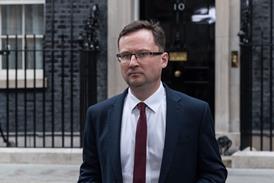
Chris Drane, Ministry of Justice
Critics remain unimpressed. Is there anything the government can do to placate them until the proposed legislation emerges? Yes – it could publish the modelling. Despite repeated requests, MPs have been told they will have to wait until the bill is published this spring.
However, Chris Drane, the Ministry of Justice’s director of analysis, shared a few details with the committee this week. Drane explained that the exercise comprised specific court simulation and dynamic whole system impact modelling.
The specific court simulation modelling helps officials to understand what a new policy regime will mean for Crown court workload.
‘To model that, we take a big dataset, looking at all the individual cases in the Crown court, pooled from 2018 to 2024. It’s individual-level data and it’s got a lot of detail in there – details on the offences associated with each case, the pleas involved, custody status, hearing time,’ Drane said.
Analysts then simulate proposed policies for the dataset. ‘For example, you take the 2024 receipts cohort and you would apply to that what new rules around magistrates’ sentencing powers might imply in terms of cases not reaching the Crown court. Or for the Crown Court District Bench Division, you would identify the cases that would likely go down that route and apply the assumption around how much quicker they would go through court,’ Drane said.
‘What that gives you in terms of outputs is effectively a measure within the Crown court of how individual policies or combinations of policies reduce the number of sitting days required in the Crown court. We adjust that data for the future and for what we think the world will look like in 2028/29.’
The whole system impact, Drane explained, builds on well-established models that, for instance, form the basis of the ministry’s prison population projections. ‘These are essentially whole system models that look at flows through the system, from courts to prisons to probation.’
Outputs from the specific court modelling are fed into the bigger modelling infrastructure. ‘The sort of outputs that will come out from that is, we have a view on the impact of various reforms, on the workload in the magistrates’ and Crown courts, in terms of numbers of sitting days they’re likely to save. But we also have a view of caseloads, what that would mean for how Crown court outstanding caseload is likely to evolve but crucially what it would also mean for the prison population, what it would mean for probation caseloads as well,’ Drane said.
On calls to see specific data in the modelling, courts and victims director Amy Randall said officials were happy to arrange a further discussion if MPs still had questions once they see the impact assessment – an invitation some MPs will undoubtedly take up.
This article is now closed for comment.













2 Readers' comments