






















1. Imperialism is back
First, to global geopolitics. Following Donald Trump’s (illegal?) Venezuela coup, is Greenland next? The International Bar Association’s latest annual issues agenda, published last week, elevates the promotion and defence of the rule of law above artificial intelligence as the most pressing concern facing lawyers globally. ‘The rule of law can no longer be assumed to be secure, even in jurisdictions that have traditionally led by example,’ says Jaime Carey, senior partner of Chile’s largest law firm. How timely of him. Carey’s message rings true here too, of course, as populist politicians continue to make convenient scapegoats of practising lawyers and judges. Paul Rogerson

2. Tops for Trump
Staying stateside, nine US law firms that feared being the subject of a presidential executive order last year cut a deal with the White House. They promised that $40m-$125m worth of pro bono work would be completed for causes of which the president approved. This caused problems for their international offices, especially in Europe. Ideas for pro bono cases included acting for police accused of racist violence. But as we hit the first anniversary of those deals, has any work been done? If it has, it changes the culture of these firms, and there will be a further reputational price to pay. If they haven’t done the pro bono, we’ll all be asking: what was the capitulation all about? Eduardo Reyes
3. Juries are out
Back on this side of the Atlantic, the rule of law is being seriously stress-tested by proposed curbs on jury trials recommended by former Queen’s Bench Division president Sir Brian Leveson. The Crown court backlog hit a record 79,616 last autumn, but David Lammy has rebuffed calls for a ‘sunset clause’ in forthcoming legislation. The lord chancellor will face an uphill struggle trying to get this through parliament unscathed. MPs have demanded to see the impact assessment. Lammy will also need to consult the legal profession, which has resoundingly rejected the plans. Part two of Leveson’s review, which explores court efficiency, is currently in the works. Monidipa Fouzder
4. SLAPP unhappy
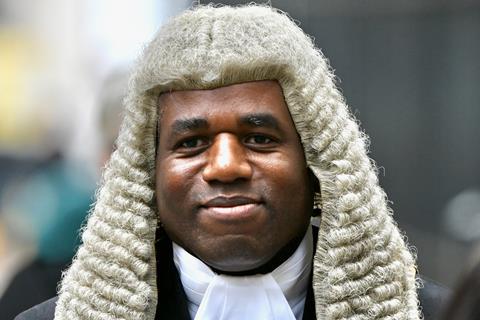
Other legislation appears to be looming which is of more than tangential interest to lawyers. The failure of high-profile regulatory moves to combat alleged strategic litigation against public participation has led to louder calls for the creation of a standalone anti-SLAPP law. ‘We’ll protect the people who shine a light on corruption in the first place, the journalists and activists who shield the public’s right to know,’ David Lammy pledged at last month’s launch of the government’s anti-corruption strategy. The Ministry of Justice told journalists that the first priority would be to enact the limited provisions in the Economic Crime and Corporate Transparency Act 2023, which tackle SLAPPs relating to economic crimes. John Hyde,PR
5. PACCAR poleaxed?
In the costs sphere, meanwhile, the government has pledged to introduce legislation to reverse the Supreme Court decision in PACCAR. This is a ‘welcome step in restoring certainty to the litigation funding market and reopening routes to justice that have effectively been closed for many claimants’, noted former Law Society president David Greene, head of commercial disputes and class actions at Edwin Coe. There is no date for a bill, however, so litigation funders face another anxious wait. A wider response to last May’s Civil Justice Council report on costs is also likely in 2026. The report’s headline recommendation was that costs budgeting and costs management should be mandatory for all funded collective proceedings, representative actions and group actions. JH, PR
6. Third way
Third-party funders are also awaiting clarification on whether they will face formal regulation. The European Union recently signalled that it plans no further action on this front, so funders are hopeful that the ‘light-touch’ approach recommended by the Civil Justice Council will be adopted in this country. PR
7. Will the cap fit?
The Ministry of Justice will report on its post-implementation review of the whiplash reforms introduced in May 2021. This may look at the compensation paid for other injuries and the current small claims limit. Ministers will also be under pressure to look at clinical negligence costs, after concerns were raised by public spending watchdog the National Audit Office. Expect more discussion about a possible costs cap for lower-value claims and reconsideration of damages based on private care costs. JH
8. Rate for the job
Staying ‘on the money’, legal aid solicitors specialising in housing and immigration work benefited from the first increase in civil legal aid fees for 30 years just before Christmas. The Ministry of Justice will now come under renewed pressure to raise fees for other categories of civil legal aid, such as family, community care, mental health, discrimination and education. A mental health solicitor had to return to Ghana last summer because her salary was not enough to stay in the UK as a ‘skilled worker’. A report published by the Bar Council on family legal aid, meanwhile, revealed that an experienced barrister took home £7 an hour – less than the minimum wage – for a piece of work that took 15 hours. MF
9. Mazur blues
Back in the courts, the outcome of CILEX’s appeal against the seismic Mazur judgment will be a pivotal moment in 2026, as the Court of Appeal attempts to offer much-needed clarity over litigation rights. The hearing, fast-forwarded to 24 February, will be closely watched by all sections of the legal profession. Mazur would certainly be number one on this list were law firm management the principal criterion for inclusion. As CM Murray, a law firm which advises other law firms, noted: ‘In the interim, there will continue to be fallout, with firms potentially having to resource teams differently and adjust their fee structures, recognising that this could all be for nothing if the decision is overturned. There is also likely to be a continuing flurry of costs disputes.’ JH, PR
10. In the post
In terms of its long-term impact on how solicitors go about their work, the second part of the Post Office Inquiry report is probably right up there with the Mazur appeal. Expected in the second half of the year, the report will inevitably critique the role of lawyers who have advised the organisation during the last 25 years and – depending on what chair Sir Wyn Williams reports – could open the way for disciplinary action by legal regulators. More broadly, its impact on legal ethics – and training – may be profound. JH, PR
11. Hot property
Home buying and selling is a perennial political football, perhaps because purchasing property is, for most of us, our biggest financial outlay. This year, the Ministry of Housing, Communities and Local Government will decide whether conveyancers should be forced to publish their track record on performance, as part of reforms that could also see the return in all but name of home information packs. Sellers could also be required to provide upfront information that goes beyond the ‘material information’ that must be included in property listings. Expect more shouting from the rooftops. MF
12. Counsel for councils
The Association of Monitoring Officers, set up by Lawyers in Local Government, will open its helpline this month. The professional body has been set up by LLG to give monitoring officers – a post usually held by solicitors – a ‘safe space’ to grapple with the growing complexity of their role. The association will also start work on best practice guidance on issues identified by council lawyers at LLG’s recent governance conference. MF
13. Double jeopardy
Regulation of legal services could fill this space on its own, so we’ll stick to the standout developments. Mazur is pre-eminent, but other key changes include the Financial Conduct Authority becoming the single professional services supervisor for anti-money laundering and counter-terrorism financing, stripping the Solicitors Regulation Authority of its current role. How AML oversight will change remains unclear, but the red tape burden looks certain to increase. The recent FCA consultation flags an element of dual regulation and a further set of practising fees. PR
14. Unhappy customers
Another indication that regulation is not going to get any cheaper is the Legal Ombudsman’s bid for a 12.1% budget increase to fund a reorganisation that will tackle a mounting client complaints backlog. The Law Society opposes the increase. LeO will come under intense pressure to improve if it does get the extra money. JH
15. Computer says...what exactly?
And so to technology. We can expect more consolidation of an overcrowded lawtech market – some 295 such businesses were identified last year – particularly as investors look for returns. The government-funded programme tracking this activity, LawtechUK, is set to wind up on 31 March. What, if anything, will succeed LawtechUK is uncertain. Michael Cross
16. Getting an Uber?
Law firms will also be taking an increasingly hard look at the returns they are getting from hefty investments in artificial intelligence over the past couple of years. Legal information giant Thomson Reuters – which has several horses in this race – says that lawyers expect their use of AI to free up about 140 working hours over 2026. For UK law firms, this equates to productivity savings of about £12,000 per lawyer. However, the history of technology suggests that the big gains will not be achieved by existing firms tweaking their operations with AI but by entirely new business models. The arrival of an Amazon or Uber of legal services has long been predicted; 2026 could be the year it happens. MC

17. Online procedure
In a related activity, we can expect more progress towards the ecosystem of online dispute resolution services long promoted by the master of the rolls. Consultation on the new rules for court-based online legal proceedings provided by HM Courts & Tribunals Service in civil, family and tribunal proceedings closes on 15 January. The draft rules include a provision that ‘the digital service providing the platforms for online proceedings must be designed and maintained so as to be usable by all’. MC
18. PE lessons
Transatlantic mergers were à la mode for the City’s self-styled elite in 2025, but what about further down the scale? Private equity has made well-publicised incursions into the law, but its impact ought not to be overstated. ‘Of more than 160 law firm transactions completed last year, only around 14 involved private equity, underlining how limited its overall penetration remains,’ stresses law firm M&A specialist Jeff Zindani. ‘Much of that activity was concentrated in consumer-facing areas of the market, where scale, repeatable revenues and operational leverage are more attractive to external investors.’
Looking ahead, Zindani expects a small number of larger mid-market firms to continue to attract private equity interest, ‘particularly those with strong leadership, clear growth strategies and the infrastructure to support external capital’. But he cautions: ‘For the majority of firms, consolidation is likely to remain grounded and pragmatic. Traditional mergers – driven by succession planning, cultural alignment and long-term stability – will continue to shape the market. As a result, 2026 is more likely to reflect steady, measured consolidation than a fundamental shift towards private equity-led transformation.’ PR
19. Annus horribilis
The Solicitors Regulation Authority endured (another?) year to forget in 2025. The regulator was heavily criticised in a report on its handling of SSB Law and sanctioned for its failures over Axiom Ince. No one resigned. Chief executive Paul Philip did, however, retire after 11 years in the role to be replaced by ex-Whitehall high-flier Sarah Rapson (pictured).

Rapson has largely maintained a watching brief since her November installation, although it is understood she has been busy meeting key stakeholders behind the scenes. After a year in which the SRA appeared to lose the confidence of so many solicitors, she attempted to reset the relationship in her first substantive statement, issued before Christmas, saying she wanted to work ‘openly and collaboratively’ with the legal sector. She added that her priority will be the ‘outcomes that matter’ – protecting the public and helping the sector to thrive – and ‘getting the basics right, making good decisions in a timely way’.
The new CEO has a lot on her plate, so it is probably helpful that the regulator has ‘parked’ the issue of whether solicitors should continue to hold client money. In its second consumer protection consultation, open until 20 February, the SRA deferred this issue while making clear that it is still on its longer-term agenda. Perhaps it got wind of the government’s controversial plans for client interest.
In the meantime, the second consultation does propose measures to strengthen SRA oversight and internal controls. These include resurrecting the requirement for firms to submit all accountants’ reports (dropped in 2014); enhancing the regulator’s oversight of firms that change their profile significantly through sales, mergers or acquisitions; and restricting key law firm decision-makers from occupying both the COLP and COFA compliance roles. JH, PR
20. Get Involved
And finally. If you still have time left over after grappling with all of the above, do consider engaging more with your professional body. The Law Society’s flagship membership campaign for 2026 is Get Involved, a flexible and accessible volunteering programme. You might be invited to join a working group on a recent policy change, or to respond to surveys on a practice-specific area. ‘Being part of the Law Society’s work has been incredibly enriching and rewarding, and has positively shaped how I encourage volunteering among peers and aspiring solicitors,’ says Dr Omar Madhloom, solicitor and director of the Legal Clinic at the University of Southampton. Help shape how you work by networking with your peers. More details can be found here.
This article is now closed for comment.





8 Readers' comments