

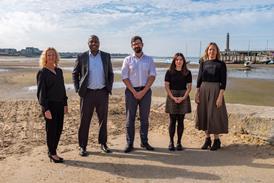






















Co-founders of coaching platform BlueSky
I meet Hannah Bradshaw and Sarah Lyons, co-founders of coaching platform BlueSky, for the first time at a restaurant in central London. They have just unveiled the findings of their latest research on women in law, entitled Empowering and connecting women in law to take charge of their careers.
In the report, for which 285 fee-earners were surveyed, 78% said they experienced a ‘motherhood penalty’ – a perceived impact of maternity leave on confidence, visibility, access to work and overall career momentum.
The report says: ‘For many women, the motherhood penalty develops gradually in the months after return, when expectations may be high but visibility, confidence and access to career-enhancing work have not yet fully re-established. Our data shows that this period can also be marked by reduced sponsorship, fewer informal career conversations and slower reintegration into client and matter teams.’
The report also highlights the difference that BlueSky has made, with all respondents saying the coaching platform helped minimise the impact of maternity leave on their careers.
Following the event, I was able to grab a few minutes with Hannah and Sarah individually, wanting to know about their journey from solicitors to executive coaches.
Hannah used to work for a US law firm. She went on maternity leave, returned and felt like she was starting from scratch again. When she couldn’t find a coach, she decided to become one. Following her second maternity leave, she took up the role full-time.
She had to do 100 hours of coaching to become accredited, which she achieved by the time of her second maternity leave. But despite quitting the law, she stayed close to it, joining a coaching provider that worked with law firms.

When Sarah returned to private practice after her first child, she was struck by how different the landscape looked. ‘People said “I can see you becoming a partner here”. But after maternity leave, no one was saying that to me anymore.’
After quitting the law, Sarah moved to Cambridge and started working at Judge Business School, which ran a leadership and development programme for professional services firms. Here, she saw how coaching could be transformative.
Hannah describes the law as a ‘really weird, unique system’, adding: ‘One of the main challenges I see is a PQE-led system which keeps running even when women go on maternity leave. If you’ve got two children, you’re out for three years. They do not really have a line manager… We see how more efficient women are when they come back from maternity leave, but that’s not rewarded by law firms. You’re 20% more efficient but billing 20% less. Coaching by someone who doesn’t understand that can really fall flat.’
Asked about the progress made by law firms to support women, Hannah says a growing number are becoming partners, but asks how many women are appointed equity partner with a stake in the firm, as opposed to salaried partners.
Both Hannah and Sarah specialised in employment law during their legal careers.
Sarah’s father was a trade union leader. ‘I like stories with real people. I like understanding the culture of organisations and how easily things go wrong and organisations that try hard to get things right,’ she adds.
Hannah initially fought hard not to become a lawyer as she came from a family of lawyers – parents, brother, grandfather. But in her last year at university, which fell in the middle of the financial crisis, she couldn’t think of any other job options. ‘I definitely didn’t enjoy studying law, but I enjoyed the human element of employment law. What I love about coaching and running BlueSky is that every day is different.’













No comments yet