























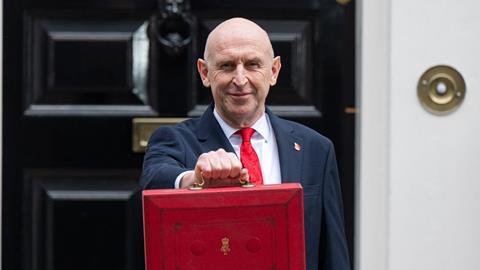
Chancellor John Healey's 'breathing space' budget today resisted the temptation to raid lawyers' client accounts. However his pledge to raise revenue 'from those who can afford to pay' suggests that the interest on lawyers' client account (ILCA) scheme - opposed across the legal profession - remains on the agenda.
Law Society president Brett Dixon commented: 'Although it is positive that the UK government has listened to the Law Society and steered clear of bringing in new taxation on LLPs, it must now take Interest on lawyers’ client accounts off the table once and for all to give the legal sector the certainty it needs.'
Healey's speech, which included a promise of 'radical rewiring of the state' made no mention of the justice or courts system among essential public services.
Treasury figures on day-to-day (RDEL) spending by unprotected government departments for the next four years predictably reveal that spending will continue to be reined in at the Ministry of Justice.
Day-to-day justice spending will rise from £12.7bn in 2026-7 to £12.8bn in 2027-8 and £13bn in 2028-9. The numbers have been adjusted downwards to reflect ‘lower employer pensions contributions resulting from 2024 public service pensions valuation, with a view to ensuring that departments are no worse or better off’.
MoJ capital spending is forecast to be £2.3bn in 2026-7, 2027-8 and 2028-9, as the government expands prison capacity, before falling back to £1.9bn in 2029-30.
Spending by the law officers’ departments is expected to be £1.1bn in each of the next three years.
Moreover, these figures could be subject to significant upward pressure. The Office for Budget Responsibility’s latest economic and fiscal outlook – the fiscal watchdog’s assessment of the budget - includes prisons and the wider justice system among specific areas of spending where cost pressures could be significantly higher than expected.
'The government’s response to capacity pressures on prisons through the early prisoner release scheme could increase costs in probation services given existing staffing shortages estimated at 3,150 sentence management staff in 2026-27 mean the marginal cost of expanding these services will be high,' says the OBR. 'There are additional pressures in courts with Crown case backlogs standing at around 80,000 and open tribunal cases reaching the highest level since 2012-13 at 860,000.'
The sole mention of a justice policy in the Budget 'red book' is the previously announced decision to expand access to Justice Transcribe, the AI-enabled transcription tool, to all probation officers. The budget also promises a funding uplift for law enforcement activity under the Violence Against Women and Girls Strategy.
Meanwhile, in its efforts to cut red tape, the government has identified up to an estimated £640m a year of administrative savings for business. These include up to £290m a year from ongoing reforms to create a more proportionate company reporting framework; and an estimated £116m a year through delivering the Ministry of Housing, Communities and Local Government’s Home Buying and Selling Road Map.
Unveiled in June under Keir Starmer’s government, the Road Map incorporates sales packs with upfront information, binding agreements and a code of practice for estate agents, in order to cut delays and stop sales falling through.
Meanwhile the Treasury opened a consultation seeking views on the detailed design of the high value council tax surcharge, a new charge on owners of residential properties in England worth £2 million or more in 2026. It will take effect in April 2028.
On tax avoidance, the government is to publish an ‘intermediation roadmap' in spring 2027. It will include measures to help taxpayers choose advisers, support advisers to help their clients get expenses right, and strengthen standards for tax software providers, the budget document states. ‘The roadmap will also help HMRC identify emerging risks and tackle harmful intermediary activity, including through a clear route for reporting harmful activity to HMRC, and set out an approach to tackling tax misinformation and incorrect tax advice online.’
Legislation in the Finance Bill 2026-27 will 'amend the Promoters of Tax Avoidance Schemes legislation to ensure that the regime works more effectively and will make a typographical amendment to the legal professionals legislation.'
Other Budget announcements included a 'founders relief' 10% rate on capital gains tax, a £700 million investment in AI safety and security, a 'new deal for data centres' and removing biodiversity requirements from developments on brownfield sites.
Michael Carter, partner and head of incentives at international firm Osborne Clarke, said the new founders relief 'appears to restore a substantial incentive for entrepreneurs to build and sell businesses in the UK'.
'The key question is who will qualify and how the new relief will work in practice,' he said. 'If it is sufficiently accessible, this could be welcome news for entrepreneurs and help encourage further investment. But as ever with tax changes, the devil will be in the detail.'





3 Readers' comments