




















Public access to legislators and officialdom could be ‘rationed’ to help state bodies cope with AI overload, a former Google policy chief told the IBA conference in Copenhagen. Citizens could draw lots to decide who gets the right to make representations, he suggested.
Dr Nicklas Berild Lundblad, a lawyer, delivered Monday’s keynote speech on ‘AI, agency, and the law: what happens when software begins to act?’ Lundblad is former head of global policy and public affairs at Google DeepMind and a long-time tech policy expert.
‘We face a significant challenge in adapting society [to these technologies],’ he told delegates. ‘So how does law deal with a will that is not ours? Law is one of humanity’s greatest inventions. It manages intentionality, enables cooperation. It creates incentives and constraints.
‘Those capabilities must now be applied to delegated machine intentionality. One problem is agentic flooding. Public authorities may face appeals repeatedly. The cost of appealing decisions falls dramatically. Agents can submit appeals endlessly. Law was built assuming scarcity of intentionality. Delegated artificial intentionality challenges that assumption. Society will need new ways of dealing with the problem.’
He added: ‘Maybe we will have to institute other ways of handling it, the way that, for example, it was handled in ancient times, by simply drawing lots as to who gets to be heard.’
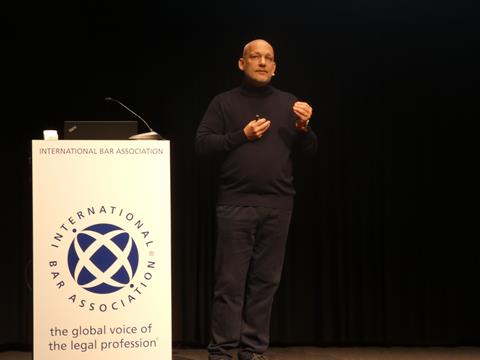
Lundblad outlined other daunting challenges that AI poses for both lawyers and law itself.
‘You could in principle have thousands of agents. I have five different agents working for me and already feel it stretches the ability of my will. How much can a human being actually direct? What does it mean to have files of agents working for you? Should accountability and liability mechanisms limit that scaling? There are already many agents with their own infrastructure, memory and instructions. Once we have given them our intentions, they can act on them.’
Lundblad said we will shortly encounter ‘persistent agents’ - agents that continue even though their owners have died or that have been forgotten by their founding organisations. ‘This creates very interesting questions of responsibility', he said. ‘We also see agents forming their own normative structures. Rules emerging between collaborating agents.
'We may see entirely new legal systems emerge from machine interaction. Perhaps those systems themselves constrain excessive intentionality.’
He added: ‘At the heart of all this lies identity. The question of legal subjects. Should we create categories allowing legal action to be attributed to agents? Law has dealt with delegated agency many times before: parents and children; employers and employees; dog owners and their dogs. The question is how to apply those lessons to AI.’
Lundblad concluded by stating that the 'next 50 years could produce the equivalent of the previous 500 years of scientific discovery.'
'I do not think that is hype,’ he said. 'It may actually be true. But only if we combine AI with law in the right way.'









1 Reader's comment