

























What should be in the business plans of mid-size firms that still want to be around and thriving in 2031? Different business models all have the attributes to operate effectively in an evolving market driven by technology. Eduardo Reyes reports from the latest Gazette roundtable
AT THE TABLE

Back row (l-r) Emma Sosner Spencer West; Philip Astles Kidd Rapinet; Eduardo Reyes Law Society Gazette; Chris Houssemayne du Boulay Hickman & Rose; Tracy Lacey-Smith SA Law; Simeon Spencer Spencer West; Nathan Hegarty Thomson Reuters
Seated, front row (l-r) Victoria Hodges Teacher Stern; John McAuley Nexa Law; Laura Devine Laura Devine Solicitors;
Corinne Staves CM Murray; Robert Williams Family Law Partners
This decade has shown that fundamental aspects of legal practice can change rapidly and in ways that can be impossible to predict. But some law firms have done much better than others in organising their businesses to be more resilient.
Going back to the Covid pandemic’s lockdown restrictions, those who had set up secure ways for lawyers and staff to work remotely are one example. Close attention to cash and cashflow, even in ‘good’ times, has also proved important. The business of law cannot just be about billable hours. It is all the things surrounding lawyering that ensure a business can still be thriving in five years.
The mid-size firms at this roundtable are closely focused on the impact of artificial intelligence (AI), changing client needs and behaviours, and perennial questions of succession. Their answers to the challenges involved also affect how they treat and train lawyers at the start of their careers.
Business models
A variety of business models at the table includes traditional partnerships, an employee-owned law firm, a ‘platform’ (more of that below), and a dispersed consultants entity.
Each believes their model is robust for their purposes.
Family Law Partners decided to become an employee-owned business. Robert Williams, director at the firm and also a deputy district judge and family law arbitrator, explains why.
'Employee ownership is a great way of making sure that whether you are the most junior or the most senior lawyer in the team, you are investing in the business'
Robert Williams, Family Law Partners
The process started with ‘a conversation we had with our accountants’, who told the partners, “you’ve got to think about your exit”’. He continues: ‘We knew that from a cultural perspective, the idea of us selling to a “big boy”… was of no interest, because that would change the culture overnight. People would leave.’
There were also personal motivations. Having built the firm, ‘we wanted to make sure that it has some legacy going forward’. Williams says he had to factor in the view that ‘the idea of a partnership… is a busted flush’.
On close inspection, employee ownership ‘is a great way of making sure that whether you are the most junior or the most senior lawyer in the team, you are investing in the business. You’re part of its growth, you’re part of its future, you’re part of its success’.
The move enabled employees to be ‘quasi-owners, without the risk and the cost… For us, a model which allowed us to pass that ownership to the team while extracting value in a tax-efficient way… was a win-win’.

John McAuley is chief commercial officer at Nexa Law, a ‘platform’ providing back-office functions which independent law firms join while retaining their identity. ‘Our model is for those people who don’t want to do the partnership model,’ he explains. ‘Most of the conversations that I have are either [with] law firm owners who have just had enough of running a firm, or people who are about to go into partner-level roles and they don’t want the pressure.’
He describes Nexa as ‘plug and play – run your business through us, and we’ll take a percentage… We take that stress away. They’ve had enough of dealing with PI insurers, had enough of dealing with the SRA’. The platform’s website is also client-facing, connecting potential clients with lawyers from the network.
'I think there’s a lot of disillusionment about job prospects for the next generation, the cost of living and the immense burden of debt. But the optimism is there'
Corinne Staves, CM Murray
Teacher Stern is an LLP but still ‘essentially a traditional partnership’, explains partner Victoria Hodges. It has equity ‘partners’ and fixed share ‘partners’.
‘I like the collaborative nature of a partnership and that you are working together as a team,’ she says. ‘I think given the size that we are, just over 100 people, that works.’
‘Some people do want to be partners,’ interjects Philip Astles, senior partner at Kidd Rapinet. Transparency regarding partnership is important in building that aspiration, he believes: ‘Demystify how one would become a partner, because frustration can gather if people think [they’re] waiting for a tap on the shoulder, or whatever it is.’
Kidd Rapinet has a pathway to partnership document that is about 10 pages long. Astles explains: ‘If they tick all the boxes, there’s no decision to be made. They can just become a partner.’
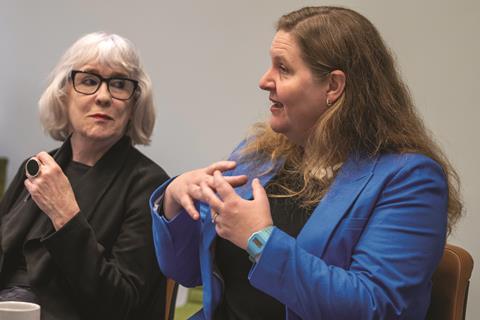
But do Gen Z want to be partners? ‘A lot of them do, actually,’ says CM Murray partner Corinne Staves, who advises professional partnerships. ‘I think there’s a lot of disillusionment about job prospects for the next generation, the cost of living and the immense burden of debt,’ she notes. But ‘the optimism is there’ when the advantages are clear.
‘It’s working really well for us,’ says Tracy Lacey-Smith, managing partner at traditional LLP SA Law. ‘We’re a very collaborative firm. Partners actually do get on really well.’ Another leader of an LLP, Laura Devine, alludes to her ‘youngish partnership. The vast majority of the partners are in their 40s. So we will have quite a long way to go until we’re retiring’.

Emma Sosner, global director of marketing and business development at Spencer West, explains that with dispersed or virtual consultant-model firms, one attraction is high fee retention. But how does such a firm avoid silo working, and how does it persuade partners and consultants to think about the interests of colleagues?
‘We’ve really worked very hard to break that,’ Sosner says. ‘We’ve taken the best of the traditional and mixed it with the revenue share model. And we’ve built this internal collaboration piece… We spend a lot of time together. We have international get-togethers. We’ve built this collaborative culture internally to purposely break down those silos, so that we do form teams. We do go out as sector groups.’
‘What you have to understand and always know is that lawyers are “pack animals”. You will always be more successful if you’re one of the pack,’ adds the firm’s co-founder, Simeon Spencer. ‘Don’t be the lone wolf.’
Back to the office?
Did 2020’s lockdown restrictions prove that we will not need offices in the future? No – but they changed expectations and practice on remote working across the legal sector.
Experience varies, nevertheless.
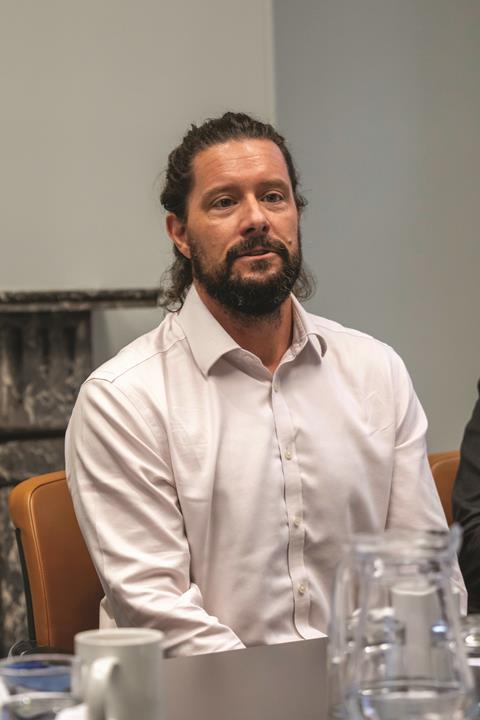
Simeon Spencer’s (pictured) firm was founded on a ‘hybrid’ model, he notes, but even he has noted changes. ‘It’s not just the solicitors’ profession that’s seeing this. I have a very good friend who happens to be a KC. I remember 20 years ago, we would meet for coffee almost every other day because we were both in the office every day. You’d just expect it. Since Covid, he’s never in chambers. And so there is this shift in mentality that does seem to have come from Covid rather than the technology.’
Kidd Rapinet’s Philip Astles, however, recalls: ‘Nobody in my firm wanted to work from home at the end of Covid. And I know that is really unique.’
‘Our trainees and our paralegals are in five days a week,’ says Teacher Stern’s Victoria Hodges. ‘At the more senior end, I think if we suddenly said to everybody, “You now have to come in five days a week”, people would say no. They’ve got so used to working from home and having that flexibility. We trust our people. We can obviously monitor their output and that’s fine.’

The challenge of tech
Most of the firms present do not have the scale to invest in creating proprietary AI products and spin-offs. But the requirement to invest in response to the adoption of AI tools in the legal sector is something that their firm ownership structures need to be able to support.

‘We are heavily investing in AI on a number of fronts,’ says Spencer. ‘We’ve got six people working almost full-time on AI as a team, including two AI software engineers.’ The engineers, says Sosner, are there to develop capabilities in-house. ‘It’s not just about designing new things,’ she says. The engineers are also connecting systems and reviewing available tools.
‘I think it’s a human industry, it’s a human profession,’ declares Spencer. That will never change.’ What he is seeking is ‘the right balance between the human and the technological’.
Lacey-Smith relates that SA Law has adopted Thomson Reuters’ Co-Counsel. ‘We rolled that out about 18 months ago and it’s now fully embedded in all our teams. We have rolling training programmes, so that for each department there’s specific training. That has really helped keep us within fixed fees instead of going over them and having write-offs. It’s increased our realisation rate.’
Research is among the tasks that AI’s use has sped up.
'AI at present is probably not a great deal more than a 24-hour, really bright work experience individual'
Philip Astles, Kidd Rapinet
SA Law has also developed a lead-generation software product that uses historical data, AI and machine learning. ‘We’re automating quite a lot of processes, including onboarding,’ adds Lacey-Smith. ‘It’s changing our business and we are seeing quite a lot of growth.’ But headcount has not fallen in consequence, she stresses.
‘AI is not new for us,’ notes Chris Houssemayne du Boulay, criminal defence partner at Hickman & Rose. ‘Technology-assisted review as part of the large-scale investigation process has existed for a very long time. In some senses, AI is just an evolution of that. Where we see the benefits of it is when you’re applying it at scale to document sets which, in some of our pieces of litigation, can run into the millions. And it’s never been possible to review that [before].’
Williams observes that the ‘paralegal role now is really the AI specialist – knowing what to prompt, how to gather and sift... how to get all that data ready for the lawyer to then analyse with their skill-set’. But this gives rise to a problem: ‘The test, I think, professionally, is how we up-skill at a lower level earlier, to make sure that we are getting people who are going to be the succession.’
Kidd Rapinet’s Astles says: ‘[AI] at present is probably not a great deal more than a 24-hour, really bright work experience individual. You give them a task and they do a really good job with it and they come back. The real future in using AI will be in terms of building agents.’
He has already introduced agents to help with emails – one helping lawyers whose first language is not English to check their grammar, and another that can modulate the composition of emails to make them more diplomatic. ‘If you think you might be feeling a bit miffed, stick your email into this and it will make it really pleasant for you.’
'We dipped our toes into AI a few years ago with a product that people generally weren’t happy With. It came up with a few mistakes'
Victoria Hodges, Teacher Stern
Thomson Reuters sales director Nathan Hegarty provides an overview on adoption: ‘I think two years ago, there was fear and denial from our customers around AI and a few people taking the plunge. Maybe last year that morphed into an acceptance and lots of people playing with it. That is setting up the ability for their people to try it out and not just doing it in a certain practice area like real estate and seeing how that goes.’
He adds: ‘What we’re seeing now is a lot of people... in the last 12 months have implemented it and are using it for legal work and what comes with that is what happens next.’

AI tools are in themselves helping law firms gain instructions, Staves says: ‘AI is actually referring in clients… they’re coming in and saying, “can you just spend half an hour telling me whether the AI was right or wrong?”.’
That also complicates legal matters and the lawyer-client relationship, however. The starting point is often wrong and the client needs to be re-educated. Firms must pay close attention to their ‘risk profile’, says Staves, where AI is in the loop: ‘We are all accountable for our output. The regulators made that really clear.’
Clients also have to be reminded of the risks of putting private information in the public version of tools like ChatGPT.

‘We dipped our toes into AI a few years ago with a product that people generally weren’t happy with. It came up with a few mistakes,’ says Teacher Stern’s Hodges. That led to trust in the product ‘dropping off a cliff’. Still, the pressure is there to keep looking, she notes, not least with junior lawyers asking: ‘How are we keeping up with what big firms are doing?’.
And can the benefits be evenly spread across a firm? There may be options for the real estate department to adopt an AI tool, but nothing suitable for colleagues in other departments whose fees will nevertheless be used to invest in real estate’s needs. Adoption, as with so much in law firms, is political too.
Technology can also take a form that shows up weaknesses in how a firm or practice is run. As Astles says: ‘If you’ve got partners who would rather use AI than a junior, then that suggests to me that there’s a lack of personal relationship between the two people and they are remote from each other, which is where your issue is, really.’
Charge-out rates
Then there is, of course, the question of money and the basis on which lawyers will charge clients. There are no settled views here, reflecting the difficulty of moving beyond a calculation based on time. There are areas where a fixed fee has replaced time recording but, even there, law firms have calculated the time likely to be involved in a fixed-fee matter to work out the fee.
With the prospect of AI providers charging by ‘tokens’ used, there is pressure to review time-based billing, and the relevant unit for that part of the work is not time, but tokens. ‘You can still charge hourly rates on tokenisation,’ is Astles’ view. But he notes other problems with client attitudes to fees. These include changing for a matter that was aborted: ‘If they’re going to pay for a professional service, they want a result, an outcome. We have to become results-based.’

Is there a future in value-based billing? It is a long-term talking point. The challenge, Hegarty says, illustrates clients’ own attachment to time. ‘[Imagine] somebody comes to paint your kitchen and you want to know how much it’s going to cost,’ he says. ‘So he tells you it’s going to be £500… If he comes around and it takes him an hour and a half, [you’d think], “Hold on. Why is it £500 for 90 minutes?”.’
Getting the customer to understand what else sits behind the cost is not easy: ‘What you’re not factoring in, or I won’t be as a consumer, is all of the other things he knows about. How much it costs him to run his business, his tools, materials, time, training, whatever else there is… there’s a lot here about what the client is willing to accept.’
Even as far ahead as 2031, do not be surprised if the way fees are best calculated and charged still divides opinion.

- Kindly sponsored by













No comments yet