






















Staying Sane in Family Law
Annmarie Carvalho
£20, Bath Publishing
★★★★★
Some people cannot understand how anyone can be a family lawyer. As the author of this book says, working in the world of family law is a unique experience. In no other area of law do you find yourself becoming so intertwined with your clients’ lives.
Carvalho was a family law solicitor and mediator at Farrer & Co for over a decade before she retrained as a therapist – and an award-winning one at that.
The work begins with an exploration of why we go into family law in the first place – a Marmite-like subject area. It goes on to consider dependency dynamics where the client feels vulnerable during the legal process. One example is the client who rings you half a dozen times a day or makes it hard for you to end the conversation. The concept of cavalry/rescuer transference is particularly strong. Clients frequently believe that their lawyers can do more for them than the lawyer actually can do.
Carvalho says that many family lawyers over-empathise and risk burnout. Just because we might be good at the job with our clients does not mean that the job is good for us. Carvalho examines the professional training which we all undertake. She quickly concludes that its analytical approach is unhelpful in readying us to deal with the irrational and the ‘emotional Wild West of family law’.
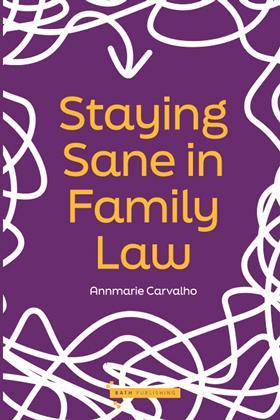
The book is notionally in two parts. The first delves into what Carvalho calls the psychology of family law, with individual chapters devoted to different aspects of experience. In a chapter entitled ‘We’re not counsellors, we’re lawyers’, she says that, if you are working with people in distress, then emotions and psychology are a fundamental aspect of your job. The second part aims to give the reader techniques and ways to cope with pressure. Much of it is intended to be a workbook with exercises to try.
This work is about adding new and essential tools to your toolkit. Carvalho is not intent on turning the professional adviser into a therapist, but aims to help the reader work in a more psychologically informed way.
The chapters throughout the book are focused and pithy. They come with reflection points, which help form a comprehensive manual. After all, the author is not just a therapist but has a training and coaching agency. The Carvalho Consultancy’s mission is to provide better mental health support and improve psychological understanding.
Attachment theory, with explanations and links to other works, is dealt with in one chapter and is applied to both lawyer and client. Codependency is also explored. This is an occupational hazard in the family law world, says Carvalho, who expands on a case of her own where she could not tell apart the opposing client and their lawyer by the end of the matter.
The author presents chapters exploring working with various categories: vulnerable people, trauma and mental health disorders and suicidality. Carvalho reminds us that the job of the family lawyer is not to rescue people. Rather, it is to try to get them to help themselves.
Addiction gets a couple of chapters to itself, as does neurodiversity.
The mood of this fascinating book is lightened by a wry style, and amusing references to pop stars and popular culture. In places, it is very funny indeed.
One of the toughest parts of working in family law, says Carvalho, is wrestling with your own client who wants to act against their own best interests or, more importantly, against the best interests of their children. Any training we have of a persuasive, directive nature fails in the face of the emotional nature of the client, she says. Moving on to the trauma that clients may have encountered, Carvalho refers to Bessel van der Kolk’s The Body Keeps the Score. Working in a trauma-informed way is one of the many threads that run through the book.
Peppered with case studies, these tie in with reflection points at the end of the chapter. The book concludes with two chapters on reflective practice, or therapeutic supervision. This means that, on a regular basis, the lawyer can talk about things which affect them in their work in a designated space. After all, says Carvalho, working in family law is a ‘curious hybrid of an analytical/left brain job and a helping/right brain one’.
Speaking as a family lawyer, I recognise that you can meet your clients at their lowest ebb. You see the worst of human nature but, sometimes, also the best. This is a book which I wish I had read years ago. It is long overdue.
Tony Roe is a family law partner at Dexter Montague LLP, Reading, an arbitrator, collaborative lawyer and mediator working towards accreditation








No comments yet