






















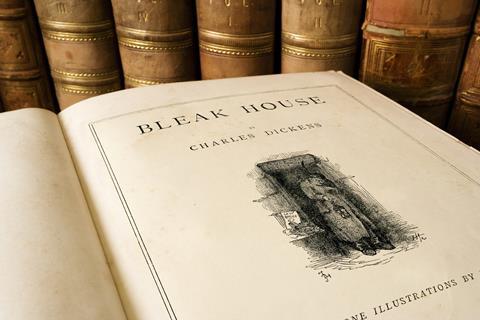
Bleak House
Charles Dickens
Penguin Random House
★★★★✩
Bleak House is a well-known classic, following the Court of Chancery case Jarndyce v Jarndyce as it impacts all those party to it. As the law plays a central role within the book, there are several points which can be understood as useful to modern practitioners almost 200 years after it was written.
Firstly, Dickens includes two occasions where he portrays how important the relationships between lawyers and clients can be. For example, Sir Leicester Deadlock is a key client of the lawyer, Mr Tulkinghorn, who demonstrates how much a solicitor can mean to a client, as he relies extensively on him to provide both legal and personal advice. This is applicable to modern practitioners as they are viewed as problem solvers by their clients, who are often turning to them in their time of need.
Furthermore, Dickens demonstrates the idea that 'the interest of clients are never to be neglected', through the solicitor Mr Vholes, who advises another character in the proceedings. This idea serves as a reminder to practitioners that all the work which we complete must be for the benefit of the client’s interests and ensure that these interests are kept at the forefront of the work undertaken. However, Mr Vholes serves as a contradiction to his statement as he allows his client to become so invested in the case that it consumes him and ultimately leads to the character’s deterioration in both mental and physical health. Therefore, it is important for practitioners to be considerate of a client’s welfare to ensure that the work which they undertake in the client’s interests does not have adverse effects on the client or their welfare.
Another lesson which a modern practitioner can take from Bleak House is the importance of clear communication between lawyer and client. Within the book, this is raised in the context of keeping clients regularly updated on proceedings and developments but ensuring that this is done in such a way that the client can easily understand. This is highlighted in Mr Jarndyce’s reply to Ester regarding 'this Chancery business' (the central case within the book), stating that 'The Lawyers have twisted it into such a state of bedevilment', suggesting that although Mr Jarndyce is one of the key parties within the case, he is no longer sure how it is proceeding. This demonstrates the importance of ensuring that clients fully understand how their case is progressing, especially in complex cases where there are several moving parts or aspects which need to be considered and the risk of confusion for the client is high.
Finally, it is also important for modern practitioners to justify to clients why certain steps need to be taken. This not only keeps the client updated but also prevents them from viewing the law in the same manner as Dickens who states that 'the one great principle of the English law is, to make business for itself'. This idea emphasises the need for clients to be fully informed of both the steps and their consequences to ensure they receive the best service possible.
Although the writing can be slightly confusing at times (as is typical with Dickens), Bleak House is a fantastic winter read perfect for the January blues, where you follow the journeys of each character as they develop and change over the course of the events which take place, while still taking in important lessons for a modern lawyer.
Michael Smith is a 4th year Law (Study Abroad) LLB(Hons) student at Lancaster University








1 Reader's comment