





















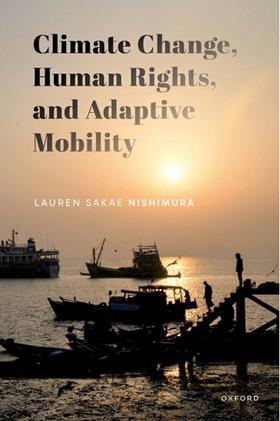
Climate Change, Human Rights and Adaptive Mobility
Lauren Sakae Nishimura
£100, Oxford University Press
★ ★ ★ ★✩
This book advances a reconceptualisation of climate-related human mobility that is both timely and legally ambitious.
Departing from dominant approaches that focus on protection only after displacement has occurred, the work shifts attention to anticipatory obligations under international law. The author argues that the international climate change regime already contains underutilised legal tools capable of addressing climate-related mobility before it becomes forced or irreversible. In particular, it contends that adaptation obligations under the UNFCCC and the Paris Agreement (often dismissed as programmatic or policy-oriented) possess concrete legal content and normative force.
A core contribution of the book lies in its careful doctrinal development of these adaptation obligations through treaty interpretation, regime interaction, and principles of international environmental law, informed and reinforced by international human rights law. The author argues that adaptation duties require states to address foreseeable climate risks in ways that protect and ensure human rights, drawing on well-established legal concepts such as due diligence, prevention of harm, non-discrimination, and progressive realisation. This integrated framework strengthens the legal character of adaptation and clarifies how failures to plan for, finance, or implement adequate adaptation measures may engage legal responsibility.
The work further develops the concept of 'adaptive mobility', emphasising that mobility outcomes, whether remaining in place, engaging in temporary movement, or undertaking planned relocation, are shaped by governance choices rather than inevitable climate impacts. Through detailed case studies in Bangladesh, the Pacific Islands, and the Sahel, it demonstrates how adaptation obligations intersect with land tenure, development planning, and mobility governance in practice. These case studies show that climate-related displacement is often foreseeable and, in some instances, preventable, reinforcing the book’s central claim that inadequate adaptation may constitute a legally relevant failure rather than a purely humanitarian concern.
For practitioners, the book’s significance lies in its ability to operationalise climate and human rights law in contexts where legal responsibility has often remained diffuse. The author provides doctrinal tools to treat adaptation obligations as enforceable standards, to integrate human rights norms into climate planning, national adaptation strategies, and international cooperation frameworks, and to frame climate-related mobility as a matter of prevention and accountability. The analysis is particularly valuable for lawyers working in government advisory roles, international organisations, climate finance institutions, and strategic litigation, as it offers a legally coherent basis for engaging upstream with planning, funding, and support obligations. In doing so, the book helps practitioners move beyond reactive responses to displacement and toward a more legally grounded, anticipatory approach to climate governance and human mobility.
Simone Mamini is a doctoral researcher in law and a visiting lecturer in maritime and international law at City St George’s, University of London









No comments yet