






















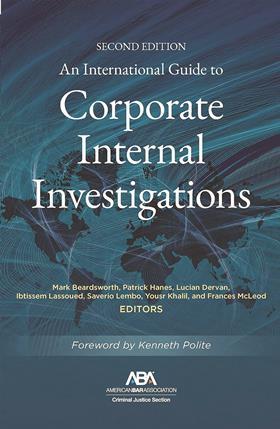
An International Guide to Corporate Internal Investigations (2nd edition)
Editors: Mark Beardsworth, Lucian E. Dervan, Patrick Hanes, Yousr Khalil, Ibtissem Lassoued, Saverio Lembo, Frances McLeod
£108.30, American Bar Association
★★★★★
This is a practical companion for counsel who readily appreciate that an ‘internal investigation’ can quickly burgeon into a multi-jurisdictional exercise in risk management. Published in December 2025 – five years after the first edition – this is a compact and comprehensive 475-page work; a ready referencer for professionals conducting multi-jurisdictional investigations.
For legal professionals dealing with cross-border allegations – bribery, fraud, sanctions risk, accounting irregularities, or misconduct – this second edition is a genuinely useful work of reference. Its consistent structure makes it easy to use under pressure, and its emphasis on procedural integrity aligns with modern expectations of corporate compliance.
It comes with a wealth of localised knowledge, and with jurisdiction-specific ‘smarts’ passed on by experts (over 40 of them) who are acknowledged leaders in their field, managing with aplomb complex investigations in one or more of 13 jurisdictions.
This book is designed to be at one’s elbow, poised to assist with focused practical advice. Its value to the novice or tyro investigator cannot be overstated. It identifies issues, enabling the practitioner to spot pitfalls in advance. The work encourages teams to ask the hard questions at the outset, concerning the ambit of the investigation, privilege, employee trust, document management and maintaining credibility with the authorities.
Anyone mastering the work would be able to deploy its accessible content and perform at a credible level. But (as the authors note) nothing can replace tailored local advice, especially in fast-moving areas like privilege, data privacy and whistleblowing.
A notably strong feature of this book is its comparative analysis. The coverage spans 13 jurisdictions: US, Argentina, Australia, Brazil, France, Germany, India, Italy, Netherlands, Switzerland, Ukraine, United Arab Emirates and the UK.
The architecture of regulation, including whistleblowing and employee rights, is clearly expounded, jurisdiction by jurisdiction. Each chapter is written by local practitioners and follows, with some exceptions, a parallel sequence of headings, each closing with a short set of recommendations. For time-starved legal teams, and internal counsel, this format enables rapid comparison and assimilation of issues – such as whether or not to self-report, evidence-gathering, the scope of LPP, and liaison with regulators and law enforcement.
While the book is organised by jurisdiction, the underlying thesis is corporate integrity: an investigation must be demonstrably independent, well governed and fair. Good investigations promote good relations with government agencies, whereas bad ones compound the initial problem. Focused but not over-tight scoping, disciplined documentation of judgement calls, accountability, and a transparent process that can withstand scrutiny (if matters escalate to regulators or litigation) are some of the messages conveyed.
The practical advantage of having local authors in a standardised format is that it helps counsel anticipate where the same step can carry different risks – e.g. when collecting employee devices, transferring data for review, or interviewing a key witness. The guide shepherds one via a clear and careful exposition to navigate and avoid procedural missteps.
Crucially, the guide treats cross-border complexity as a set of operational choices rather than abstract doctrine. Its practical approach demystifies what could be a daunting subject. Best practice across the 13 jurisdictions is spelt out, assaying legal and cultural nuances, which should inform how investigations ought to be conducted in each jurisdiction.
The editorial team is to be commended for fashioning and developing this invaluable, practical and pragmatic book. The book also includes a valuable foreword by former US assistant attorney general Kenneth Polite, which sets the scene and provides helpful content. It also reprints the foreword from the first edition, written by Sally Yates.
Edward Henry KC is head of regulation at Mountford Chambers, London








No comments yet