























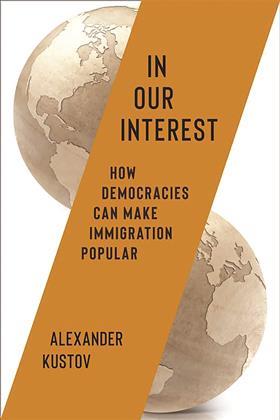
In Our Interest: How Democracies Can Make Immigration Popular
Alexander Kustov
£28, Columbia University Press
★★★★✩
UK immigration solicitors frequently find themselves explaining an uncomfortable paradox to employer clients. Skilled migration is economically essential, yet the legal framework governing it grows ever more regulated, restrictive and complex. Alexander Kustov does not resolve this paradox, but goes a long way towards explaining why it persists and how, over time, it might be resolved.
Paradoxes resist simple solutions. Attempting to ‘solve’ immigration by choosing one side – by arguing, for example, that immigration is straightforwardly good for the economy – often entrenches opposition rather than reducing it. Kustov’s central insight is that the paradox must instead be managed. Immigration policy must accommodate two truths at once: that migration can deliver economic and social benefits, and that it remains politically divisive. His book explores how relatively open immigration can be designed and justified in ways that are both effective and popular.
Kustov begins by considering existing research on public attitudes to immigration and distilling it into a clear analytical framework. He challenges the assumption that opposition to immigration is driven primarily by economic self-interest or hostility to outsiders. Instead, his research points to what he terms ‘altruistic nationalism’: people care about fairness and collective outcomes, but they prioritise the interests of their own national community.
Drawing on large-scale survey data from multiple countries, Kustov shows that even liberal or cosmopolitan voters tend to favour immigration policies that demonstrably benefit their own country. Policies framed as helping foreigners for their own sake are consistently unpopular – even among those most sympathetic to migrants or asylum seekers. Public scepticism, he argues, is less about immigration itself than about uncertainty over who gains from it.
This distinction matters. People are significantly more supportive of immigration when it is linked to shared national outcomes, such as funding public services or strengthening the tax base, rather than framed primarily as meeting employer demand. Skilled and economically productive migration is therefore not only more beneficial in material terms, but also more politically sustainable.
From this flows one of the book’s most provocative conclusions: societies are more likely to accept broader forms of immigration liberalisation if they begin with routes that demonstrably serve the national interest. By building legitimacy and trust through skilled worker routes, political space can gradually open for other types of migrants, such as those seeking family reunification or international protection. Kustov points to Canada as a leading example, where immigration across multiple categories is widely recognised, across the political spectrum, as serving national interests.
The book is divided into two parts. The first examines why people oppose immigration and the conditions under which they support it, rejecting explanations based solely on self-interest in favour of reasoning grounded in national benefit. This section provides a robust theoretical framework, supported by empirical evidence.
The second part, by Kustov’s own admission, is more speculative but centres on the imperative to effect change. Politicians must engage with voters as they are, and the most effective way to build support for freer immigration is through policies that are clearly beneficial to the country.
In conclusion, Kustov reviews his findings and considers their broader implications for understanding public opinion and policymaking. He offers practical guidance for efforts to persuade the public in favour of pro-immigration reform.
Kustov does not aim to address legal consequences. He pays little attention to administrative law, procedural fairness or the realities of enforcement. The solicitors dealing with sponsor licence revocations or opaque decision-making may find his optimism about consensus-building difficult to reconcile with daily practice. That limitation reflects the book’s purpose rather than a flaw in its argument.
In Our Interest is not a legal text, but its value for immigration solicitors lies in the broader context it provides. It explains why simplification is rarely prioritised, why compliance obligations continue to expand, and why politically driven change persists even when it undermines stability for employers.
For lawyers advising on workforce planning, compliance risk and long-term recruitment, that perspective alone makes this a timely and worthwhile read.
Katie McDermott is a solicitor and managing director of the London and Dublin offices of Erickson Immigration Group









No comments yet