





















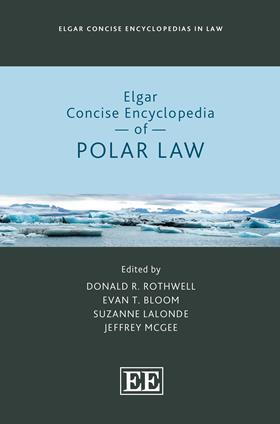
Elgar Concise Encyclopedia of Polar Law
Editors: Donald R. Rothwell, Evan T. Bloom, Suzanne Lalonde, Jeffrey McGee
£260, Edward Elgar Publishing
★★★★★
The structure of this much-needed volume on polar law and the breadth of issues it addresses are commendable. The encyclopedic format allows the reader to navigate through the 144 entries for specific topics.
Particularly timely are the entries on Greenland. These highlight its transition from a colonial territory to an increasingly autonomous political entity, with growing relevance in Arctic governance. The historical process of Danification, the development of home rule and self-government, and the gradual move toward possible future independence are all covered. Key themes include the role of indigenous peoples, the principle of ‘nothing about us without us’, and the link between political autonomy and control over natural resources such as oil and gas. Greenland’s strategic importance is also stressed in relation to Arctic sovereignty, security and international politics, as well as its involvement in territorial and maritime disputes.
The treatment of historical questions, such as those relating to the Antarctic Treaty System and the Falklands/Malvinas dispute, is especially valuable.
There is also coverage of more contemporary issues, including the cruise ship sector. This is gaining increasing relevance due to the opening of Arctic routes (about 100 ships were reported in the region in 2019, with Svalbard and Alaska accounting for the largest share of cruise visits). The authors explain the multi-level framework that governs Polar cruise tourism, encompassing international law (such as the Polar Code), regional regimes, national legislation and industry self-regulation.
There is also a comprehensive overview of the states with interests in both polar regions, namely the Arctic and the Antarctic.
The discussion of indigenous peoples is another notable strength of the book. This issue is often underestimated, partly because of the common misconception that the Arctic is merely an ocean and the Antarctic merely ice, whereas in reality, about four million people live in the Arctic region.
With clarity and depth, the book also looks at climate change, fisheries and biodiversity conservation.
Dr Carlo Corcione is a lawyer and manager specialising in trade, shipping and logistics









No comments yet