






















Outsourcing Crimmigration Control
Samuel Singler
£100, Oxford University Press
★ ★ ★ ★✩
This is a timely examination of how migration control is increasingly shaped by digital technology, outsourced governance and criminal justice logic. There is a growing social and political debate about technology and its relentless infringement on our privacy – for instance, with the proposals in the UK for a digital identity scheme. This study provides a warning not to accept what, on its face, appears to be mundane, even boring and inevitable technological progress, in the form of digital border control, without deeper examination and a sense of unease.
The same technology that awaits us all in the Global North at the end of our travels at the airport, allowing us to walk through borders efficiently and without human interaction (if the facial recognition technology works), can have very different ramifications for people in other parts of the world, particularly the Global South.
Singler cautions against treating digital border control as a technical upgrade rather than a political transformation – one that fundamentally alters how migration is governed and how people are classified, monitored and may be excluded.
The author’s central thesis is that migration governance is undergoing a profound transformation. Immigration control is no longer exercised solely through domestic law and state actors, but through global digital infrastructures, biometric systems and international organisations operating at arm’s length from traditional accountability mechanisms.
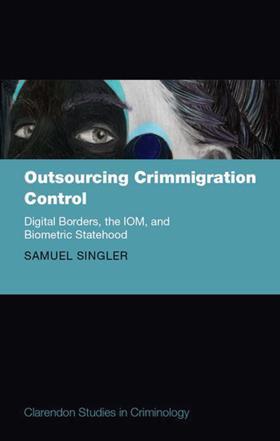
At the heart of the book is the expanding field of border criminology. Criminal justice policies, migration control and border control practices seem to have merged to the extent that they have given rise to a diffuse set of what are now called ‘crimmigration’ control practices.
Migration is increasingly governed through concepts traditionally associated with crime: risk-profiling, surveillance, pre-emptive intervention and suspicion. In this framework, migrants are not merely regulated but assessed, categorised and managed as potential security threats. This fusion, ‘crimmigration’, creates a system in which administrative decisions can have punitive effects without the procedural safeguards normally associated with criminal law. This shift allows states to extend their control outward, particularly those in the Global North such as European countries, while simultaneously diluting responsibility for the consequences of that control.
The empirical heart of the book is a detailed case study of the International Organization for Migration’s system, known as the Migration Information and Data Analysis System (MIDAS), used in Nigeria. Singler demonstrates that MIDAS is not simply a data-management tool designed to assist border administration. Rather, it functions as a mechanism through which biometric surveillance, border enforcement and state-building are simultaneously advanced. Control is effectively outsourced: not only to an international organisation, but to a digital system that embeds criminal justice assumptions into migration governance from the outset.
What makes this analysis particularly compelling is Singler’s attention to how power operates through technical design. Decisions about what data is collected, how individuals are categorised and how risk is defined are not politically neutral. Once embedded in software, these decisions become difficult to challenge. Responsibility becomes diffuse; spread across states, international bodies, contractors and technical systems, leaving affected individuals with little clarity as to who governs their fate, or where accountability lies.
While the case study is situated in the Global South, the underlying dynamics are familiar. The UK increasingly relies on biometric enrolment, automated checks, data-sharing arrangements and third-party actors, often justified in the language of efficiency, security and risk management. Singler’s work invites us to look beyond that rhetoric and ask more difficult questions about power, accountability and rights. The author also explores the question of whether unchecked technology is the answer to all the difficult issues surrounding migration – and whether MIDAS really has the Midas touch.
This work is not a polemic, nor does it offer easy solutions. Its strength lies in its careful, methodical exposure of processes that are often taken for granted, and which, due to their mundane nature, may just be ignored. Thus, their gradual infringement on all of our lives – unchecked. Singler shows how borders are being quietly re-engineered through technology, how migration control is being externalised and depoliticised, and how rights can be eroded not through dramatic policy shifts, but through banal systems that appear merely administrative.
The book is an important reminder that when governance is outsourced to code, the consequences remain profoundly human. Thanks to the University of Essex, this book is also available as an open access pdf.
Sally Azarmi is a solicitor and director at Azarmi & Company









No comments yet