






















The Defamation Act 2013 tilted the law away from claimants but many lawyers believe it did not go far enough, reports Sian Harrison. London remains the world’s libel capital
The low down
Since it emerged in the 13th century, the law on defamation has been subject to constant revision. That reflects the tension between society’s conflicting aims on freedom of speech, privacy, right to a reputation and the ‘public good’. Rival camps are unable to agree on how to typify the balance of power libel actions demonstrate. Is an individual claimant the ‘little guy’, up against well-funded, cynical media outfits? Or are all journalists public interest champions at constant risk of litigation designed to break or silence them? There is some agreement on one issue. Costs in libel claims are deeply unsatisfactory. The ‘loser pays’ principle does not reliably play out. A threat of action alone can be expensive to see off. And claims with merit may be abandoned because costs are mounting. Small wonder reform is in the air.
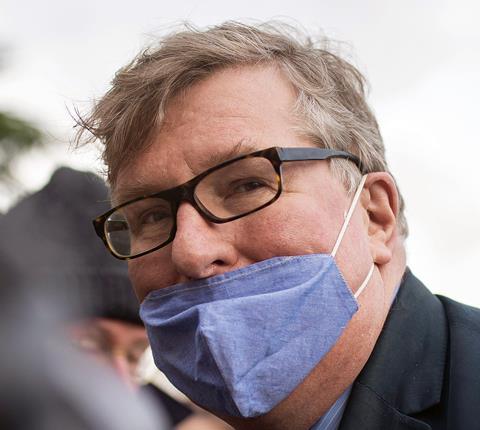
Madison Marriage was on maternity leave almost two years ago when she received the news every journalist dreads – her work was at the centre of a libel action. Along with colleagues at the Financial Times, she had investigated former hedge fund mogul Crispin Odey and he was now bringing a record £79m defamation claim over reports of sexual misconduct allegations from 20 women.
Last week, while still strongly denying any wrongdoing, Odey withdrew his case three months ahead of trial. His lawyers said he had been ‘forced to accept’ that the FT was likely to successfully defend its journalism as being in the public interest, even though he believed he would have demonstrated at trial that he is ‘not the violent predator he was presented as being in the articles’. The response from the FT’s editor, Roula Khalaf, was stark: ‘The FT was always confident in its reporting. This is a case that should never have been brought.’
Odey’s climbdown will of course have come as a relief to many, not least the 15 women who would have had to go to the High Court in London and repeat their evidence in the full glare of publicity. The reporting team, the legal team and all at the FT tasked with fending off this whale of a claim will also, no doubt, permit themselves a brief exhale.
'Only well-resourced, well-insured or extremely brave publishers can afford to take the sort of financial risks involved in publishing this sort of legitimate public interest story'
Gill Phillips, former Guardian editorial legal director
Yet, even before reaching trial, the news outfit had racked up seven-figure costs. This is easily done in a high-stakes defamation case, with such a huge damages bill looming and a large volume of disclosure.
Odey is now liable for those costs, as well as his own, and one would expect the FT will be able to recover them. However, recovery is not guaranteed in such cases. The Guardian, for instance, is unlikely to ever see much of the £3m that actor Noel Clarke was ordered to pay last year, following his failed libel claim against the newspaper, as he was declared bankrupt in December.
Former Guardian editorial legal director Gill Phillips is resolute in her belief that the huge costs involved in libel cases have a ‘serious chilling effect’ on journalism and are seriously disproportionate to the damages that might be awarded. The Guardian’s total costs were ‘significantly in excess of £6m’ and the trial judge, Mrs Justice Steyn, said they had been increased by the conduct of Clarke and his legal team, after her finding that he was ‘not a credible or reliable witness’.
Phillips, now an editorial consultant, says: ‘Only well-resourced, well-insured or extremely brave publishers can afford to take the sort of financial risks involved in publishing this sort of legitimate public interest story.’
History lessons
Defamation – libel in writing, slander in speech – is a complex area of law and therefore strikes fear into the heart of most journalists. While investigative types become somewhat inured to the rhythm of legal threats, for the rest of us a legal letter stings and causes sleepless nights.
Yet in a world where ‘content’ is consumed 24 hours a day and lives as long as it remains online, the ability to protect one’s reputation and seek remedy when it is impugned continues to be of the utmost importance – especially as everyone now has the ability to publish at their fingertips. There can be few more stubborn stains upon a person’s character than the sort of allegations levelled against Odey and Clarke. It is only right claimants are able to correct inaccurate and unfair reports about them, preferably in the most swift and cost-effective way possible.
Trials take their toll. One only has to recall the dramatic collapse and dash to hospital of actress Gillian Taylforth as she and her partner Geoff Knights lost their case against The Sun. A jury (in the days when juries heard libel trials) found in favour of the tabloid over a story about the couple engaging in what would no doubt be described as a ‘romp’ in their Range Rover off the A1 in Hertfordshire.
The spectacle of a high-profile libel trial, with every twist and turn reported in full detail over many weeks, protected by absolute privilege, is often far more damaging for the claimant than the original libel. This is one factor which has seen a shift towards more pre-publication handling of defamation complaints; and the rise of reputation management.
The balance for the courts (and the law itself) to strike is one that draws the line correctly between a person’s right to defend their reputation and freedom of expression – including the public’s right to know about wrongdoing, especially by those with power and wealth.
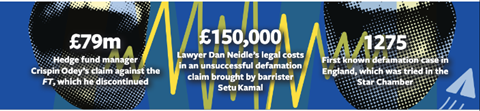
The origins of English defamation law stretch back to the 13th century, with the crime of scandalum magnatum (insulting peers of the realm) established in 1275. In what is believed to be the first criminal libel case, tried in the Star Chamber under James I, Sir Edward Coke said: ‘A person’s good name … ought to be more precious to him than his life.’
Since first being codified in the 19th century, defamation law has been updated every few decades. The current legislation, the Defamation Act 2013, was a response to criticism of London’s increasingly negative reputation as the ‘libel capital of the world’. The act introduced a raft of measures designed to make the defence of defamation claims easier – including the ‘serious harm’ hurdle claimants must overcome.
In spite of this, and the bill’s relatively young age, there are growing calls for reform which stem from defamation becoming synonymous with a certain type of lawfare – the SLAPP.
SLAPPs – Strategic Lawsuits Against Public Participation – are notoriously difficult to characterise, but are generally seen as abusive litigation by a well-funded party against one with fewer resources at their disposal.
The Solicitors Regulation Authority defines SLAPPs as ‘an alleged misuse of the legal system, and the bringing or threatening of proceedings, in order to harass or intimidate … thereby discouraging scrutiny of matters in the public interest’.
It is easy to see, therefore, why defamation has become such a vehicle for this type of action – especially as the burden of proof remains with the defendant, unlike in other areas of law.
In the first test of the only anti-SLAPP legislation in England and Wales, which is contained in the Economic Crime and Corporate Transparency Act 2023, former tax lawyer turned journalist Dan Neidle saw off a defamation claim brought by barrister Setu Kamal. Mrs Justice Collins Rice struck out the claim and declared the case a SLAPP last month. Yet Neidle complained publicly that, even having avoided a trial, his costs were approaching £150,000 (although he hopes to recover these from Kamal).
Classic cases: Tests of reputation
Kamal v Neidle
In a landmark 2026 ruling, the High Court struck out a ‘spectacularly inflated’ £8m libel lawsuit brought by tax barrister Setu Kamal against Dan Neidle, who had investigated a tax avoidance scheme. This was the first test of the only UK anti-SLAPP legislation in the Economic Crime and Corporate Transparency Act, which relates only to economic crime and therefore cannot be deployed in other types of case.
Abramovich v Belton/HarperCollins
Several Russian oligarchs, including former Chelsea FC owner Roman Abramovich, sued journalist and author Catherine Belton and her publisher over her book Putin’s People. The case was widely regarded as a SLAPP, and Belton faced costs of £1.5m. Some claims were dropped in 2021 after Mrs Justice Tipples concluded most of the text complained of was not defamatory, while Abramovich agreed a settlement.
ENRC v Burgis/HarperCollins
Eurasian Natural Resources Corporation sued journalist and author Tom Burgis over his book Kleptopia. Mr Justice Nicklin dismissed ENRC’s case against Burgis and his publisher as being without merit in 2022. Burgis said at the time: ‘It’s harder to imagine a higher public interest than reporting on the deaths of potential witnesses in a major criminal corruption case. I’m delighted that this attack on our journalism has failed.’ A second claim by ENRC against Burgis and his former employer, the Financial Times, was dropped shortly after the High Court ruling.
Yevgeny Prigozhin v Eliot Higgins
In 2021, the now dead Russian oligarch Yevgeny Prigozhin sued Eliot Higgins, founder of investigative outlet Bellingcat, for identifying him as the commander of the Wagner Group. The case was struck out in 2022 after Prigozhin failed to comply with court orders. Higgins’ lawyers said the case was a ‘demonstrable example’ of a SLAPP. At the time, Higgins stated that the case was a reminder of how the UK legal system is abused by wealthy individuals ‘to stifle legitimate investigative reporting into their activities’. He also said it was ‘absurd’ that a sanctioned person could sue a UK citizen for reporting on the connections which got him sanctioned in the first place.
Slapping back
In Neidle’s view, the substantive law is fine, but the problem lies in procedure and costs. ‘Most people when faced with Kamal’s libel threat would have made the rational decision to back down,’ he says. ‘Who would risk six months of their life and £146,000 on a small story not many people cared about? The test shows that libel law is broken: it makes rational people stay silent even when they know they’re speaking the truth. That’s an indefensible outcome.’
The campaign for the government to widen the scope of anti-SLAPP legislation gathered pace following Neidle’s win. The UK Anti-SLAPP Coalition co-chairs said his case proves there is a need for a SLAPPs law but that what is currently in place is ‘not sufficient’.
In a statement, they added: ‘It is important to emphasise that not everyone is in Dan’s position to defend such a case – both in terms of time and money. Those who find themselves targeted for speaking out in the public interest – on any subject matter – need to have the confidence that they can fully defend themselves, with a robust but straightforward mechanism in place to protect them from potential SLAPPs.’
Just this week Pia Sarma, The Times’ editorial legal director and chair of the Media Lawyers Association, wrote in the newspaper that ‘weaponising the law to stifle public discourse has to stop’.
Joshi Herrmann, founder and editor of Mill Media – a series of hyperlocal sites and newsletters across the UK, including the Manchester Mill – implored readers to join the campaign for reform by emailing their MPs. In his newsletter, Herrmann said: ‘Our ongoing cases will end up costing us around £100,000, or even more if they drag on in the months ahead. We are confident of winning both of them, but much less confident about recouping those costs from the claimants suing us. That’s the crux of the problem with the legal system as it stands: it’s incredibly expensive to defend even the flimsiest of claims.’
Neidle and Herrmann are among 120 other voices, including journalists, lawyers, and academics, to call on the government for robust anti-SLAPP legislation in a recent open letter.
On the other side of the scales are ordinary members of the public whose lives have been affected by press intrusion or misreporting. Campaigners have recently urged the government to hold the second part of the Leveson Inquiry and believe it remains too difficult to get an effective remedy for a complaint.
There are also deplorable cases of online abuse which cross the line into defamation and cause serious damage when coming from accounts with large follower counts.
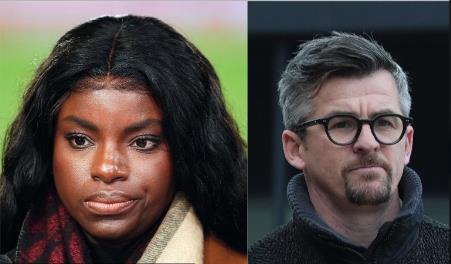
The recent win by football pundit Eni Aluko against Joey Barton over his online posts about her came after what her lawyers described as ‘a deliberately targeted public campaign of vilification’.
‘While there can be no doubt that some defamation claims are ill-founded, and occasionally even abusive in nature, that is true of all types of legal claim, and the court has various powers to strike out such claims and sanction those who bring them,’ says Max Campbell, a partner at Brett Wilson.
‘There is simply no evidence to support the suggestion made by some, that the UK has an endemic problem with wealthy and powerful individuals using defamation claims to silence journalists,’ Campbell adds. ‘It is true that the costs of litigation can sometimes be prohibitive, but again, that is true in most areas of litigation, and in defamation cases it is often the defendant publisher which has the far greater resources.’
While Campbell’s view that publishers are often the better resourced may be true of some outlets, new publishers, like Herrmann, say they are at greater risk given their size and more investigative nature.
Creating fear
Natalie McEvoy, head of content clearance at ClearDraft, says these smaller independent publishers ‘feel the chill of legal threat hanging over their copy on a daily basis.
‘Even the most diligent, responsible publisher preparing a story of clear and obvious public interest can find themselves facing substantial, often unrecoverable, legal costs if a subject challenges an article,’ she says. ‘This is the case even if it is struck out at a preliminary stage. For example, one publisher recently bore the cost of preparing for two hearings where the claimant did not appear, burning irreplaceable time and significant money in defending their journalism, and then the claim was struck out. These are funds and manpower which are then unavailable for important investigations and following new leads.
‘Some say that the Defamation Act 2013 tilted the balance in UK libel law away from claimants, but it didn’t go far enough. London is still the libel capital of the world, thanks to our punitive costs system and a SLAPP culture that hasn’t been properly checked.’
It remains to be seen how the government will attempt to balance all of these issues in any proposed legislation included in the King’s Speech on 13 May. But in a landscape which is changing by the day, given the rapid development of artificial intelligence, the fragmentation of media and rise of influencer culture – plus an explosion of lawfare across the world – it seems certain that doing nothing is not an option.
Sian Harrison is a freelance journalist and co-editor of McNae’s Essential Law For Journalists







No comments yet