





















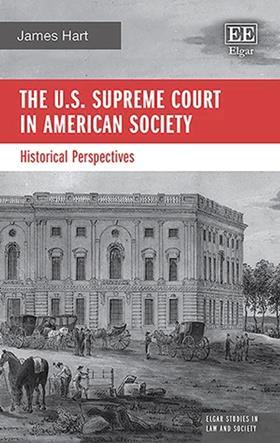
The U.S. Supreme Court in American Society: Historical Perspectives
James Hart
£85, Edward Elgar Publishing
★ ★ ★ ★✩
The US Supreme Court seems to have glamour that does not quite attach to its British equivalent. Maybe it is the ubiquity of American culture in the west over the last century or so. Whatever the reason, names such as Roe v Wade, or Brown v Board of Education seem to hold some mystique that cases from our own Supreme Court do not.
James Hart, a constitutional law scholar, sets out to provide a brief overview of the role of the Supreme Court in US society. It is not a work for historians, who would find it too brief, and is probably written for the educated layperson, with or without a legal background. The structure is a simple but effective one. Different key historical periods are arranged thematically, with each era given a context-setting description, followed by a summary of the law and where the key cases fit into the era. Each section concludes with a short biography of one or two judges from each period.
Hart’s reading of history is undoubtedly Whiggish and progressive – it would be interesting to know what his view is of more recent decisions which seem to favour the executive branch – which has the benefit of creating a clear and readable narrative.
In Hart’s hands, history has more than a hint of melodrama. It has grand moral themes; individual liberty and equality among them. It has dramatic twists; Brown, or Dobbs v Jackson Women’s Health Organization overturning previously touchstone precedents. It has heroes: John Marshall, who effectively created the Supreme Court’s judicial review jurisdiction. There are villains: Roger Taney, whose ham-fisted attempt to square the circle of a liberal constitution permitting slavery in Dred Scott v Sandford contributed to the outbreak of the civil war. There is even an anti-hero: Antonin Scalia, whose politics Hart unquestionably abhors, but whose wit, intellect and humanity he undoubtedly admires.
This work is genuinely enjoyable. It is readable, admirably short and would probably appeal to general readers with a bit of interest in the subject. The US’s 250-year history has been relatively short but rarely dull. And as Hart illustrates, the Supreme Court has often been at the centre, both shaping and being shaped by that history.
James E Hurford






No comments yet