





















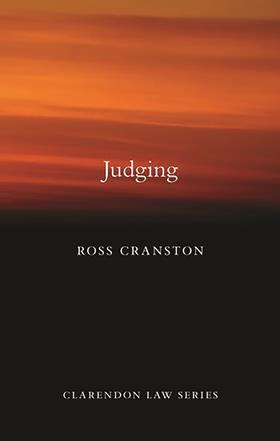
Judging
Ross Cranston
£45.99, Oxford University Press
★★★★✩
Globally, judges and lawyers in general are under pressure. An International Day for Judicial Well-being was held on 25 July, a United Nations-recognised day established to highlight the physical, mental and emotional demands on judges and judicial staff. Dictatorial regimes restrict the legal profession, selecting only judges who make decisions which the government wants.
Here, jury trials are threatened, despite the evidence that this will not deal with the backlog. There is criticism of ‘activist’ judges, leading to individuals fearing for their safety. This book is a timely and important study of the art and significance of judging.
Any book with a biographical essay more than 50 pages long wins my approval. This is a valuable reference source on judges. Ross Cranston, a professor of law and former High Court judge, writes from a historical and worldwide perspective.
Cranston looks at judicial guidance and codes of practice, structural protections for judges, and the behavioural rules for judges both in and away from court. There are sections on the legal and policy framework for judging, judgecraft and judicial decision-making. Judicial appointments, work conditions, fact-finding, litigants in person, ex tempore decisions and influences on decisions are all covered.
Clearly, there is an overwhelming case for valuing the judicial system and its heritage of impartiality built on past struggles. Judges and legal professionals, however, face great challenges. In some places, thousands of judges and prosecutors have been detained as ‘suspects’.
I enjoy reading about the characters who have courageously stood up for justice. In the 1940s, the lord chancellor tried to persuade Lord Atkin to change his dissenting judgment in Liversidge v Anderson, a case about whether wartime detention without trial could be challenged in court.
In his speech, Lord Atkin stated that the views of his fellow judges in the majority were ‘more executive-minded than the executive’ and that their judgment was ‘a strained construction put on words with the effect of giving an uncontrolled power of imprisonment to the minister’. Lord Atkin’s view was that the phrase ‘reasonable cause’ in the regulations indicated that the actions of the secretary of state were meant to be tested objectively. Did it mean what a government minister deemed reasonable, or could its reasonableness be examined by a court? He added: ‘I know of only one authority which might justify the suggested method of construction.’
He cited Humpty Dumpty in Lewis Carroll’s Through the Looking-Glass, and what Alice Found There, who said: ‘When I use a word, it means just what I choose it to mean – neither more nor less.’
Atkin did not amend his speech. He was effectively ostracised by his judicial colleagues thereafter.
This characteristic of making decisions which are legally right, but unpopular or misunderstood, is vital to a democracy. In 1914, the great constitutional lawyer Dicey wrote that the judge’s duty ‘is not to remedy a particular grievance, but to determine whether an alleged grievance is one for which the law supplies a remedy’.
There is an interesting section on independence and unconscious bias. In an address to students in 1920, Scrutton LJ defined unconscious bias as ‘not… conscious impartiality; but the habits you are trained in, the people with whom you mix, lead to your having a certain class of ideas [and] you do not give as sound and accurate judgments as you wish’.
Impartiality and independence are not only about selection and political respect for the role. Pay and pensions, retirement ages, appointment procedures, career structure, and integrity are all vital elements of a healthy and independent judicial system. In some countries, troublesome judges have been ‘retired’ early, demoted or overlooked for promotion.
This is an excellent book. But there could have been more on the need for judges who are or were solicitors, and also on the role of specialist tribunals.
David Pickup is a partner at Pickup & Scott Solicitors, Aylesbury






No comments yet