























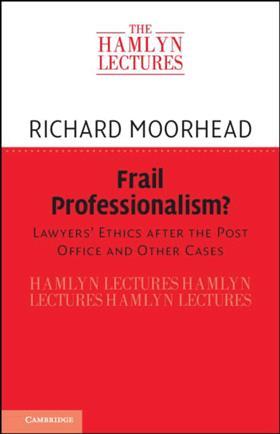
Frail Professionalism? Lawyers’ Ethics after the Post Office and Other Cases
Richard Moorhead
£105 (hardback), £32 (paperback), Cambridge University Press Free digital version
★★★★★
When I finished reading this book – based on Richard Moorhead’s Hamlyn Lectures – I thought: ‘Well, that was depressing.’
Like many of you, I listened to the Post Office Inquiry and read Nick Wallis’s work. On Twitter (as it was then) I asked: ‘Will there be action against the lawyers?’ Stony silence from my legal followers. Nada, nothing. It must be that we do not see fault in ourselves; we are all just doing our job, no?
Where I wonder is the legal profession’s Cassandra? Maybe it is Moorhead, but I hope not because we cannot afford to ignore this text.
Moorhead takes us on a whistle-stop tour of the awful things that lawyers have done, failed to do, and more. His text encompasses the PO scandal, the banking crisis, unfair contracts, NDAs, SLAPPs, dodgy disclosure, abuse of legal privilege (to avoid disclosure), plea bargaining, abuse and suppression of expert evidence, and silencing potential whistleblowers. The list goes on and on; it is damning.
I know that none of us does well when we are criticised. But the behaviours, thinking and ways of lawyering must be widespread and likely not confined to the cases the writer presents. There are a few examples of good practice, where lawyers are recorded as saying something like, ‘this doesn’t seem right’, but they seem few and far between.
The sad truth, we are told, is that lawyers think they are better than others. We are right. It is hard for us to see ourselves as others do. I am told that we are universally hated – and reading this text will give you some insight into why.
This is an exciting read. Problems with in-house lawyers and external lawyers doing everything they can to please their clients. To get and keep the business. To be ‘commercial’. Not to go behind clients’ instructions and not to go ‘too deep’ – to just carry on without thinking or reflecting upon the bigger picture. We are supposed to be independent and impartial. Integrity ought to be core to our work.
If you think this is about junior lawyers – yes, it is, but it is actually about all of us, including the most senior solicitors and KCs. The problems are endemic and the writer goes to some lengths to explain them.
He notes a widespread complacency about professional ethics. He quotes research showing that most of us do not know our professional rules anyway. But as he notes, ‘We speak of lawyers’ ethics, but they are also properly understood as rules. Laws.’
What is clear from the evidence of lawyers in the PO inquiry is that they only acknowledge wrongdoing with the ‘benefit of hindsight’. Well, obviously, we are all better practitioners when we properly reflect on our practice. However, such reflective work seems rare as a profession.
Maybe the SRA’s proposals are good ones? There would be ‘three-hour mandatory ethics “discussions” every year where solicitors talk about their approach to ethical dilemmas to help them decide on the right course of action if they are confronted with the same situations in practice. Where a competence concern has arisen with a solicitor or other law firm worker, they would be required to complete specific learning and development work. But Birmingham Law Society has pointed out that such training would be too expensive and prescriptive, and that it is being done anyway. This view is likely to echo across the profession.
Reading Moorhead’s book, as a profession, we need to welcome these changes and consider yet more radical action to move away from being a ‘frail profession’ to one that is robust and thriving instead.
Jo O’Sullivan
Frail Professionalism? Lawyers’ Ethics after the Post Office and Other Cases
★★★★★
Although it provides the principal case study, this is much more than another book about the Post Office Horizon scandal. The author instead uses the history of that miscarriage of justice as a launching point to explore wider questions about legal ethics and the behaviour of lawyers and legal institutions.
The book’s particular strength is in looking beneath the failures identified by it and other books, to examine why they may have arisen. It develops an intellectual framework through which professional behaviour can be understood and analysed, providing a basis for applying the lessons of the scandal more widely.
Moorhead’s analysis is convincing. Lawyers, he argues, are ‘frail gods’: professionals possessing an elevated self-perception but nevertheless subject to the same psychological weaknesses as everyone else. Add professional zeal, adversarial habits, commercial pressures and established professional orthodoxies, and the ingredients for ethical failure become apparent.
The author develops a vocabulary to explain these phenomena. ‘Legal aggression’ describes the use of positions that are arguably legal but probably unlawful or misleading. ‘Legality illusions’ describe appearances of legality that can conceal something more troubling, while ‘irresponsible orthodoxies’ are routine professional practices which become normalised despite their potentially harmful consequences. These are not merely memorable labels. Moorhead carefully develops the academic arguments behind each and demonstrates how they interact.
The Post Office examples make the analysis particularly powerful. The problems extend from the drafting of the (unfair) subpostmasters’ contracts for the Post Office (an issue which often escapes attention), through civil proceedings brought in reliance on those contracts, to related criminal proceedings. Moorhead’s formulation that information was processed according to what was ‘arguable or helpful’, rather than what was ‘true, fair, and balanced’ captures much of his concern.
The book is commendably clear and accessible despite its academic basis. Some passages are more intellectually demanding, but they are sufficiently brief and well contextualised to reward rather than alienate the reader.
Moorhead’s proposed route back to ‘proper professionalism’ is more challenging. He advocates greater integrity, contextual thinking, active independence and consideration of harm, and a willingness sometimes to say: ‘It may be lawful for you to do X, but I will not do it’.
Yet concepts such as truth and, particularly, fairness, which are key to his concept of integrity, inevitably involve an element of judgement. The challenge is to translate these broader notions of professional responsibility into standards which guide lawyers without unduly constraining legitimate professional judgement.
Sean Gordon








No comments yet