























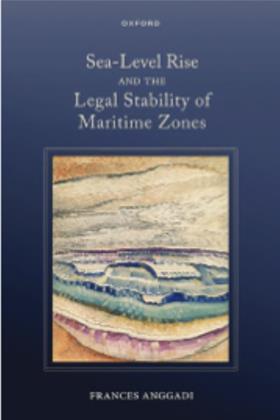
Sea-Level Rise and the Legal Stability of Maritime Zones
Frances Anggadi
£105, Oxford University Press
★★★★★
Sea-level rise is challenging some of the fundamental assumptions underlying international law. Because maritime entitlements under the United Nations Convention on the Law of the Sea (UNCLOS) derive from land territory and are measured from coastal baselines, the erosion or inundation of coastlines raises the possibility that maritime zones may shrink or even disappear. Frances Anggadi addresses this question through a timely and rigorous examination of whether maritime zones can be preserved, notwithstanding the physical consequences of climate change.
Anggadi challenges the traditional assumption that changing coastlines must necessarily result in changing maritime entitlements. Rather than arguing that the preservation of maritime zones requires an amendment to UNCLOS, the author develops a doctrinal framework through which the emerging notion of the legal stability of maritime zones may be accommodated within the existing convention. Her analysis is grounded in the rules of treaty interpretation and in an expanding body of state practice, including international declarations and domestic legislation.
This methodological approach represents one of the book’s principal strengths. The debate surrounding sea-level rise and maritime entitlements inevitably involves important considerations of equity and the vulnerability of small island developing states. The author carefully examines how the evolving practice of states may influence the interpretation and application of UNCLOS. In doing so, the book moves the discussion beyond the simple opposition between an orthodox understanding of ambulatory maritime limits and the political aspiration to preserve existing entitlements.
The resulting analysis highlights a broader tension between legal stability and environmental change. Maritime zones perform an essential function in organising jurisdiction and allocating rights over marine resources. If they were to fluctuate continuously in response to changing physical conditions, the consequences could extend beyond the loss of particular entitlements and generate wider uncertainty concerning the legal organisation of maritime space. The preservation of maritime zones, therefore, is not simply a question of protecting vulnerable states, but also of maintaining certainty and predictability within the international legal order.
The book’s reliance on the growing body of state practice is especially significant in this regard. Recent international declarations and domestic measures increasingly reflect a preference for maintaining existing maritime zones, notwithstanding sea-level rise. By examining this evidence through the framework of treaty interpretation, the book provides a principled explanation of how international law may respond to a challenge that was not fully anticipated when UNCLOS was adopted.
There are important questions about the relationship between treaty interpretation and modification. The more the law moves away from the traditional understanding that maritime entitlements follow changes in the coastline, the more significant the question becomes regarding whether such a development can be accommodated through interpretation alone. Yet this tension does not weaken the book’s contribution. On the contrary, it reflects the importance and difficulty of the problem with which the author engages. The book provides an essential framework for evaluating precisely how far the interpretative evolution of UNCLOS may extend.
More broadly, it contributes to the growing debate concerning the adaptability of international law in the face of environmental transformation.
Simone Mamini is a doctoral researcher in law and a visiting lecturer in maritime and international law at City St George’s, University of London








No comments yet