

























Jo Delahunty KC and Dana Denis-Smith, chroniclers of the experience of women in the legal profession, talk to Eduardo Reyes about remaining obstacles to true gender equality
In one sense, the conversation related below began in 1919. In that year, the Law Society and Bar Council responded to the certainty of legislation requiring women to be admitted to the law through the Sex Disqualification (Removal) Act by changing their rules to allow women to qualify as lawyers. As the Gazette’s commissioning editor during the centenary, I entered the orbit of two prominent chroniclers of the experiences of women lawyers.
This looming milestone drove Dana Denis-Smith, now deputy vice president of the Law Society, to create the First 100 Years project. This is a digital archive to save and promote the lives, experiences and achievements of women over the past century.
Also in the centenary year, the venerable public education institution Gresham College appointed family law silk Jo Delahunty as its professor of law, for which she delivered a series of lectures on women in the law.
In this regard, the college did rather better at marking the centenary than the organisers of the Reith lectures. Their choice of lecturer in 2019 was Lord Sumption, who, when a Supreme Court justice, forecast in an interview that it would take 50 years to achieve gender equality in the judiciary.
Next week sees the publication of Delahunty’s book We Set The Bar – Fighting for Equality, Empowerment and Change within the Legal Profession. Denis-Smith, along with former Family Division president James Munby (who sadly died on 1 January), was among a handful of lawyers who read the book pre-publication for reviews.
We Set The Bar is a personal account of Delahunty’s journey to leading family law silk and recorder, which morphs into a vehicle for giving voice to the people and issues she encounters along the way. That takes into account the significance of legal aid and the tragedy of its demise. She relates other women’s accounts of sexual harassment and bullying in the legal profession, contrasts that experience with the generous and intelligent women and men who helped her entry into the law and her career, and makes a point of celebrating champions of women’s equality.

‘I wrote the book because I think the divide between private wealth and those who act in private wealth cases, and the legal aid clients and those who act in legal aid cases, is becoming an unbridgeable divide,’ Delahunty begins. That, she says, is true, ‘both in terms of pay and work conditions… I consider legal aid to be the fourth emergency service and I’m passionate about it’. While the book is about much more, she has dubbed it ‘a love letter to legal aid’.
The worldview she promotes involves a balancing act. In recounting ‘unflinching’ accounts of harassment and bullying (of younger women barristers in particular), and criticising the bar’s poor record on diversity, the book is something of an exposé – a blow-by-blow account of her profession’s failings and outrages.
But she also aims to encourage people from diverse backgrounds to aim for a legal career. She champions the good done by family law practitioners, and the importance of the law, not least in public inquiries, where it can secure accountability. (She acted for victims and victims’ families at the Hillsborough Inquiry.)
Delahunty’s own background is modest. Her mother was a single parent living near a large, tight-knit working-class family in Finchley, north London, where she attended the local comprehensive school.
Delahunty’s mother took a job at a law firm where she observed the solicitors had a rewarding and secure career, and formed the idea that her daughter Jo should be encouraged to aim for it. She also determined that Oxford was a good university to set a lawyer on a good career path. Delahunty recalls being marched by her mother into St Anne’s College, where they asked the porter at the gate how one got in.
Instead of being sent away, college principal Nancy Treneman was produced to explain, in encouraging terms, the admissions process.
Interviewed by Ruth, now baroness, Deech, she was made an offer. While she describes the ways she did not fit in – at Oxford and later at the bar – Delahunty also stands out for not trying to fit in too hard.
Always sporting bright red lipstick, with prominent tattoos and many piercings (‘My lipstick is my armour!’), she says of her start at the bar: ‘I had dyed blonde hair, thick eyeliner and I looked naughty. I looked like the secretary you might want to go and have a fling with, rather than the barrister that’s going to appear in court, and the voice was just too much on top of it because at that stage, back in the 1980s, 1990s, having a London accent, there was an automatic assumption you were thick.’
Accent has been one concession, she notes: ‘Gradually, my accent dropped and it only comes back now when I’m with my proper family. Then I immediately fall back into the voice that I was born with and what I heard around me.’
'I think the divide between private wealth and those who act in private wealth cases, and the legal aid clients and those who act in legal aid cases, is becoming unbridgeable'
Professor Jo Delahunty KC, 4PB
Denis-Smith is also somewhere very different to where she started. She grew up in Romania, where the despot Nicolae Ceaus’escu was in charge until his execution in 1989. Nevertheless, arriving in the UK, her career led her to the opposite side of the divide that Delahunty worries is becoming unbridgeable. She was a business journalist before retraining as a lawyer and qualifying with magic circle firm Linklaters. She then turned entrepreneur, founding successful legal services provider Obelisk.
With her election as deputy vice president of the Law Society, she is on the path to the presidency in 2027. Will she be leading a single profession? ‘I trained in the City, so I come to it from a very different angle,’ she says. ‘I operate in the business world. What unites us is this idea of guardians of the rule of law, and many people that come into the profession believe in it.’ As a business lawyer, she nevertheless worries about ‘a huge crisis, both in criminal justice and legal aid’.
The contribution made by lawyers to society generally needs to be better understood, she argues. Business lawyers’ work involves ‘underpinning the economy… creating jobs’, a point which requires emphasis.
I note that there is a difference in tone between Delahunty’s approach to writing about the profession (‘unflinching’) and Denis-Smith’s. The latter stresses achievement, celebration and progress (her current project is titled the Next 100 Years). What, then, is her reaction to a book like We Set The Bar?
‘I care about biography because it is important to illustrate women’s achievements through their life story,’ Denis-Smith says. ‘That’s why I’m happy Jo wrote the book, because I think that is the most important thing.’ In ‘actually telling the story’ of her career, she adds, Delahunty is ‘showing the path and showing that access is possible… I know, from having tried to unearth all these stories, that there’s a poverty of evidence of how women have contributed to the legal profession’.
Whereas, Delahunty points out, surveys show that many would leave the legally aided bar ‘in a heartbeat’, in the commercial law sector, there are more options. And on diversity, the self-employed bar comes with disadvantages. Denis-Smith notes: ‘The bar has run itself very well for hundreds of years by not paying pupils and bringing people in and expecting them to volunteer, for the privilege of being at the bar… I know it’s self-employed but they need to recognise that that lack of… fair pay’ [is something] ‘they can’t do’. That professional structure, she notes, ‘is an inherited problem’, but one that needs tackling.
By contrast, training contracts and apprenticeships at commercial law firms can mean a better start, with less attrition.
The conversation turns to sexual harassment and bullying. Since the legal profession’s #MeToo moment, high-profile men have left positions of power at major law firms and elsewhere following accusations of misconduct. Cases continue to be brought at the Solicitors Disciplinary Tribunal and Bar Standards Board.
As Delahunty notes, these issues have not dissipated as a younger generation moves into and up the professions. The ‘common link between an abuser and the abused is that the abuser’s got power and abuses that power in order to abuse someone’, she notes. It is ‘inconceivable to me that we still tolerate’ defences of bad behaviour that include ‘I was drunk, I didn’t know what I was doing’. The Harman Report on harassment and bullying at the bar, Delahunty points out, examines extant problems.
Power is the common factor for Denis-Smith, too: ‘I’ve never come across a person who was a bully who ended up being forced out. The victim tends to be the one that leaves.’ The impact is obvious, she notes: ‘It erodes our credibility if your conduct isn’t right… I think we’re seeing a rise in sexism and misogyny around the world, amplified by social media, and it is making its [way] back into the workplace.’
Do Delahunty and Denis-Smith have questions for each other? They do, of course.
'I’d like to move the conversation to the point where women just accept they are the majority and they have to redesign the world around them to fit their majority'
Dana Denis-Smith, deputy vice president of the Law Society

Delahunty asks of Denis-Smith: ‘Based on the respect I have for [your] work, of the First 100 Years and then the Next 100 Years, my question is: do you think the work, the historical archives that you’ve created, are making a difference to the way we look at the next 100 years with how we see people and how we see the distribution of power?’
Denis-Smith replies: ‘I very much hope that my thousands of hours of work are actually contributing towards something… Do I think we managed to reframe some of the debate? I think so… Women have started to understand their place in history, which is important because they haven’t built enough on that legacy. I think it has moved the conversation. I’d like it to move the conversation to the point where women just accept they are the majority and they have to redesign the world around them to fit their majority, which is the next stage.’
That work is, Delahunty responds, ‘galvanising, illuminating, stimulating’.
Denis-Smith’s question centres on organisations ‘like the Law Society, the Bar Council, the Inns. Institutions are under attack around the world… it’s not like people love institutions,’ she notes. ‘What do you think the institutions’ roles should be?’ In particular, she wants to know the barrister’s view ‘to help me shape what I could see as a useful outcome at the end of my presidential year… to drive the right changes around behaviours in the legal profession’.
‘The organisations, whether it’s the Law Society or the Bar Council or the Inns, for example, all do an incredibly important job because they are a collective body of learning and also influence and power,’ Delahunty replies. ‘But where the message may get lost is that, by virtue of their amorphous structure, [an organisation] doesn’t have a figurehead to say the words and to make them feel articulated.’
For women in the law, Delahunty thinks that the election of last year’s Bar Council chair, Barbara Mills KC, and the current chair, Kirsty Brimelow KC, are ‘really worthy of celebration and promotion because if you personalise someone’s achievements, it gives a route for others to follow’.
She also praises former Law Society president I. Stephanie Boyce, the society’s first Black president, ‘who makes such a difference whenever she’s speaking’.
‘Personalising the principles makes them more powerful… so if you’re not afraid of being a figurehead for change,’ she says, addressing Denis-Smith, then she can make sure that what she stands for ‘goes beyond your profession. Personalising it is a really powerful statement’.
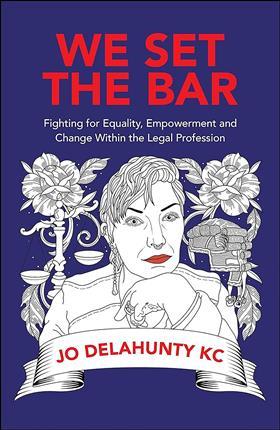
- We Set The Bar – Fighting for Equality, Empowerment and Change within the Legal Profession is published by Bristol University Press on 31 March












No comments yet