


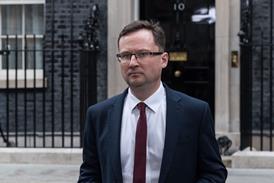



















Dropping one element of a bad package does not make the remaining elements good law, the shadow justice minister told MPs on Tuesday. Kieran Mullan had already teased his opposite number Sarah Sackman for abandoning plans to have some indictable offences tried without a jury – a reform she had previously said was unavoidable if the Crown court backlog was to be brought down. But Mullan’s main point was broader: the amended Courts and Tribunals Bill still attacked jury trial and still did not address the law’s delays.

Clause 1 of the bill will remove the right of defendants to insist on a Crown court trial if charged with an offence that could also be tried in the magistrates’ courts. A government impact assessment suggests it will reduce the number of jury trials by 5,500 a year. Ministers want to stop defendants gaming the system, delaying their trials in the hope they will never happen.
The Bar Council opposes this restriction on the right to trial by jury. I disagree. Parliament has already decided that these offences are fit to be tried by magistrates. Parliament could easily decide that they should be tried only by magistrates. Under the bill, there is at least a discretion: magistrates could still decide that a particular case should be tried by a jury, presumably because it was so serious.
Magistrates may be less likely to send a case to the Crown court if ministers increase their sentencing powers, as the bill will allow them to do. That, too, would be a curb on jury trial.
But there are risks. If magistrates take on too many heavy trials, they will not have the time to get through their normal workload. If they pass longer sentences than offenders would have received in the Crown court, prisons may again become overwhelmed. So ministers will have the flexibility to shift the maximum sentence magistrates can pass for a single offence between six, 12, 18 and 24 months.
Perhaps the most worrying curb on jury trial is in clause 4. This not only allows complex or lengthy indictable offences to be tried without a jury if one or more of the defendants is accused of fraud, tax evasion, false accounting, insider dealing, money laundering, terrorist funding or bribery – and none of the defendants is accused of homicide or a specified serious sexual offence. It also allows ministers to add or remove offences from that list of complex or lengthy offences.
As the shadow justice secretary said, ‘this would give the government the power to resume its attack on jury trials without proper scrutiny or debate’. The proposal was a disgrace, said Nick Timothy. Conservatives would reject it emphatically.
The bill received a third reading by 301 votes to 193, with all opposition amendments defeated. But the government made some additions and one of these will establish an independent review of the bill’s main provisions. It will not consider whether the legislation has reduced court backlogs, as might have been expected. Instead, the reviewer’s task is limited to examining whether any of the reforms ‘has created or exacerbated any differences in treatment or in outcomes as between defendants of different racial groups… or defendants of different socio-economic status’.
This, explained Sackman, was because people from black and ethnic minority backgrounds were more likely to be victims of crime – and also because defendants from black, Asian and ethnic minority backgrounds were more likely to be remanded in custody before trial. Gaps in the data made these disparities harder to understand and tackle, she explained.
But that was not how the Conservatives saw it. ‘Once again, the party opposite is trying to engineer judicial outcomes based on identity rather than treating us all as free individuals accountable before the law,’ said Timothy. ‘We will resist this and stand for the principle that it is only our actions that matter, not who and what we are.’
How a review could engineer judicial outcomes was not immediately obvious. But Timothy was presumably suggesting that changes would be made if the reforms were found to have put minorities at a disadvantage.
While supporting juries, the shadow justice secretary also sounded a note of caution. There was increasing evidence that some verdicts had been compromised by the political or religious bias of some jury members, he said. ‘If those who break our laws walk free because jurors feel kinship towards them,’ he added, ‘justice is no longer blind.’
‘Almost all defendants facing trial in the Crown court will continue to be tried by a jury,’ Alex Norris told MPs. But what about those who will no longer face Crown court trial as the result of his bill? Will the magistrates’ courts be able to cope? Time alone will tell.
joshua@rozenberg.net









No comments yet