























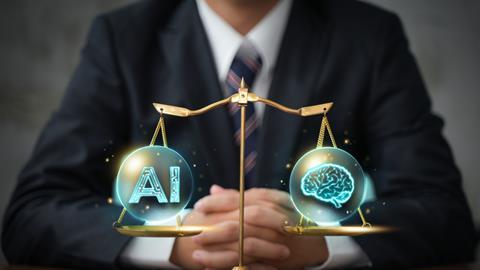
So much material has been produced on AI and the law over the last week that I feel the need for an AI agent to sort it into a manageable summary.

Only joking! The attraction of writing comes from mistakes, idiosyncrasies, oversights and amplifications slowly produced by a human, not the flat sheen of automated text.
Reading last week’s material makes me realise even more that there is a division between those who welcome, and those who are enraged by, the arrival of AI. I shall say at the start that I support what Tina Brown wrote in her Substack about the Trump gathering of AI bosses to launch a supposed international AI code:
‘The sight of the AI gods surrounding Trump at his White House luncheon for Joint Commitment on Frontier Responsibilities said it all: the combined fortunes round the table were in the multi trillions but the combined EQ of his guests was less than Trump’s age. Without ever being asked to either vote for or design it, humanity is being hijacked and bent into a direction dictated by an uber race of emotional metronomes and the money slaves who promote them.’
I congratulate those who have contributed their thoughts over the last week to what is overwhelming us, with the aim of setting a direction for the Law Society and the profession. We need to think and act fast, and some are trying to do that.
For instance, the Law Society has been quick out of the gate with its new research on agentic AI (systems which can take actions and execute multi-step tasks independently of humans). The headline is that the justice system is not ready for agentic AI, which is moving faster than the rules needed to govern it. There must be accountability, transparency and oversight of the systems i.e. new regulation. I support that fervently, but good luck with persuading the giants behind the Joint Commitment on Frontier Responsibilities about it.
I also congratulate Matt Gingell, a Law Society Council member, who has produced a paper called ‘Law out of time’ sub-titled ‘Artificial intelligence, climate change and the stewardship of legal legitimacy’. I will not deal with his content on climate change, although his thesis is that the two challenges are closely intertwined.
Read more
Regarding AI, he suggests that ‘Artificial intelligence turns law from a professional craft into infrastructure’. Legitimacy stops attaching to individual professionals or individual decisions, but attaches instead to the systems that produce outcomes: who designed them, who oversees them, and who answers for them when they get it wrong. He says that solicitors are not an end in themselves, but the means by which the legal system has historically delivered trusted human judgement, ethical restraint and accountability. His thesis is that the Law Society should continue with its current role, representing those in the new dispensation who provide judgement where law meets uncertainty or, maybe more particularly, who are needed to police the ethical boundaries of automated legal infrastructure.
His views were exceeded by the prophet of the demise of the legal profession, Richard Susskind, when he was speaking at last week’s IBA annual conference in Copenhagen. He said that it is fallacious to suppose that there can never be a substitute for human judgement; this is a ‘judgement misjudgement’, since machines can already handle uncertainty in many cases better than humans. In the short-term, lawyers will be licensing content and systems, and AI is for use by lawyers, but in the long-term, it is for use by non-lawyers.
I believe that there is a number of issues which are overlooked or minimised by all these contributions.
First, criminal and family law hearings cannot be swept up in AI generalisations. I can see many of the predictions applying to other civil law disputes, but they don’t and can’t apply to proceedings which depend almost entirely on the public hearing of human witnesses, victims, defendants and other principal parties.
Second, the contributions don’t sufficiently take account of agentic flooding. Solicitors are beginning to see this in complaints received from clients using generative AI. These, and the submissions made to courts and tribunals by litigants in person using generative AI, will be multiplied a thousand fold when agentic AI gets going. One of the speakers at the IBA in Copenhagen last week touched on this: ‘Public authorities may face appeals repeatedly. The cost of appealing decisions falls dramatically. Agents can submit appeals endlessly. Law was built assuming scarcity of intentionality. Delegated artificial intentionality challenges that assumption … we will shortly encounter ‘persistent agents’ - agents that continue even though their owners have died or that have been forgotten by their founding organisations.’ The law and the justice system will be gummed up.
Finally, last week’s contributions overlook growing human resistance to AI. The protests and refusals are merely beginning, starting with opposition to data centres, often because of their impact on the environment and on climate. There is the deskilling of the young, and dependence on systems beyond our legal reach. It is impossible to predict what a human wave of resistance might do.
I know where my heart lies.
Jonathan Goldsmith is Law Society Council member for EU & International, chair of the Law Society’s Policy & Regulatory Affairs Committee and a member of its board. All views expressed are personal and are not made in his capacity as a Law Society Council member, nor on behalf of the Law Society









No comments yet