





















Picture a ten-year-old at their school in Newcastle standing up in front of a packed classroom, arguing with complete conviction that a Jaffa Cake is, obviously a cake, and that anyone who says otherwise simply hasn't thought it through properly. She doesn't know yet that this exact question has been argued in a real courtroom. But in the moment, armed with nothing but her reasoning and her confidence, she is magnificent.
This is School Tasking. And moments like that one is exactly why it matters.
Yesterday, six teams of Year 5 pupils from across the UK and Ireland competed in the Champion of Champions Final, the culmination of a legal outreach project that began as a small pilot at Warwick Law School in 2021 and now runs at 34 universities across the UK and Ireland, with expansion to Iceland and Australia on the horizon. Every child who competed today had already won their in-school competition, their university heat, and their regional final. They earned their place on that stage.
The premise is disarmingly simple. School Tasking uses the format of the hit television show Taskmaster, tasks and absurdity. In our version, students from universities across the UK and Ireland teach children about the law and how to develop the skills that underpin it: oracy, advocacy, reasoning, critical thinking. Is a Jaffa Cake a cake or a biscuit? If a car is placed on roller skates on the road, is it actually on the road? These are not silly questions. They are the questions lawyers get asked every day.
University outreach in law has historically carried a reputation for being dry, complex, and frankly difficult to make exciting. There are no colour-changing chemical reactions or exciting experiments to demonstrate. What legal education can offer instead when done well is something arguably more valuable: the chance to discover that you have a voice, that your argument matters, and that the rules that govern all our lives are not beyond your understanding or your influence.
All of the schools competing today serve less-advantaged communities. That is not incidental. It is the point. For children who grow up in households where the law is something that happens to you through housing disputes, immigration processes, encounters with the police, the idea that you might one day shape it, argue within it, or even practise it can feel remote to the point of impossibility. School Tasking is designed to close that gap.
The rule of law is not an abstract principle. It shapes every aspect of daily life, from individual rights to the protections we all rely on when things go wrong. Yet for too many young people, particularly from less-advantaged backgrounds, the law feels like something distant, complicated, and not meant for them. When children are given the opportunity in a safe and encouraging space to argue their case and discover they can hold their own, something shifts. They begin to see themselves not as bystanders in the legal system, but as participants in it. Inspiring that sense of ownership, regardless of background or postcode, is central to what public legal education should be.
The future leaders of the next generation, who will sit on juries, challenge injustice, and hold power to account, are sitting in classrooms right now. Some of them were on stage yesterday. Whether or not any of them becomes a lawyer, they leave with something important: the knowledge that the law is theirs too.
School Tasking is expanding. But there are still millions of children who will never encounter public legal education in any meaningful form, who will reach adulthood without ever being told that they have rights, that they can argue, that the system exists to serve them. That needs to change.
Supporting programmes like this is not a nice-to-have. It is an investment in the kind of society we want to build, one where access to justice begins not in a courtroom, but in a classroom.
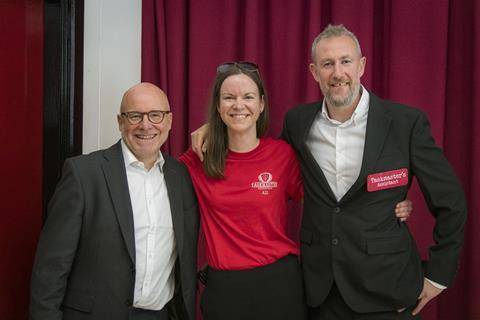
Dr Ali Struthers, University of Warwick, Richard Hermer KC, attorney general for England and Wales, and Alex Horne, creator and star of Taskmaster









1 Reader's comment