





















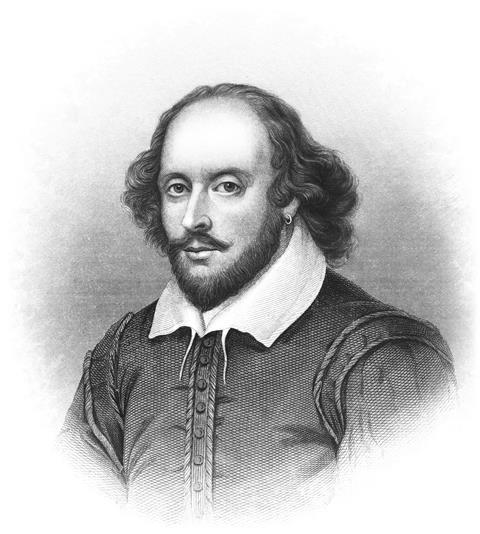
While it is William Shakespeare’s imaginary sister Judith, brought to life by Virgina Woolf in A Room of One’s Own as the personification of women’s oppression and lack of opportunity, who gets all the attention, in fact Shakespeare had four sisters.

Five years William’s junior, Joan was his only sister to survive to adulthood and the only one of his seven siblings to outlive him. Despite her oldest brother’s success – though unsurprisingly to anyone who’s tried researching women’s history – we know relatively little about Joan Shakespeare. What we do know is that she made an ‘unimpressive match’ with a hatter named William Hart – a man found in the archives most due to his array of debts – and later had four children, two of whom survived to adulthood. We also know that she remained in touch with her brother. Joan, widowed just a week before her brother’s death, is provided for in William’s will, part of which included the right to remain in a property on Henley Street in Stratford-upon-Avon where she lived until her death in 1646. This detail in the will is important. For it is in the rafters of the Henley Street property that Joseph Moseley – who had been employed to retile the roof in April 1757 – found an incomplete manuscript of what is now known as the 'Spiritual Testament', a document declaring the author’s commitment to Saint Winifred and Catholicism.
For centuries authorship of this document has been attributed to John Shakespeare. However, in 2024 Matthew Steggle, a professor of Early Modern English Literature at the University of Bristol, advanced the double thesis that not only was this attribution incorrect, but that the author was in fact John Shakespeare’s daughter and William’s sister: Joan. If this thesis is correct (and it seems at the very least plausible) Steggle concludes, ‘Joan Shakespeare Hart … is truly the “Shakespeare’s sister” of Virginia Woolf’s famous essay of 1925’: 'a figure so trapped by gender conventions that it seems there is no chance of finding anything she wrote or created. And yet perhaps there is a profoundly personal statement of her religious faith that had already been in the public domain for over a hundred years at the point that Woolf wrote her essay. [And so] … it is ironic, and sadly appropriate for Woolf’s thesis, that Joan’s spiritual testament has for all these years been wrongly assigned to her father.'
The location of the document in the rafters of Joan Shakespeare’s former home, as Steggle points out, is a serendipitous echo of Woolf’s imagining of Judith Shakespeare hiding her scribbles ‘in an apple loft on the sly’.
Of course, Steggle’s discovery demonstrates what Woolf and Shakespeare already knew: sisters – whether imaginary, familial or chosen (and whether or not they happen to have a famous brother) – matter. As legal historians we know this too. The lives and words of women – whether they be sisters, mothers, maidens, warriors, queens, widows, witches, lesbian, scholars, authors, law breakers – are vital to our understanding of history. But more than this our willingness to find, hear and amplify their voices matters. It matters not only in order to ensure the accuracy of the historical record (though this is important). Nor does it matter simply because recognition matters – that all contributions to a discipline should be acknowledged wherever and howsoever they come. Neither is it simply a case of credit and censure being given when they are due. Or simply a matter of seeing ‘people like you’ in positions of power, on bookshelves, in the archives, taking trips to the moon – though this too is important.
It matters – and matters most of all – because who the author is makes a difference to what and how a story is told. When I studied legal history in the mid-1990s there were no woman authors or indeed authors from the global majority on my reading list. It is no coincidence, of course, that the efforts and experiences of women or people from minoritised ethnic backgrounds rarely (if ever) arose in discussions in my legal history tutorials. This is less so the case today. Legal history particularly about women, and/or written by women, abounds. Its existence a practical demonstration not only that women were there too – that women have been making history, writing history, and shaping history all along – but also of seeking out others waiting in the archives. For when we do, we see that women were there all the time – just like Joan Shakespeare. We simply needed to make the effort to look. And when we do so – when we finally let them speak – we and our discipline are beneficiaries.
Erika Rackley is a professor of law at the University of Birmingham and co-hosts a history podcast Not for Want of Trying
This article is a revised version of the foreword to Celebrating Women in Legal History: Making and Shaping a Discipline edited by Lorren Eldridge, Emily Ireland and Caroline Derry, published by Hart Publishing