



















On a Crown court visit, rebel MP Charlotte Nichols and bar chair Kirsty Brimelow heard about what’s really ailing criminal justice. It’s not jury trials
Keir Starmer’s government defeated the first attempt by MPs to water down jury trial reforms, when the Courts and Tribunals Bill escaped the public bill committee largely unscathed. However, the battle is far from over.
Last week, Bar Council chair Kirsty Brimelow KC and Labour MP Charlotte Nichols visited Snaresbrook Crown Court to observe RASSO (rape and serious sexual offences) cases and speak to barristers.
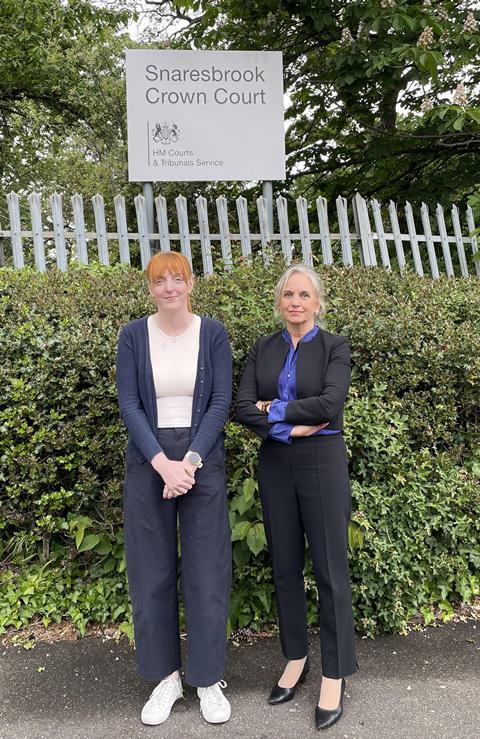
The bar has been campaigning vigorously against any curtailment of jury trials. Nichols, who delivered a powerful speech in the Commons about her experience of the criminal justice system as a rape complainant, wants specialist courts for domestic abuse and sexual offences to be introduced – something rebel MPs believe would render jury trial reforms unnecessary.
Speaking to me afterwards, Brimelow said: ‘The conversation with barristers started by asking them to put their hand up if they agreed on the proposal to reduce jury trials. Not one hand went up.’
Barristers spoke about defendants not being brought to court on time, ‘even at Woolwich, where HMP Belmarsh is next door’. Crumbling court infrastructure, plumbing issues, interpreters, tech woes and prosecutor workloads also came up. Barristers agreed that cases such as assaults on emergency workers should be heard in the magistrates’ court, not in the Crown court. A junior member of the bar pointed out that they learn their trade in smaller jury trials, such as burglary cases or possession of bladed articles.
'Even if the proposals get through in relation to jury trials, that will not have any impact until 2028. We’ve got disputed data on whether it will have any impact at all. You need to deal with what’s happening now'
Kirsty Brimelow KC, Bar Council chair
Ministers say the Crown court backlog will get a lot worse if they do not throw the kitchen sink at the crisis. A Courts Modernisation Bill was among the measures announced in this week’s King’s speech, though its prospects now appear more uncertain.
‘The difficulty of having so much focus on reducing jury trials is that it drains away time, energy and resources to get on with what will have an impact now,’ Brimelow said. ‘Even if the government’s proposals get through in relation to jury trials, that will not have any impact until 2028. We’ve got disputed data on whether it will have any impact at all.
‘You need to deal with what’s happening now. How do you do that? Open up the courts – the government has done that. Put money into the system – the government pledged a £34m increase in legal aid on 3 December 2025. They have not done it yet; there has been no consultation. That would address the workforce issue. Listings – you can learn from the courts having to get on with it themselves. It could be blitz courts or particular specialist courts.’ She points to Preston, Nottingham and Teesside, where delays have reduced. ‘Take these models and roll them out nationally.’
Brimelow and Nichols witnessed several technology issues during their visit. In one case, Nichols said the judge was ‘having to hotspot from their own phone’ because the wifi was not working. In another, a defendant was being cross-examined and digital evidence was being put to him, but the screen was not working. ‘The only thing today that was working on time was the jury,’ Brimelow said.
Talk turned to the Courts and Tribunals Bill’s journey through parliament and Nichols’ amendment for specialist domestic abuse and sexual offences courts. Even though rebel MPs secured a concession at the bill’s second reading with a seat on the public bill committee, Nichols said there was ‘no planet’ in which a committee with a minister and an in-built majority would accept her amendment.
‘On a practical level, I was putting it at committee stage as a probing amendment. I did not put it to a vote. It was to draw from the government their issues or concerns about the amendment. They came back and said there were reasons why the government couldn’t back it at committee stage. I’m able to take those things away.’ Nichols will retable a revised amendment for report stage, ‘when all MPs have the opportunity to vote on it’.
Nichols stressed that no one in the profession or at Westminster is arguing for the status quo. ‘All of us agree that the backlog is intolerable. We need to see serious reform. The point of difference is what that looks like.’
None of the barristers Nichols spoke to on Monday thought the jury trials proposals would change things for the better: ‘People raised a number of practical points about how they could end up inadvertently making the situation worse. As a legislator, my job is not to pass bills for the sake of passing bills. I want to make good law. I do not want inadvertent consequences.’
This article is now closed for comment.













3 Readers' comments