























With the Solicitors Qualifying Examination now in its fifth year, Joanna Goodman asks if its creators have kept their promises
The low down
‘The death of law as a learned profession.’ That was how one Cambridge law professor privately described the Solicitors Qualifying Examination at its inception. Perhaps it was the multiple-choice format of SQE1 that offended. Yet the SQE route is not easy. The failure rate fluctuates, but is never low. Indeed, that rate is itself controversial, especially in the context of entrance fees rising above inflation. Broken down by ethnicity, there is an attainment gap between white and non-white candidates. And does the SQE marque signal day-one competency? Obviously not. Government cuts to apprenticeship funding have hardly helped a route designed, among other things, to boost diversity. But we are where we are. Law firms and preparation providers are being creative as they strive to sustain the excellence that the professor feared would be lost.
The Solicitors Qualifying Examination (SQE) aimed to create consistency through a centralised assessment, provide quality assurance to the public and make entry into the profession more flexible. Introduced in the autumn of 2021, if SQE were a child, it would be preparing to start school in September. So how well is it delivering? Have the logistical and operational issues relating to taking exams and assessments been resolved? How are candidates and sponsor firms managing the new routes into the profession?
Pass marks
SQE1 and SQE2 assessments plus Qualifying Work Experience (QWE) replaced the Legal Practice Course (LPC) plus training contract route to becoming a solicitor in England and Wales.
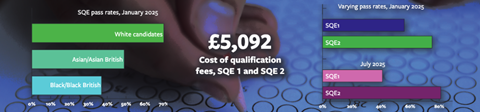
After four years, pass rates remain unpredictable. January 2025 saw a 56% overall pass rate for SQE1 and a 75% pass rate for SQE2. But in July 2025, only 41% of nearly 6,000 candidates passed SQE1. The overall SQE2 pass rate increased from 76% to 81% in 2025.
'If you don’t have backing, and you’re trying to find QWE too, it is more difficult
Lucie Allen, BARBRI
Although July’s low SQE1 pass rate cannot be attributed to the unusually high number of resit candidates, the Solicitors Regulation Authority reported that the July 2025 cohort was weaker than previous ones, based on performance comparison on common questions.
Lucie Allen, co-CEO of SQE training provider BARBRI, offers an explanation in respect of the correlation between funding and performance: ‘January sitters typically perform better than July sitters because most sponsored candidates sit January assessments. If you don’t have backing, and you’re trying to find QWE too, it is more difficult.’

On a positive note, more lawyers are qualifying via the SQE. According to the SRA, of all candidates who have attempted SQE1 – including those who have made multiple attempts – 19,281 (66%) have now passed. For SQE2, 10,718 (85%) of all who attempted it have now passed, across more than 30,000 candidates in 50 countries.
The financial and personal cost is high, nevertheless, in terms of exam and prep fees, time commitment and relentless pressure.
In August 2025, hundreds of candidates signed a petition calling for a fairer, more transparent exam. The petition was set up by a trainee solicitor who said the SQE had taken a severe toll on their mental, financial and physical wellbeing.
This pressure on candidates was acknowledged by SRA chief executive Sarah Rapson when setting out the SRA’s priorities for 2026. Rapson said: ‘The Solicitors Qualifying Examination is another major priority. It is encouraging that the SQE is helping to provide a consistent standard and improve diversity in the sector, but we also need to improve candidate experience and increase confidence in its operation.’
Price inflation
Cost is a major barrier to the SQE making the profession fairer, more accessible and more diverse. Notwithstanding the regulator’s stated priorities, SQE fees have risen 28% in four years, from £3,980 to £5,092 after this year’s increase.
Fees are payable for each assessment, so retakes are expensive. And preparation courses and resources require further significant outlay. Self-funding candidates and sponsoring firms have to take this into account as part of the overall expense of qualification.
Nir Chanoch, managing director of QLTS School, which provides preparation courses for SQE1 and SQE2, questions the rationale for increasing the SQE1 fee given its multiple-choice format. His argument is that while SQE2 is resource-intensive and involves written assessments requiring human marking, SQE1’s multiple-choice, computer-based format should be scalable and efficient to mark.
Stress test
A National Junior Lawyers Division survey published in April found: ‘Four in five respondents do not consider the examination fit for purpose. A similar proportion regard its fees as poor value for money. Nearly half of all respondents have spent over £10,000 on the process and a majority have encountered difficulties with the booking system, the examination environment, or both. Half of those who required reasonable adjustments found them inadequate.’
Moreover, when asked to rate the impact of preparing for the SQE on their mental health and wellbeing, the median score was 17 out of 100. Some 77% of respondents scored 30 or below on the mental health and wellbeing scale.
NJLD chair Harry Clark explains: ‘Some people have misinterpreted [the report] as the NJLD calling for the exam to be scrapped or saying that it’s too difficult, or not fit for purpose in that regard, whereas actually, most of the criticisms [relate to] the operative elements of the SQE.’
He asks: ‘Is it functionally fit for purpose in allowing people to find exam centres that are close to where they are and… providing an adequate resit process or appeals process?’
The section on mental health related to the intensity of SQE prep and the gruelling nature of the assessments. One respondent was unable to take their medication because they were not allowed to bring water into the SQE1 exam – which takes place over five hours with only one break.
The report concludes with eight recommendations, which cover education (making available past/sample papers and marking schemes, feedback on failed assessments, prep providers’ data transparency); finance (assessment and resit fees); and operation (location of test centres, ease of booking).
It called for further investigation into the mental health impact of the SQE on candidates and an appropriate candidate welfare strategy.
Law Society president Mark Evans observes: ‘The profession is coming to the SQE in greater numbers than before, so some issues are becoming more prevalent, while some have been solved and some are ongoing. The assessment booking system has been improved following feedback, while a new system for reasonable adjustments has been put in place. The Law Society is continuing to engage with the SRA to see whether these improvements have had the intended positive outcome.’
Ethnicity attainment gap
In January 2025, white candidates had the highest SQE1 pass rate at 70%, compared with 49% for Asian/Asian British candidates and 37% for Black/Black British candidates.
Between January 2023 and January 2025, the pass rate gap varied between 29 and 34 percentage points.
This is a perennial problem that existed before the SQE. In 2021, the SRA commissioned the University of Exeter to investigate underlying causes, but the gap persisted and widened in some areas in 2025.
While the SQE was promoted as a route to a more accessible and diverse profession, that promise remains unfulfilled.
‘The challenge is the numbers aren’t moving positively and we are still seeing disparate results across ethnicity,’ says BARBRI’s co-CEO Lucie Allen. ‘The University of Exeter report is inconclusive and primarily focused on the LPC and not the SQE, so it is not looking at what’s happening in the market now.’
The Exeter study did identify external factors influencing outcomes, including educational and socio-economic differences, lack of opportunity and support, discrimination and bias, and cultural issues in respect of ‘fitting in’.
It is also possible that aspiring solicitors from ethnically diverse backgrounds who struggle to find a training contract/sponsorship might be more inclined to self-fund, which tends to reduce performance.
Allen believes that the profession needs to move from discussion to action. ‘Following the Exeter report, the SRA has been convening stakeholders across the profession, training providers, City of London training, to talk about how we can make things better, but those sessions have turned into lunch-and-learns. The intention is good, but nothing demonstrable is moving the needle.’
More encouragingly, an SRA report on diversity in the workforce published in March reported that the proportion of Black, Asian and minority ethnic lawyers working in SRA-regulated firms increased from 14% in 2015 to 20% in 2025.
Day-one competency
There is general agreement that the SQE qualification does not give trainee solicitors day -one competency, particularly compared with the previous LPC/training contract route.
Patrick McCann is chief executive of the City of London Law Society and co-CEO of City Century, a collaboration of over 50 City law firms involved in qualifying solicitor apprentices. He was previously director of learning at Linklaters.
'When we meet candidates who have completed or are close to completing the SQE route, the gaps in foundational knowledge are noticeable and troubling'
Yulia Barnes, Barnes Law
‘The SQE is basically a licensing exam,’ McCann says. ‘It has two key purposes: to get candidates past a certain level of competence so that the SRA can say we’ve done what we need to do to protect clients from incompetence; and to prepare people to take an exam against day-one standards when they may not have previously worked in a law firm. We’re asking someone to perform as if they are qualified before they’ve actually worked as a solicitor. So we are setting quite a high bar.’
Yulia Barnes, managing partner at mid-size London firm Barnes Law, is concerned about the downstream consequences of SQE graduates starting training contracts with no practical legal experience. ‘When we meet candidates who have completed or are close to completing the SQE route, the gaps in foundational knowledge are noticeable and troubling. I am referring to an understanding of how firms operate day to day, solicitor ethics and the Accounts Rules. These are not peripheral matters; they are the bedrock of competent and compliant practice and failure in these areas carries serious consequences.
‘The SQE assessments are simply not an adequate replacement for the LPC,’ she adds. ‘The difference in depth and discipline is stark. I have found myself sourcing old LPC textbooks and encouraging our paralegals to read them, simply to give them a working understanding of how a practice operates, something that previously could be taken as a baseline when a trainee walked through the door.’
Debbie Moors is emerging talent manager at south of England firm Moore Barlow. The firm employs SQE trainees who sit SQE1 and SQE2 before they join the firm. Moors recalls a new trainee expressing concern about supervisors’ expectations, having been told that the SQE is designed to deliver day-one competence, but never having worked at a law firm.
Moore Barlow takes a proactive approach: ‘The reality is that [the SQE] does not deliver day one competence. That is what the training contract is there to do – to make trainees into competent lawyers.
'We have developed our own ‘Learn to Thrive’ programme, which focuses on the soft skills that trainees don’t necessarily develop on the SQE'
Debbie Moors, Moore Barlow
‘We also sponsor paralegals, and that is very different. When they get to the point of qualification, they are at least at the level of a NQ solicitor because they have to spend at least a year with the firm to be able to get sponsorship and then they take almost another year to complete the SQE. You cannot compare someone who has two years’ QWE with someone with no legal experience.’
Moors is concerned about the pressure on trainees to pass the SQE first time. ‘We allow one resit, but the pressure on individuals is immense,’ she says. ‘We have a good success rate generally, but we have had candidates who get brilliant scores in all the MCQ practice sessions, but it goes wrong in the exam.’

On resits, she urges: ‘Getting exam results sooner would make life easier. We have two intakes a year, in March and September. So if somebody fails SQE1, the chances are that their contract will be deferred until the following intake, because we need to give them time to do another prep course and another set of exams.’
Moore Barlow trainees also receive in-house training in professional skills, which were covered by the LPC, but are not part of the SQE. ‘We have developed our own “Learn to Thrive” programme, which focuses on the soft skills that trainees don’t necessarily develop on the SQE,’ Moors explains. ‘Communication skills, resilience, teamwork, commercial awareness, emotional intelligence – qualities that you’re not going to learn from a multiple-choice exam.’
Candidate perspective
Lucy Ewen, a trainee solicitor at Moore Barlow, sat SQE2 in January. She completed the Graduate Diploma in Law (GDL), and SQE1 and SQE2 before joining the firm.
Ewen emphasises that the assessments are difficult, but she considers herself privileged, as a well-educated candidate who is sponsored by her firm, and supported by SQE preparation training from BARBRI and others. ‘SQE1 is a multiple-choice exam, so a lot of the prep is about strategy and practice,’ she says. ‘SQE2 is about putting the legal principles covered in SQE1 into practice, and this may or may not be relevant to a trainee lawyer’s role, depending on which practice area they join.’
Ewen agrees that ‘SQE1 and SQE2 do not prepare candidates for working in a law firm’. She adds: ‘I had never worked in a law firm before, so I had never conducted a client interview. The SQE2 gives you 10 minutes to prepare for a client interview, and 45 minutes to complete legal research, which would never happen in real life.’

Prep transparency
The Law Society’s Evans acknowledges that SQE preparation is a critical success factor. ‘The Law Society is working with the SRA to better understand pathways to success in the ways aspiring solicitors are educated and train for the SQE, as there’s a wide training market and different pathways,’ he says.
‘We are also continuing to engage with the profession, the SRA and Kaplan to understand issues that arise with the SQE and where better information can be provided. Meanwhile, the Law Society has met with the National Junior Lawyers Division to discuss the findings from their recent report on the SQE. We will continue to work closely with them, as their concerns are incorporated into our ongoing work.’
Training resources are key because of the volume of content covered and the stressful exam conditions. QLTS’s Chanoch sat the SQE1 and SQE2 exams – and passed them – because he wanted to understand what would most help candidates.
Recognising the importance of the experience on the day, he built a platform and mock exams that replicated exam conditions as closely as possible. He created summary notes and resources that accommodated different learning styles, from postcards to audio.
Pricing and access to training resources are key. Clark highlights feedback on SQE prep from the NJLD report: ‘Our qualitative responses indicate that value for money [for SQE prep resources] goes beyond flat amounts; it is also about how long [candidates] continue to get access to training materials that they have paid for.’
'We have improved our trainee recruitment process, continuously talking to our trainee solicitors to see how we can tailor our recruitment'
Victoria Jackson, Preston Turnbull
There is an ongoing debate regarding data transparency. The SRA initially pledged to publish pass rates by training provider by late 2023. In February 2025, it attributed the delay to ‘unexpected problems with data quality’. In the absence of official data, providers rely on students voluntarily reporting their results. This tends to be skewed in favour of those who passed – with BPP reporting 83% for first-time sitters and BARBRI reporting 72% for engaged students completing 90% of the course.
Both Allen and Chanoch highlight the difficulty providers face in collecting meaningful data, as candidates are not obliged to report their results.
This is not an issue for law firms, which appreciate that the SQE is broadening routes into the profession and increasing their trainee recruitment options.
Victoria Jackson, director of HR, risk and compliance at City firm Preston Turnbull, considers the SQE to be a positive development. ‘We have improved our trainee recruitment process, continuously talking to our trainee solicitors to see how we can tailor our recruitment, learning and development support, and qualifying work experience, to support and guide [trainees] through the process,’ she says. ‘For example, we have found that candidates perform better if they complete at least the SQE1 before they join.’
Like others, Jackson is concerned about the pressure on candidates ‘to balance full-time work (especially in a new job) with intensive studying/exams. So we give them one day a week to focus on their SQE and time off for exams. We also have student support networks among the trainees, and BARBRI allows us visibility on student progress – which means we can step in and offer support when needed’.
Solicitor apprentices
Another route to the profession enabled by the SQE is the solicitor apprenticeship scheme, which is increasingly popular among firms of all sizes – and aspiring solicitors. These are typically six-year programmes, combining one day a week at a university or SQE prep provider with four days in the firm.
Many of the larger and mid-size firms publish their salaries, many of which include a sign-on or welcome bonus. Common starting salaries are around £30,000 in London and slightly less in the regions. Apprentices typically gain higher pass rates in SQE1 and SQE2. The diversity data is also encouraging: 42% of apprentices are from minority backgrounds and more than a third are from disadvantaged areas.
While the nature of legal apprenticeships means that candidates earn while they study, the ability of apprenticeship schemes to address the social mobility gap was threatened by the defunding of level 7 apprenticeships for people aged 22 and over in January 2026. The Law Society, City of London Law Society, City Century and many law firms opposed the government’s decision. While apprenticeships were lauded in this week’s King’s speech, there was no clear indication that funding will be restored for the level 7 route.
Just last week, training providers BARBRI and Damar responded by creating the level 6 Legal Professional apprenticeship for chartered legal executives.
As Damar CEO Jonathan Bourne explains, this is an all-age apprenticeship route to qualification into private practice and in-house legal teams. Like the SQE, it comprises two parts: Part 1 focuses on knowledge and skills; and Part 2 on the practical application. Assessment includes a practice-area-related dissertation. This approach is more realistic than the SQE1 in terms of both format and content.
‘The idea that a good lawyer can (or should) be able to have the entire syllabus at their fingertips (and from memory) does not reflect what is needed in practice,’ Bourne says. In terms of content, he is concerned that because of its structure, ‘the SQE is not keeping pace with the needs of the profession in terms of tech and AI, but also the human-centric skills that are AI-proof and crucial to apprentices’ future success’.
The funding changes are affecting access to the profession via apprenticeship schemes that were enabled by the switch to the SQE. East Anglia firm Ashtons Legal’s CEO James Tarling and its head of learning, Felicity Sparkes, run a highly successful legal apprenticeship scheme, with a 100% success rate.
Ashtons employs 11 apprentices – a combination of school leavers and graduate apprentices. Another 11 paralegals in the firm are self-funded SQE candidates. Apprentices get training from BPP University one day a week, as well as support from the firm. SQE candidates also benefit from a peer network of trailblazers who previously qualified through the firm’s apprenticeship scheme.
The key challenge is the intensity of SQE assessments. ‘The SQE combines the LPC, the PSC (professional skills course) and a training contract all in one,’ says Sparkes. ‘Having a degree doesn’t indicate that you will pass the SQE1 in particular, because you have to be trained to sit an exam in such intense conditions.’
SQE1 involves two long sessions of best-fit answer multiple-choice questions. ‘Our apprentices have been successful because they are tested from day one, sitting exams that are simulating those conditions, including the types of questions and the time pressure,’ Sparkes says.
SQE2 is a different challenge, she adds: ‘SQE tests them on best practice, which is often different from the day-to-day reality of a law firm. So you need to understand how to differentiate what you need to say [in an assessment] from what you would do in practice.’
Tarling believes that the apprenticeship route, which combines study and practice, is the best approach for SQE2: ‘If you’re more of an experiential learner, actually having that experience to apply to your exams can be really beneficial. If you’re just doing it in theory, you miss so much.’
Ashtons’ apprenticeship scheme is threatened by the level 7 funding cuts because it has a mixed cohort of apprentices. While those who started as school leavers fall within the age range of the apprenticeship levy, most of their graduate apprentices are over 22.
Tarling explains that while the firm is continuing to fund the current cohort, it will have to keep the situation under review in the longer term: ‘The business is in a difficult position because we want to give equal opportunities to everyone, but commercially that’s challenging.’
The SQE has provided opportunities for lawyers to qualify into areas of the profession that are traditionally underfunded. McCann is also co-founder with Victoria Fearne of the Social Welfare Solicitors’ Qualification Fund (SWSQF), which is supporting over 100 lawyers through the SQE.
This represents a major advantage of the SQE system. ‘One thing SQE has done is allow different routes into law, including for example for legal aid lawyers who can work full-time, study and then qualify. SWSQF has supported this by matching funding from commercial legal organisations with talented candidates, securing funding for over 150 and to date qualifying 52 social welfare solicitors, delivering access to justice to the most vulnerable members of society in the country.’
In modern times, the solicitor profession has always leant on the guarantee of a high-standard ‘gateway’ to the profession. For the public and businesses, that is intended to guarantee the probity and abilities of the solicitors they instruct. SQE is the latest ‘gate’, and as such the standards it imposes and its operability matter. Yet, the success of the profession rests on the development of many more competencies and much more knowledge, which is why law courses, firms and in-house legal departments are finding creative ways to augment the qualities and knowledge the SQE tests. Away from discussions about SQE, perhaps that is the best guarantee of professional standards we have.
Joanna Goodman is a freelance journalist







1 Reader's comment