





















This is not about defending Kanye West. It is about the risk of broad immigration powers being used reactively in a high-profile case, with limited routes for challenge and consequences far beyond the individual decision
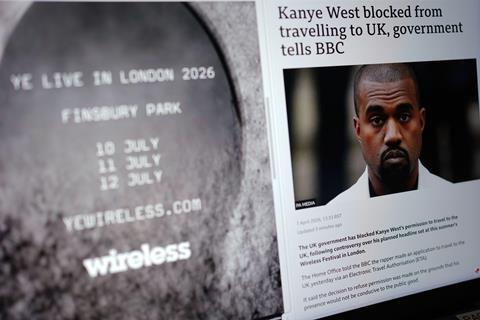
Ye, formerly Kanye West, was due to headline all three nights of Wireless Festival in London this July before the Home Office blocked his entry to the UK on the basis that his presence would not be conducive to the public good. The decision followed renewed controversy around his public statements and had immediate commercial consequences, with the festival subsequently cancelled.That said, there were already signs of mounting commercial pressure, including sponsors reconsidering their involvement, so the festival’s viability may in any event have been in question.

The legal issue is not whether Ye is a sympathetic figure. He plainly is not. It is whether broad Home Office powers are being exercised carefully, lawfully, and on a basis that would stand up to scrutiny in a high-profile case.
The starting point is straightforward. No one has an automatic right to enter the UK just because they are famous, booked for an event or commercially valuable. A high-profile booking does not override immigration control. However well known the individual, and however advanced the arrangements, the Home Office has wide powers to refuse entry where it considers a person’s presence not conducive to the public good.
So, this is not about suggesting the Home Office could not act. It plainly could. The issue is whether it did so properly.
That is where the issue deserves closer attention. Hard cases are often the ones where broad powers are pushed furthest, because there is very little public appetite to question the process. If the individual involved is provocative, unpopular or plainly offensive, there is a natural temptation to focus only on the outcome. But the rule of law is not tested by easy cases or sympathetic claimants. It is tested where public opinion strongly favours a result and the pressure to get there quickly is at its highest.
I am always wary of Home Office decisions that seem to ride a wave of public pressure. In high-profile cases, that pressure is rarely just political or media driven. There are often commercial pressures in the background as well. That is not because the Home Office cannot take a firm position where the threshold is met. It is because broad discretionary powers still must be exercised lawfully: rationally, proportionately, and on the basis of relevant evidence.
On the flip side, decisions to allow individuals to remain in the UK simply because they have gone to the press can be equally unpalatable, as they reward those with the loudest voices and disadvantage those who don’t have similar media access.
As has been reported, the decision in Ye’s case was made under the Electronic Travel Authorisation regime. This matters because ETA decisions – like applications for visit visas - do not carry a statutory right of appeal or administrative review. In practical terms, that means a decision with serious personal, family, commercial or reputational consequences may be taken without any straightforward appeal route at all.
Had Wireless gone ahead, I would have expected this kind of ETA cancellation to be challenged in the courts. It may still be possible by way of judicial review, depending on the facts and whether the issue is now treated as academic. But where the state is using broad discretionary powers in a high-profile case, and there is no direct appeal route, the quality of the decision-making matters even more.
It is also important to be clear about what is and is not being said. The absence of a relevant criminal conviction does not stop the Home Office relying on public good grounds. These powers are not limited to conviction-based cases. But where the case does not rest on a simple disqualifying conviction, there is even more reason to examine how the decision was reached. What material was relied on? Was all relevant context considered? Was the response proportionate? Was the decision made as a matter of law, or in reaction to a very public row? The Home Office’s own guidance, in line with case law, stresses that a decision-maker 'must be able to show on a balance of probabilities that a decision to refuse is based on sufficiently reliable information. Allegations, unsubstantiated and vague generalisations are not sufficient.'
Those questions go to the heart of public law. Immigration control is one of the clearest areas in which law, politics, and public sentiment meet. Governments are always under pressure to look decisive. In controversial cases, there is an obvious temptation to act quickly and let the popularity of the outcome carry the day. But a decision should be defensible because it is lawful, not simply because it is popular.
That is why this case matters beyond the celebrity angle. A decision of this kind can affect major events, commercial arrangements and public confidence very quickly. It can also create a precedent, in a political rather than a legal sense. If the Home Office is seen to be using broad powers reactively in a high-profile case, with limited routes for challenge and too little transparency around the threshold being applied, confidence in the exercise of that discretion starts to erode.
Ultimately, the issue is not whether Ye deserves sympathy. The issue is whether broad immigration powers are being exercised as a matter of law rather than expediency. If the threshold is met, the Home Office is entitled to act. But where it acts in a case like this, it should also expect the legal basis for that decision to be examined closely.
That is not indulgence towards the individual involved. It is simply what the rule of law requires.
Gary McIndoe is managing partner at Latitude Law








2 Readers' comments