
























Some legal employers are clear – they want to see people back in the office more often. Has the sector found a balance which reflects the many benefits of hybrid working? asks Joanna Goodman
The low down
The Covid-19 pandemic supplied a shock ‘proof of concept’ for remote and flexible working. Challenges included isolation, problems with work supervision and the adverse impact on homeworkers living in unsuitable accommodation. Yet after teething problems, it was clear that the flexibility long sought, and often denied, for people with disabilities and caring responsibilities was possible. Profitability and productivity increased in many cases, while firms saved on the costs of maintaining expensive commercial space. Hard-pressed courts found that remote hearings delivered efficiencies. But has the home working revolution run its course? The drive to get people back to the office has ranged from subtle and consultative to low-key threatening. Has the legal sector found the right balance?
Six years after the pandemic, hybrid working is normal. A Law Society survey found that flexible working is embedded in the profession, with nine in 10 respondents having some such arrangement and 96% using remote or hybrid working. And according to JMC Legal Recruitment, no major City or US firm in London is asking its lawyers to work five days a week in the office.
The government defines any variation in hours worked or location (a ‘hybrid’ split between an office and ‘remote’ working) as ‘flexible working’. In practice, work policies and patterns in the legal sector cover and combine the two, with the result that ‘hybrid’ and ‘flexible’ are often used interchangeably.
But while hybrid and flexible working arrangements provide obvious benefits to individuals, and to firms in the form of reduced overheads and a wider talent pool, it remains an operational and cultural challenge. Indeed, a report by business management software provider The Access Group highlights managing a remote and hybrid workforce as one of the five biggest challenges facing the profession in 2026.
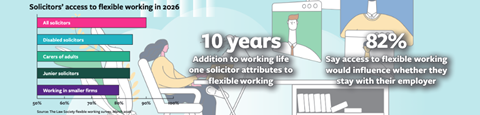
The Law Society survey also found that not everyone benefits equally. While 90% of respondents have access to flexible working, access is lower for disabled solicitors (85%), carers of adults (84%), younger solicitors (84%) and those in small firms with one to four partners (80%).
Society president Mark Evans observes: ‘Our members highlighted challenges to hybrid working due to limited home working space, competing demands at home and other environmental distractions. This suggests that while flexible working can help, it does not always benefit everyone equally.’
Inconsistency
A recurring theme is inconsistency: informal, team-level expectations often diverge from stated policy, creating uncertainty and a risk of discrimination.
As Evans explains: ‘Respondents to our survey reported inequalities in access to flexible working based on individual manager attitudes. Some felt that senior people received more flexibility and people with caring responsibilities were treated differently. They also identified a need for better manager training, clearer processes and guidance, a more supportive workplace culture and access to flexibility at all career stages.
‘The key takeaway is that consistency is as important as flexibility. A well-written policy alone is not enough if day-to-day expectations differ across teams and managers.’
This was also highlighted by Pressure Points: Mapping Women’s Wellbeing in Law, a research study undertaken by The Next 100 Years project, backed by RPC, legal charity LawCare, and consultants Goodbody Wellness.
‘Eighty percent of respondents reported that flexible working was available, but availability does not equal cultural acceptance,’ the study warns. ‘Organisations should establish flexible working as the default position, with the burden of justification on those who require deviation from it, not on those who request it. Presenteeism should be actively challenged at leadership level.’
Lawyer support charity LawCare’s Life in the Law research report, meanwhile, highlights the opportunities for better work-life balance. One research respondent writes: ‘Working from home has been a gamechanger in terms of managing childcare and managing my disability. I love it and it gives me so much more work-life balance. I feel like it has prolonged my career by 10 years.’
However, other respondents mention disadvantages like ‘a loss of social connectedness and collegiality, as well as clients expecting lawyers to be available 24/7. The key change is no longer working with others in an office, so losing the social interaction and the opportunity to discuss any issues, shared experiences’.
Who benefits?
Florence Brocklesby, founder of Bellevue Law, a boutique employment, family and litigation law firm which has always operated a hybrid model, observes: ‘While before Covid, it tended to be working mothers who were asking for flexibility, post-Covid, the people who work from home the most are the most senior people, not necessarily those with health issues or caring responsibilities.’
She says the gap between policy and practice is partly an intergenerational workplace issue: ‘The more senior you are, the fewer consequences you face if you feel the rules don’t apply to you. So if the policy states you need to be in the office three or four days a week and you don’t abide by the policy, you may not face the same consequences as someone more junior would.’
‘Hybrid working can be more challenging for people at the start of their careers,’ agrees LawCare’s interim CEO Trish McLellan. ‘So much learning comes from asking questions and picking things up as you go. Organisations need to think about how they create those opportunities when people aren’t in the office every day.’
Junior lawyers and trainees are also most impacted by the loss of professional and social interaction, and this can impact mental health too. ‘One of the challenges with hybrid working is that it’s hard to tell when someone is struggling. Managers need to make time to check in with people and ask how they’re doing,’ adds McLellan.

Evans agrees: ‘Some junior members [of the Law Society] spoke about challenges around connection and belonging when new in the team. They described increased feelings of isolation, reduced opportunities to build personal relationships with colleagues, and a weaker sense of team cohesion, particularly where in-person interaction is limited.
‘The challenge for firms, meanwhile, is ensuring effective supervision, mentoring, knowledge sharing, networking and relationship building within increasingly flexible working environments.’
JMC Legal Recruitment’s market assessment of remote policies at London’s top law firms, published in June, identifies inconsistency between policy and practice as a key risk factor for junior associates in particular.
‘Research consistently shows that at most large law firms, written remote working policies substantially understate the real cultural expectations,’ it says. ‘For lawyers earlier in their careers, there is an additional dimension: visibility. In most City and US firm environments, being present in the office still affects, formally and informally, how you are perceived by senior colleagues, how much spontaneous work comes your way, and how your commitment is read at review time.’
National Junior Lawyers Division chair Harry Clark highlights other considerations beyond visibility and learning. These include the impact of artificial intelligence (AI) on junior lawyers’ work and the onus on individuals to exercise judgement on how work is done and supervised.
‘There is also a developmental perspective in terms of remuneration and career progression,’ Clark says. And while hybrid working policies tend to focus on numbers of days people are required to be in the office, for junior lawyers, the experience of working with other people is more important.
He notes: ‘I would like to see a more nuanced conversation beyond just days in and days out, and more about the experience of days in [the office] in terms of expectation and culture. Junior lawyers’ priorities over the last three or four years have shifted from prestige and pay to culture and career direction. So having the ability to get face time and exposure to people you want to model your career on is increasingly important.’
Clark raises another important point: that juniors are defined by post-qualification experience (PQE), not age. So some may also have caring responsibilities. On training, if juniors are expected to work in the office for a certain number of days, senior lawyers also need to be there to supervise them.
Brocklesby confirms that juniors cannot benefit from their days in the office unless there are experienced people to learn from. ‘We have junior people in our team, and we’ve had to think really carefully about getting the right balance, where we’re not requiring them to come into the office unless they can benefit. For example, because we have an open-plan office, I might include them in a conversation about business development or AML [anti-money laundering], so they are learning about the business of law. While confidential conversations take place in a private meeting room, juniors learn just by being around senior lawyers.’
While attitudes to hybrid working vary from firm to firm, intergenerational fairness crops up repeatedly. ‘This is an extremely challenging time to be starting a career in law,’ says Brocklesby. ‘There are fewer jobs and a lot of messaging around junior lawyers being replaced by AI. And apart from limiting learning opportunities, the ability to build working relationships with your peers and network with senior people in the organisation comes less naturally if you’re not there all the time.’
Brocklesby flags another worrying issue: hybrid working can sometimes provide more scope for harassment and bullying than an office environment, partly because it is also more difficult for people to build up supportive relationships in the workplace. There is also potential for discrimination simply because of visibility: people who come into the office more may be treated more favourably or given more opportunities.
IT security and client confidentiality
While secure and resilient technology is obviously a critical success factor, remote working heightens security risks. According to business management software provider The Access Group: ‘Accessing sensitive client data outside the office increases the chance of accidental breaches, phishing attacks or unauthorised access. Each device or home network becomes a potential vulnerability, meaning that firms must remain vigilant to protect client information, maintain regulatory compliance, and preserve both operational resilience and reputation.’
David Hymers, IT director at Wedlake Bell, explains that hybrid working has forced the IT function to adjust its priorities. ‘As an IT team, our job is to ensure the overall technology stack supports hybrid working and enables employees to work as effectively from home as they do in the office,’ he says. ‘Tools such as Microsoft Teams, which we introduced early on during lockdown, have become part of the fabric of how firms operate now. Security principles have had to evolve to support hybrid working too. Traditionally, organisations prioritised protecting the office network. Today, the greater emphasis is on verifying the identity of the user, securing the device they are using, and providing secure access to systems and data regardless of location.’
Hymers adds: ‘Our IT service desk [staff] are in the office most of the time; some are in five days a week. Other IT staff are typically in the office 2.5 days per week. We use a desk-booking system to ensure desks are utilised optimally, and to support hybrid working fairly.’
While good technology facilitates hybrid working, for law firms, the human factor needs to be managed to support data security and client confidentiality. Florence Brocklesby, founder of Bellevue Law, highlights the importance of training juniors that they still need to respect client confidentiality when working remotely. That means using secure systems and ensuring they find somewhere private to make client calls.
Brocklesby says: ‘While I’ve never heard of any breach of confidentiality b
Culture nurtured
The Access Group’s report highlights the importance of communication in maintaining culture in a hybrid law firm. It refers to new working practices such as setting expectations around availability, response times and collaboration, and encouraging informal interaction across teams.
Client communication is key too. Clark stresses the need for junior lawyers to develop ‘a real sense of connection and relational understanding with their clients. And in the age of AI, firms need to differentiate themselves by their ability to provide useful, trusted advice. Maybe that will entail a shift to in-person connection’. This might explain firms’ renewed investment in making their offices attractive places to work.
Maximising the value of hybrid working means providing genuine flexibility while maintaining productivity and profitability. There has been a noticeable shift from mandating a specific number of days in the office to a more responsive approach.
‘It’s important to remember that the same approach won’t work for everyone,’ says LawCare’s McLellan. ‘Organisations need to build flexibility into the way they work, recognising that different people have different needs.’
Tim Farr, managing partner of Sharpe Pritchard, says: ‘We’ve learned that mentoring, supervision and firm culture are often strongest when people spend time together. The key is balancing flexibility with opportunities for collaboration and business need, while ensuring firms have the technology and cybersecurity needed to support effective and secure ways of working.’ Perhaps this is because Sharpe Pritchard’s hybrid working arrangement, SP Flex, is ‘a principles-based hybrid working policy rather than a rigid one-size-fits-all approach’.
'Managers need training and time to lead hybrid teams well, and people need clear expectations about how they’ll work together'
Trish McLellan, interim CEO, LawCare
Forsters’ managing partner, Emily Exton, takes a similar line: ‘Our well-established agile working framework recognises the value of flexibility while acknowledging the huge value of in-person connection, particularly for learning, supervision and relationship-building.’
She adds: ‘Rather than enforcing or revising attendance targets, we trust our people to make the right decisions about where to work each week based on what’s best for clients, colleagues and the firm’s culture. We’ve found this to be effective in ensuring that the time we do spend together is meaningful – whether that’s collaborating on complex matters, mentoring colleagues, sharing knowledge or strengthening the relationships that make Forsters such a supportive and enjoyable place to work.’
‘Trust is what makes hybrid and flexible working work,’ says McLellan. ‘A policy on its own won’t do that. Managers need training and time to lead hybrid teams well, and people need clear expectations about how they’ll work together.’
David Hymers, IT director at Wedlake Bell, observes: ‘Culture needs to be nurtured. Hybrid working can be effective, but firms must create reasons for people to come together in-person. For Wedlake Bell, that’s for supervision, team interaction, training, and collaboration.’
The firm’s hybrid working policy states that practice group and business services leaders are responsible for arranging physical gatherings such as team meetings and social events, but the firm regularly arranges drinks, theatre trips, and other activities such as annual walking and ski trips.
The Law Society survey found a positive correlation between hybrid working and job satisfaction: 82% of respondents say access to flexible working would influence whether they stay with their employer.
Excello Law operates a consultancy model that has always included hybrid working. Founder and CEO George Bisnought explains: ‘Almost everyone at Excello worked remotely to some extent.’ And partners and staff are accustomed to managing their own working patterns: ‘Mandated office days will always come with risk – from a morale standpoint in particular. Many people are more motivated when they have a say in their working patterns.’
A key part of Excello’s strategy has been to organise opportunities for people to connect, online and in person.
‘We do recognise the importance of maintaining a community and culture even while more of our teams are working remotely than at many firms,’ says Bisnought. ‘Our strategy in this area is multi-faceted: we run regular events through the Excello Inspire programme to give our lawyers and staff chances to spend time together outside of a work setting. That might mean in-person socials, which we run on a region-focused basis across the UK as well as a couple of national events a year; or it might be something online, even as simple as “coffee roulette” connecting lawyers and staff who’ve not worked together previously.’
Career lifeline
While a Law Society survey found that disabled solicitors experienced fewer wellbeing benefits from flexible working compared with other groups, for some, hybrid working is a career lifeline.
Hannah Campbell is a senior associate solicitor at Higgs & Co, working in the firm’s serious injury team, and a committee member of the Law Society’s Disabled Solicitors Network. She condenses 10 working days into nine, which gives her a rest day every other Friday. She writes on LinkedIn: ‘Flexible working has been fundamental in allowing me to work full-time alongside managing my disability and all of the medical needs that come with having a disability.’ She continues: ‘[Flexible working] has also made a huge difference to my ability to flourish within the profession. It has taken a significant amount of pressure off me and has allowed me to bring my best self to work every day.’
Campbell considers herself fortunate that her current and previous firms have always supported her need for flexibility. ‘Before the pandemic, flexible working was the most requested reasonable adjustment and the most refused. But then everyone was forced into a new way of working,’ she says.
While the pandemic’s working arrangements opened up conversations about disability, she is concerned about renewed pressure for presenteeism, especially for junior solicitors. That can affect career progression for people whose disabilities or caring responsibilities require them to work flexibly.
In relation to wellbeing, working flexibly means that Campbell doesn’t have to continually explain her personal circumstances. ‘Sometimes it’s nice to just get on [with work] and not have to explain again why I was coming in later, or said no to an event,’ she says. ‘I don’t have so much pressure on me now I’m seven years qualified, but if I didn’t have that stability, I might be worried that talking about [my disability] might affect my career. You can be surrounded by support, but often some part of you will be worried about sharing too much and appearing vulnerable, which may explain the inconsistent results in the [Law Society] survey.’
Campbell’s perspective validates the survey’s recommendations on removing the barriers and misconceptions that stand in the way of people with complex needs who need flexibility to progress.
Team dynamics
‘The team dynamics have changed,’ Susan Glenholme, managing partner at St Albans firm Debenhams Ottaway, told the Law Society’s study. ‘Juniors sometimes resent it if older partners or the senior staff are not in the office, but they have to be in the office. It’s about trying to balance that side of things to make sure that you are effectively supervising [juniors].’
Clark emphasises the importance of partners setting expectations by their own behaviour – for example, if partners work during their holidays. ‘You can have a firm-wide or office-wide mandate,’ he says, ‘but it really comes down to the team you work with and your immediate supervisor as to how the [supervisory] relationship works in practice day to day.’
McLellan at LawCare agrees. ‘Creating supportive hybrid environments requires effort, planning – it doesn’t happen accidentally. Policies need to be authentic and embedded. We saw this in the qualitative feedback from the Life in the Law 2025 research, and we also hear it through our support services. Some organisations have policies that don’t reflect people’s day-to-day experience.’
She continues: ‘Trust is what makes hybrid and flexible working work. A policy on its own won’t do that. Managers need training and time to lead hybrid teams well, and people need clear expectations about how they’ll work together.’
It is not just junior lawyers who need supervision and support. Hymers at Wedlake Bell runs an IT team that includes people who work flexibly as well as full-time office employees. ‘At Wedlake Bell, trainee lawyers are required in the office most of the time; it’s the same with junior IT staff – I personally believe at this stage in their career it’s important juniors are in the office for their personal development, knowledge upskilling and mentoring. Additionally, some younger employees may not have access to suitable working environments, which can make remote working difficult.’
He agrees that more senior people need to be available to support them. ‘I’m in the office four days a week so I can better interact with my team,’ he adds.
Brocklesby also tries to lead by example. ‘I go into the office three days a week to contribute to my team, whereas the days that I work from home are more about getting my own work done,’ she says.
As well as supporting junior lawyers and paralegals, a successful hybrid model includes cultivating team culture and a sense of belonging. ‘Most of our team are senior lawyers who don’t need to be in the office to learn or supervise, so from the outset, we made time to be together,’ says Brocklesby. ‘We have regular Teams meetings to discuss know-how and business development, as well as online training sessions [and] some in-person training. And about four times a year we have purely social meetups.’
Collaboration is mostly online, using Teams channels. ‘We have something we call “Hive Mind”, where if you’ve got a tricky question you can share it with your colleagues, so we all feel part of a team and support each other. You can build a good culture while working remotely, but you have to build it quite thoughtfully,’ she adds.
Hybrid working in law firms has shifted from mandated patterns to a more nuanced approach, designed to support collaboration, supervision and wellbeing. While this is beneficial to lawyers with disabilities, caring responsibilities or other personal circumstances that require them to work flexibly, there are still challenges in the form of inconsistencies between firm policy and managerial discretion, and between established practitioners and junior lawyers. Especially at junior levels, visibility remains a factor in career progression.
As the pandemic retreats into the past, firms are becoming more alert to culture and wellbeing. However, there is also renewed focus on in-person connection because firms recognise the business value of working relationships with colleagues and clients, which, alongside secure and resilient technology, underpin talent and client retention and commercial success. It is likely that these tensions will continue to drive working patterns.
Joanna Goodman is a freelance journalist








1 Reader's comment