






















Critics argue that the silk selection process remains discriminatory, reports Catherine Baksi. Supporters counter that such an esteemed mark of excellence must remain reserved for the best
The low down
As a quality mark, ‘silk’ is internationally known and respected. But is the award fair? A new body, Queen’s (now King’s) Counsel Appointments, was designed to make the selection of silks fairer and more transparent. But after 20 years of the independent body’s superintendence of the system, critics argue that it has not done enough. They say the appointments process continues to discriminate against solicitors, women, ethnic minority lawyers and those in certain practice areas. Further reform, they say, could make the mark more equitable and inclusive.
The designation ‘silk’ – King’s Counsel – is one of global law’s foremost brands. Last year’s film Nuremberg, on the groundbreaking trial of Nazi leaders, captured this. It shows US Supreme Court justice Robert Jackson failing in his cross-examination of Hermann Göring. But British barrister and politician Sir David Maxwell Fyfe KC, who took silk aged just 34, embodies the designation in this scene. He steps in – smooth, assertive, clever, strategic. He controls Göring, saving the cross-examination.
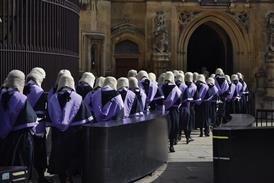
Regarded as the pinnacle of success for advocates, the rank of KC is an elite club to which around 10% of practising barristers and far fewer solicitors belong. In less than a fortnight, 96 newly minted KCs will don a full-bottomed wig, silk jacket and buckled shoes for their appointment ceremony in Westminster Hall.
In addition to status and a new outfit, KCs usually command significantly higher fees.
However, away from the pomp and ceremony, there is concern that the system for appointing them excludes meritorious candidates, has bias ‘baked in’, and discriminates against lawyers in certain practice areas and from certain backgrounds.
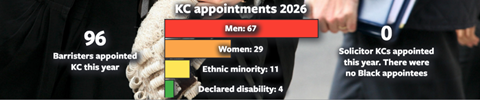
All 96 successful candidates in the most recent competition were barristers. None of the nine solicitors who applied was appointed. Since solicitors were permitted to apply for the award in 1995, only 66 have been appointed out of 231 applicants.
Solicitors are not the only under-represented demographic. Male silks still vastly outnumber women. In the most recent competition, 67 of those appointed are men and 29 are women; 11 successful applicants were from an ethnic minority background and two Black; four said that they had a disability.
The Gazette spoke to a range of lawyers – barristers and solicitors from different practice areas – some of whom had applied successfully, others who were rejected and another group who have not yet applied. One thing they had in common was their insistence on anonymity.
Silk road
The award of Queen’s or King’s Counsel in England and Wales dates from the reign of Elizabeth I. Silks were appointed by the monarch and acted as representatives of the Crown. In modern times, until 2006, the award was bestowed by the lord chancellor based on the much-criticised system of ‘secret soundings’. This was roundly criticised as elitist, lacking in transparency and favouring ‘male, pale’ barristers.
A new independent body, Queen’s (now King’s) Counsel Appointments, developed by the Bar Council and Law Society, was introduced in 2006.
In the revamped process, applicants are assessed according to criteria examining: oral and written advocacy; understanding and using the law; working with others; understanding of and commitment to diversity; and integrity.
Candidates must complete a 65-page application form and list 12 ‘cases of substance, complexity or particular difficulty or sensitivity’, in which they had appeared in the last three years, though there is flexibility on the number of cases and time period from which they can be drawn.
Applicants must provide the names of judicial, practitioner and lay assessors. They are then interviewed by a selection panel that includes lawyers and laypeople.
Under the old system, it was free to apply. Now applicants pay an application fee of £2,225. Those who are successful have to pay an appointment fee of £3,900.
Completing an application is hard work, taking around 40 hours, says Tim Collins, a consultant who offers help to silk hopefuls.
Process problems
Those with experience of the system highlight three main problems. The first is the weight placed on advocacy, which, given that the mark is designed to recognise ‘excellence in advocacy in the higher courts’, is perhaps unsurprising.
Yet critics say this acts as a barrier to the advancement of barristers whose strengths lie in other areas, no less demanding, such as advisory work, negotiation, conference work and drafting.
One senior personal injury barrister says that he has not been able to apply because the nature of his practice means that he does not often find himself before High Court judges, whose references he requires.
‘The reality is that if I do my job properly, the case settles before a High Court judge gets anywhere near it,’ he notes – a not uncommon story. Almost resigned to being a ‘junior’ barrister for the rest of his career, he says: ‘I’ll just keep being busy and doing my job well. Maybe I’ll get lucky and have some misguided clients or opponents who want to fight a trial.’
A Cardiff-based civil law barrister, who unsuccessfully applied for silk, suggests that the system works unfairly against civil practitioners based in Wales, noting that there has been no appointment from this cohort since 2010.
The gap, he suggests, could support an inference that the system is discriminatory and breaches the Equality Act.
He says the examples given of cases ‘of substance’ in the guide for applicants – which include an appeal before the Court of Appeal and a case included in the law reports – suggest the criteria ‘do not reflect what a successful civil practice looks like in Wales’.
In addition, he notes, the application form cannot be completed in Welsh and interviews are not held in Wales
A commercial barrister suggests that many in his practice area will also struggle to find a sufficient number of cases to make an application. Using his own practice as an example, he says: ‘I was employed almost full-time from May 2025 to February 2026 on a single case, with written closings likely to take another two months.’
That means, he explains, ‘one of my three years gone, for just one case on a potential application’. Without a ‘bit of flexibility’ from the appointment body, he warns that the number of silks, at least at the commercial bar, will continue to dwindle.
More drastically, another barrister says, the system’s faults ‘result in the stagnation and waste of talent of barristers, depriving the legal sector and the public of their ingenuity, skills and vision. So many bright individuals are driven to apathy, discouragement and sometimes even despair’.
Some suggest that the current system unlawfully indirectly discriminates against women, solicitors and others whose practices are more likely to fall outside those for whom the KC appointment is designed.
'Junior' tag is 'pejorative and demeaning'
Traditionally, there has been a clear, graduated hierarchy for solicitors, marking their progression up the career ladder – from trainee to assistant, associate and partner, with opportunities to become heads of teams or move into management positions. But after barrister pupils have qualified, they remain ‘junior’ barristers unless and until they are appointed King’s Counsel, when they become known as ‘senior’. The oxymoronic term ‘senior junior’ is used in a bid to reflect experience levels.
Some lawyers suggest that the time is ‘long overdue’ for the term ‘junior’ barrister to be scrapped. They point to the change in nomenclature for junior doctors, who have been restyled as ‘resident’ doctors.
The word ‘junior’, according to some who want change, is ‘pejorative and demeaning’. More crucially, they argue, while those within the profession understand that ‘junior’ is used to apply to barristers with a wide range of seniority, most lay and corporate clients are not up to speed with the semantics. ‘To many of them, the word “junior” means precisely that – junior.’ This ‘can lead to mistrust and a lack of confidence in the barrister’.
Additionally, critics suggest that the use of the term ‘compounds poor job satisfaction among established barristers, affects wellbeing and [shapes] perception of their practice and hence their profitability’.
Rightly, they explain, there has been an increasing focus on wellbeing and retention at the bar in recent years. They argue: ‘The lack of opportunity for career progression, leading to profound stagnation, discouragement and even sometimes despair among so many established barristers, together with the unhelpful “junior” appellation, should be placed front and centre on the wellbeing and retention agenda.’
Besides tradition, one critic suggests that the only justification for keeping the term ‘is to protect the practices of silks by creating an artificial imbalance between silks and others’.
Taking account
KC Appointments (KCA) appears to recognise that barristers in certain practice areas will find it hard to fulfil the criteria.
In its report to the lord chancellor on the latest competition, the body notes: ‘The nature of some kinds of practice means that an applicant might seldom come to court. Where it appears that an applicant is highly successful at settling cases, we have accepted that only rarely will he or she appear before a court in cases of substance, complexity, or particular difficulty or sensitivity, and we have been ready to accommodate that.’
The report goes on to state that one personal injury barrister was recommended for appointment. One observer says this ‘serves only to highlight the concern rather than demonstrating any reassurance about the fairness of the system’ – particularly as the latest Bar Council statistics show that personal injury is the fourth-largest specialisation, accounting for 6% of all practising barristers.
The judicial reference system, which lies at the heart of the process, is another key concern flagged up by critics as ‘baking in discrimination’ and ‘inviting bias in by the back door’.
As the senior judiciary remains dominated by white men, another barrister points to a ‘vicious circle effect’ in which successful KCs become the successful High Court judges of the future. ‘The bias which is baked into the KCA system thereby feeds further bias in the future.’
In response to the alleged unfairness that arises from candidates in certain areas lacking the required number of examples of oral advocacy, KCA suggests in its ‘FAQ guidance’ that such experience ‘could be gained by, for example, undertaking pro bono work’.
However, critics suggest that rather than seeking to address the problems, this merely compounds the indirect discrimination. ‘The very people who are disadvantaged by the current system – particularly people with caring responsibilities – are the people who have the least time to give to unpaid work,’ says one barrister. ‘It is clear that a system which requires unpaid work risks compounding the discrimination which is already baked into the system.’
They note that the advice is not practical: ‘To transform a paper-based practice to an oral advocacy practice sufficient to generate 12 judicial references, the amount of unpaid work which would have to be undertaken would be enormous and financially unmanageable.’ They add that the vast majority of pro bono work is in lower courts and tribunals.
Most significantly, critics claim the KC system is the ‘gateway’ to roles in the senior judiciary at High Court level and above. As one barrister explains: ‘The discrimination which is baked into the KC system is relevant to society at large,’ because ‘the KC system shapes the senior judiciary, the senior judiciary shape the law, and the law shapes wider society.’
Whitewash
‘The dearth of Black KCs is one reason there are so few Black High Court judges,’ observes Alex Taylor-Camara, a barrister and founding member of the group ‘Black Silk’, which seeks to encourage Black barristers to apply for the quality mark.
‘Taking silk is like receiving a gold medal for a particular event,’ says one barrister who is among the crop of 96 appointed this year. As such, he argues, ‘it is not unfair to make it very hard to achieve and to award it only to the best’. That is a minority view, but he does add a caveat that the judgement on the ‘best’ must not discriminate against individuals with protected characteristics.
Setting the bar high, he suggests, does not mean that other forms of excellence are downgraded. He argues against changing the rules ‘to allow a chance for more people to win’. This barrister found the process ‘very time-consuming, difficult and stressful’, but ultimately it was ‘an appropriately challenging exercise, which seemed generally to give an opportunity to candidates to show their excellence in depth’.
He concedes that the system ‘does discriminate against solicitors working in law firms’, but suggests that it is ‘no more than the consequence of enforcing the standards that the selection panel is seeking to maintain’.
Some suggest replacing the KCA body with an examination-based system, akin to the process in which doctors become consultants, run by the Inns of Court in conjunction with legal professional organisations.
Less radical ideas for change include introducing competencies in other practice areas, such as alternative dispute resolution, negotiation, advisory work and complex drafting.
Permitting mediators to act as judicial assessors, suggests one barrister, would help those who work in practice areas where the vast majority of cases settle, and recognise the increasing importance of mediation and ADR in the legal system.
Other suggested tweaks include reducing the number of judicial assessors required and taking references from heads of chambers or others in equivalent positions who are likely to be in a strong position to comment on a barrister’s track record.
'KC is an internationally recognised mark of excellence in advocacy in the higher courts, and there is necessarily a rigorous application process'
Kirsty Brimelow KC, Bar Council

Hannah Miller, chief executive of KCA, acknowledges that some applicants may have faced a range of barriers in progressing their careers. For that reason, she says, the body ‘endeavours to ensure that our own process is open, clear and transparent so that there are no barriers to the application process’.
She points to measures to help applicants and assessors understand the process, including numerous webinars, presentations, and written and video guidance.
Law Society president Mark Evans is ‘saddened to hear some of the experiences of aspiring King’s Counsel’ and ‘disappointed’ that no solicitors were appointed this year. ‘The Law Society has long advocated that all legal professionals, including solicitors, should have a fair chance to make KC,’ he says, adding that improving diversity is ‘essential’.
Evans accepts that ‘there is a risk that elements in the process itself, such as the requirement for judicial and client assessors, tend to make it more difficult for advocates with certain types of practice to qualify, despite delivering very high-quality advocacy’.
The Society ‘supports a robust, merit-based application process that values a range of experiences’, adds Evans, and is ‘committed to seeing an improvement in the process’.
Defence
Kirsty Brimelow KC, chair of the Bar Council, robustly defends the current scheme. ‘King’s Counsel is an internationally recognised mark of excellence in advocacy in the higher courts, and there is necessarily a rigorous application process,’ she says.
Over the years, she adds, the appointment body has worked hard to provide outreach and detailed guidance to support applicants from diverse backgrounds and practice areas.
‘KCA has also undertaken internal and external reviews of its processes to make sure they comply with best practice,’ says Brimelow. The Bar Council continues to ‘explore how it can better support potential applicants from across the bar to gain the requisite skills to succeed in their applications’.
Catherine Baksi is a freelance journalist








No comments yet